. 2018 May 14;9(1):1881.
doi: 10.1038/s41467-018-03984-5.

Engineering modular intracellular protein sensor-actuator devices

Affiliations

Engineering modular intracellular protein sensor-actuator devices

Velia Siciliano et al. Nat Commun. .

Abstract

Understanding and reshaping cellular behaviors with synthetic gene networks requires the ability to sense and respond to changes in the intracellular environment. Intracellular proteins are involved in almost all cellular processes, and thus can provide important information about changes in cellular conditions such as infections, mutations, or disease states. Here we report the design of a modular platform for intrabody-based protein sensing-actuation devices with transcriptional output triggered by detection of intracellular proteins in mammalian cells. We demonstrate reporter activation response (fluorescence, apoptotic gene) to proteins involved in hepatitis C virus (HCV) infection, human immunodeficiency virus (HIV) infection, and Huntington's disease, and show sensor-based interference with HIV-1 downregulation of HLA-I in infected T cells. Our method provides a means to link varying cellular conditions with robust control of cellular behavior for scientific and therapeutic applications.


Conflict of interest statement

The authors declare no competing interests.

Figures
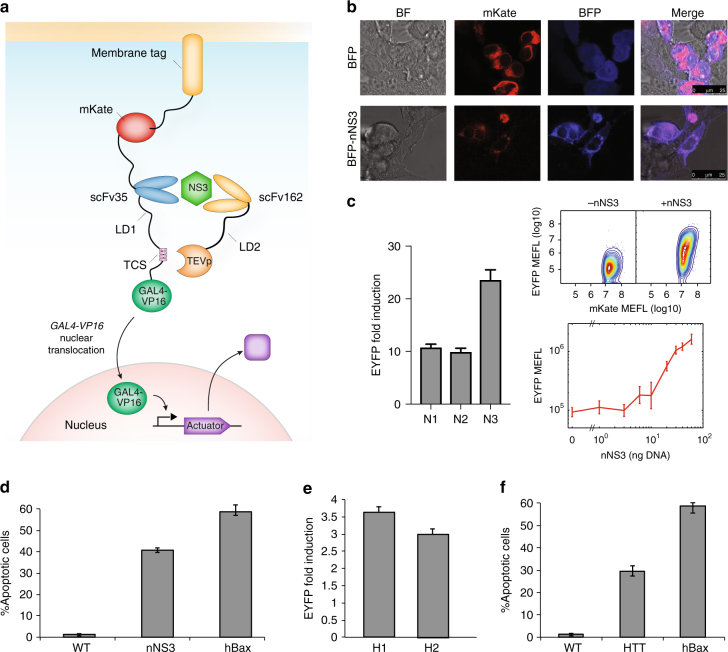
Fig. 1
Fig. 1
Protein sensing-actuation devices in mammalian cells. a Schematics of the protein sensor. One intrabody is anchored to the membrane and fused at the N-terminus to mKate fluorescent tag and at the C-terminus to the TEV cleavage site (TCS) and to a GAL4-VP16 transcriptional activator. A second intrabody is fused to the TEV protease (TEVp). Interaction of the intrabodies with the target protein results in TEVp-mediated release of membrane-anchored GAL4-VP16 and output activation. b Co-localization of BFP-nNS3 and mKate-scFv35-antibody in HEK293FT cells. Confocal images (×63) indicate co-localization when BFP is fused to nNS3 in HEK293FT cells (scale bar = 25 µm). Non-fused BFP was used as control and show diffused cellular localization. c Best performing variants of intrabody-TCS/intrabody-TEVp combinations (N1: scFv35-LD15-TCS(L)/TEVp-LD15-scFv162, N2: scFv35-LD0-TCS(L)/DD-scFv162-LD15-TEVp, N3: scFv35-LD0-TCS(L)/TEVp-LD0-scFv162) for nNS3 device. EYFP data shows fold induction and standard deviation using molecules of equivalent fluorescein (MEFL) of EYFP for cells expressing >1 × 107 MEFL of transfection marker mKate. n = 3 independent technical replicates. Right-top inset: Two-dimensional flow cytometry plots for the best variant (N3) in the absence and presence of nNS3. Right-bottom inset: EYFP MEFL as function of the concentration of transfected DNA encoding nNS3 for the N3 variant of the device. d Selective cell death induced by pro-apoptotic hBax-N3 variant in cells expressing nNS3 was determined by Pacific-Blue conjugated to Annexin V staining 48 h posttransfection. Constitutively expressed CMV-hBax (labeled as “hBax”) was used as positive control for apoptosis. Data and standard error are of n = 3 independent technical replicates. e Best performing HTT (HDx-1 first exon with poliQ tract) devices (H1: Happ1-LD0-TCS(S)/DD-TEVp-LD0-Vl12.1, H2: Happ1-LD0-TCS(S)/TEVp-LD0-Vl12.1). Data shows EYFP fold induction and standard deviation of EYFP MEFL for cells expressing >3 × 107 MEFL of transfection marker mKate. n = 3 independent technical replicates. f Selective cell death induced by hBax apoptotic protein in cells expressing HTT was determined by Pacific-Blue conjugated to Annexin V staining 48 h posttransfection. The assay was performed on HTT best performing device (Happ1-LD0-TCS(S)/DD-TEVp-LD0-Vl12.1) using the pro-apoptotic hBax as reporter activated by GAL4-VP16. Constitutively expressed CMV-hBax (labelled as “hBax”) was used as positive control for apoptosis. Data and s.e.m. are of n = 3 independent technical replicates
Fig. 2
Fig. 2
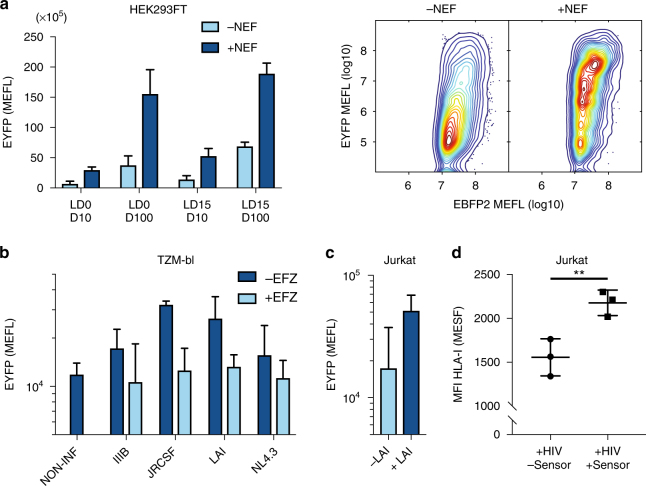
Nef-based HIV sensor-actuator. a Flow cytometry analysis of Nef devices (sdAb19-LD0/15-TCS(L)-GAL4-VP16, TEVp-LD0-SH3) in HEK293 cells treated with 10 nm or 100 nM Dox (D10, D100) 48 h post-transfection. Data show EYFP expression and standard deviation using molecules of equivalent fluorescein (MEFL) of EYFP for cells expressing >1 × 107 MEFL of transfection marker Pacific-Blue. n = 2 independent technical replicates. Two-dimensional flow cytometry plots for the best variant (sdAb19-LD0/D10) are shown on the right. b Infection with HIV strains (IIIB, JRCSF, LAI, NL4.3) of TZM-bl cells expressing Nef device (sdAb19-LD0/D10). EYFP expression was compared to non-infected cells (NON-INF) and to cells infected and treated with the reverse transcriptase inhibitor Efavirenz (EFZ), showing that the device is sensitive to the inhibitory activity of the drug on viral genome retro-transcription. EYFP expression and standard deviation, using molecules of equivalent fluorescein (MEFL) of EYFP for cells expressing 2 × 105 MEFL of transfection marker Pacific-Blue. n = 3 independent technical replicates. c Infection with HIV LAI strain of Jurkat cells expressing the Nef device (sdAb19-LD0/D10). EYFP expression and standard deviation using EYFP MEFL for cells expressing >1 × 105 MEFL of transfection marker Pacific-Blue. n = 2 independent technical replicates. d HLA-I surface expression in Jurkat cells infected with LAI strain in the presence or absence of Nef device (sdAb19-LD0/D10). Immunostaining was followed by flow-cytometry of infected cells (gated on intracellular p24+ cells) expressing (+sensor) or not expressing (−sensor) the device. MFI indicates Mean Fluorescence Intensity. Results are mean ± s.e.m. of three independent experiments. Statistical significance was determined by a paired t test **p = 0.0046

References

    1. Tigges M, Marquez-Lago TT, Stelling J, Fussenegger M. A tunable synthetic mammalian oscillator. Nature. 2009;457:309–312. doi: 10.1038/nature07616. - DOI - PubMed
    1. Siciliano V, et al. MiRNAs confer phenotypic robustness to gene networks by suppressing biological noise. Nat. Commun. 2013;4:2364. doi: 10.1038/ncomms3364. - DOI - PMC - PubMed
    1. Zah E, Lin MY, Silva-Benedict A, Jensen MC, Chen YY. T cells expressing CD19/CD20 bi-specific chimeric antigen receptors prevent antigen escape by malignant B cells. Cancer Immunol. Res. 2016;4:498–508. doi: 10.1158/2326-6066.CIR-15-0231. - DOI - PMC - PubMed
    1. Ye H, et al. Pharmaceutically controlled designer circuit for the treatment of the metabolic syndrome. Proc. Natl Acad. Sci. USA. 2013;110:141–146. doi: 10.1073/pnas.1216801110. - DOI - PMC - PubMed
    1. Thaker MN, Wright GD. Opportunities for synthetic biology in antibiotics: expanding glycopeptide chemical diversity. ACS Synth. Biol. 2015;4:195–206. doi: 10.1021/sb300092n. - DOI - PMC - PubMed

Publication types

MeSH terms