


Processed electroencephalogram and evoked potential techniques for amelioration of postoperative delirium and cognitive dysfunction following non-cardiac and non-neurosurgical procedures in adults
- PMID: 29761891
- PMCID: PMC6494561
- DOI: 10.1002/14651858.CD011283.pub2
Processed electroencephalogram and evoked potential techniques for amelioration of postoperative delirium and cognitive dysfunction following non-cardiac and non-neurosurgical procedures in adults
Abstract
Background: Postoperative delirium (POD) and postoperative cognitive dysfunction (POCD) may complicate a patient's postoperative recovery in several ways. Monitoring of processed electroencephalogram (EEG) or evoked potential (EP) indices may prevent or minimize POD and POCD, probably through optimization of anaesthetic doses.
Objectives: To assess whether the use of processed EEG or auditory evoked potential (AEP) indices (bispectral index (BIS), narcotrend index, cerebral state index, state entropy and response entropy, patient state index, index of consciousness, A-line autoregressive index, and auditory evoked potentials (AEP index)) as guides to anaesthetic delivery can reduce the risk of POD and POCD in non-cardiac surgical or non-neurosurgical adult patients undergoing general anaesthesia compared with standard practice where only clinical signs are used.
Search methods: We searched CENTRAL, MEDLINE, Embase and clinical trial registry databases up to 28 March 2017. We updated this search in February 2018, but these results have not been incorporated in the review.
Selection criteria: We included randomized or quasi-randomized controlled trials comparing any method of processed EEG or evoked potential techniques (entropy, BIS, AEP etc.) against a control group where clinical signs were used to guide doses of anaesthetics in adults aged 18 years or over undergoing general anaesthesia for non-cardiac or non-neurosurgical elective operations.
Data collection and analysis: We used the standard methodological procedures expected by Cochrane. Our primary outcomes were: occurrence of POD; and occurrence of POCD. Secondary outcomes included: all-cause mortality; any postoperative complications; and postoperative length of stay. We used GRADE to assess the quality of evidence for each outcome.
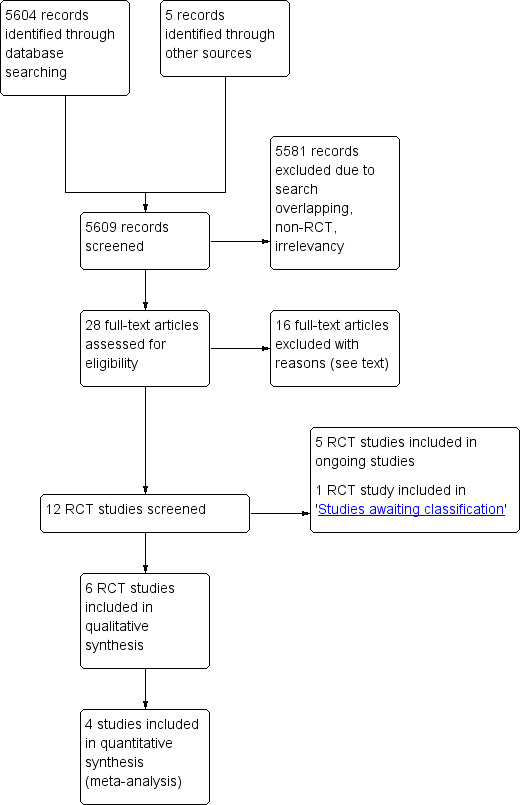
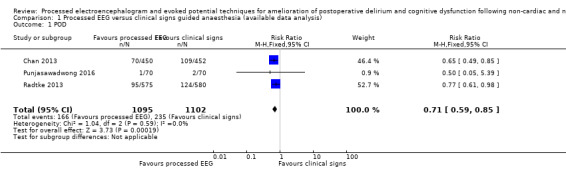
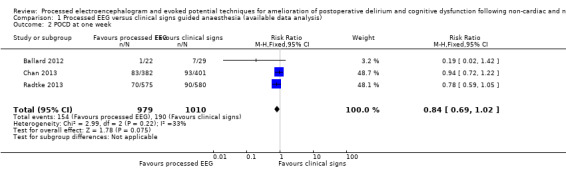
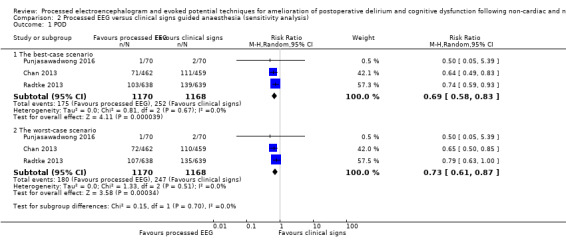
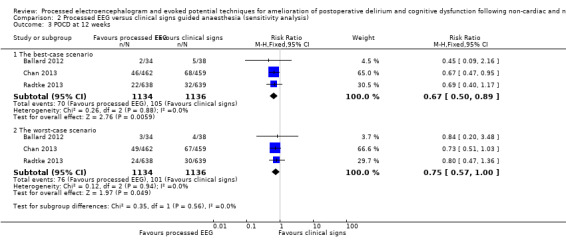
Main results: We included six randomized controlled trials (RCTs) with 2929 participants comparing processed EEG or EP indices-guided anaesthesia with clinical signs-guided anaesthesia. There are five ongoing studies and one study awaiting classification.Anaesthesia administration guided by the indices from a processed EEG (bispectral index) probably reduces the risk of POD within seven days after surgery with risk ratio (RR) of 0.71 (95% CI 0.59 to 0.85; number needed to treat for an additional beneficial outcome (NNTB) of 17, 95% CI 11 to 34; 2197 participants; 3 RCTs; moderate quality of evidence). Three trials also showed the lower rate of POCD at 12 weeks after surgery (RR 0.71, 95% CI 0.53 to 0.96; NNTB 38, 95% CI 21 to 289; 2051 participants; moderate-quality evidence), but it is uncertain whether processed EEG indices reduce POCD at one week (RR 0.84, 95% CI 0.69 to 1.02; 3 trials; 1989 participants; moderate-quality evidence), and at 52 weeks (RR 0.30, 95% CI 0.05 to 1.80; 1 trial; 59 participants; very low quality of evidence). There may be little or no effect on all-cause mortality (RR 1.01, 95% CI 0.62 to 1.64; 1 trial; 1155 participants; low-quality evidence). One trial suggested a lower risk of any postoperative complications with processed EEG (RR 0.51, 95% CI 0.37 to 0.71; 902 participants, moderate-quality evidence). There may be little or no effect on reduced postoperative length of stay (mean difference -0.2 days, 95% CI -2.02 to 1.62; 1155 participants; low-quality evidence).
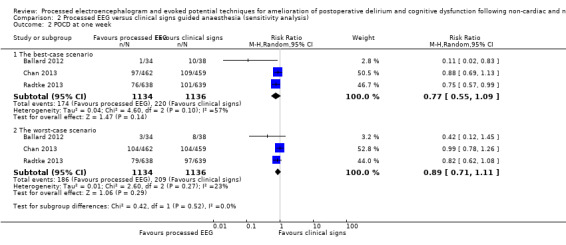
Authors' conclusions: There is moderate-quality evidence that optimized anaesthesia guided by processed EEG indices could reduce the risk of postoperative delirium in patients aged 60 years or over undergoing non-cardiac surgical and non-neurosurgical procedures. We found moderate-quality evidence that postoperative cognitive dysfunction at three months could be reduced in these patients. The effect on POCD at one week and over one year after surgery is uncertain. There are no data available for patients under 60 years. Further blinded randomized controlled trials are needed to elucidate strategies for the amelioration of postoperative delirium and postoperative cognitive dysfunction, and their consequences such as dementia (including Alzheimer's disease (AD)) in both non-elderly (below 60 years) and elderly (60 years or over) adult patients. The one study awaiting classification and five ongoing studies may alter the conclusions of the review once assessed.
Conflict of interest statement
Yodying Punjasawadwong was involved in an included study (Punjasawadwong 2016) as a primary investigator. Dr Punjasawadwong did not assess the risk of bias and perform data extraction in this trial.
Waraporn Chau‐in: none known
Malinee Laopaiboon: none known
Sirivimol Punjasawadwong: none known
Pathomporn Pin‐on: none known
Figures




Update of
References
References to studies included in this review
Ballard 2012 {published data only}
-
- Ballard C, Jones E, Gauge N, Aarsland D, Nilsen OB, Saxby BK, et al. Optimised anaesthesia to reduce post operative cognitive decline ( POCD) in older patients undergoing elective surgery, a randomised controlled trial. PLoS ONE 2012;7(6):1‐8. [Control‐Triasl.com: ISRCTN39503939; DOI: 10.1371/journal.pone.0037410; DOI: 10.1371/journal.pone.0037410; PUBMED: 22719840] - DOI - PMC - PubMed
Chan 2013 {published data only}
-
- Chan MT, Cheng BC, Lee TM, Gin T, CODA Trial Group. BIS‐guided anesthesia decreases postoperative delirium and cognitive decline. Journal of Neurosurgical Anesthesiology 2013;25(1):33‐42. [PUBMED: 23027226] - PubMed
Jildenstål 2011 {published data only}
-
- Jildenstål PK, Hallén JL, Rawal N, Gupta A, Berggren L. Effect of auditory evoked potential‐guided anaesthesia on consumption of anaesthetics and early postoperative cognitive dysfunction: a randomised controlled trial. European Journal of Anaesthesiology 2011;28(3):213‐9. [PUBMED: 21088592] - PubMed
Punjasawadwong 2016 {unpublished data only}
-
- Punjasawadwong Y, Pipanmekaporn T, Wongpakaran N. Optimized anesthesia to reduce incidence of postoperative delirium in elderly undergoing elective, non‐cardiac surgery: a randomized controlled trial. Anesthesia and Analgesia 2016; Vol. 123, issue 3S_Suppl:211. [ClinicalTrials.gov.: NCT02133430]
Radtke 2013 {published data only}
-
- Radtke FM, Franck M, Lendner J, Krüger S, Wernecke KD, Spies CD. Monitoring depth of anaesthesia in a randomised trial decreases the rate of postoperative delirium but not postoperative cognitive dysfunction. British Journal of Anaesthesia 2013;110(Suppl 1):i98‐105. [PUBMED: 23539235] - PubMed
Wong 2002 {published data only}
-
- Wong J, Song D, Blanshard H, Grady D, Chung F. Titration of isoflurane using BIS index improves early recovery of elderly patients undergoing orthopedic surgeries. Canadian Journal of Anaesthesia 2002;49(1):13‐8. [PUBMED: 11782323] - PubMed
References to studies excluded from this review
Farag 2006 {published data only}
-
- Farag E, Chelune GJ, Schubert A, Mascha EJ. Is depth of anaesthesia, as assessed by the Bispectral Index, related to postoperative cognitive dysfunction and recovery?. Anesthesia and Analgesia 2006;103(3):633‐40. [PUBMED: 16931673] - PubMed
Fernandes 2007 {published data only}
-
- Fernandes CR, Gomes JM, Cordeiro RA, Pereira Kde S. Assessment of the cognitive effects of inhalational induction with sevoflurane associated or not with nitrous oxide: a comparative study in adult volunteers. Revista Brasileira de Anestesiologia 2007;57(3):237‐46. [PUBMED: 19466359] - PubMed
McDonagh 2012 {unpublished data only}
-
- McDonagh D, Attix D, Pieper C, Martin G, Monk T. Preoperative cognitive status, not type of general anaesthesia, predicts early postoperative cognitive dysfunction. 40th Annual Meeting of the Society for Neuroscience in Anesthesiology and Critical Care. Lippincott Williams and Wilkins, 2012.
Meineke 2014 {published data only}
-
- Meineke M, Applegate RL, Rasmussen T, Anderson D, Azer S, Mehdizadeh A, et al. Cognitive dysfunction following desflurane versus sevoflurane general anesthesia in elderly patients: A randomized controlled trial. Medical Gas Research 2014;4(1):6. [DOI: 10.1186/2045-9912-4-6; PUBMED: 24666542] - DOI - PMC - PubMed
Ovezov 2012 {published data only}
-
- Ovezov A, Lobov M, Knyazev A, Nad'kina E, Bragina S, Myatchin P, et al. Neuroprotective prevention of early postoperative cognitive dysfunction in adults. 16th Congress of the European Federation of Neurological Societies. Blackwell Publishing Ltd, 2012.
Plaschke 2010 {published data only}
-
- Plaschke K, Fichtenkamm P, Schramm C, Hauth S, Martin E, Verch M, et al. Early postoperative delirium after open‐heart cardiac surgery is associated with decreased bispectral EEG and increased cortisol and interleukin‐6. Intensive Care Medicine 2010;36(12):2081‐9. [PUBMED: 20689917 ] - PubMed
Santarpino 2011 {published data only}
Seo 2014 {published data only}
Short 2015 {published data only}
-
- Short TG, Leslie K, Chan MT, Campbell D, Frampton C, Myles P. Rationale and design of the balanced anesthesia study: a prospective randomized clinical trial of two levels of anesthetic depth on patient outcome after major surgery. Anesthesia and Analgesia 2015;121(2):357‐65. [PUBMED: 25993386 ] - PubMed
Shu 2015 {published data only}
-
- Shu AH, Wang Q, Chen XB. Effect of different depths of anaesthesia on postoperative cognitive function in laparoscopic patients: a randomised clinical trial. Current Medical Research and Opinion 2015;31(10):1883‐7. [PUBMED: 26202165 ] - PubMed
Soehle 2015 {published data only}
-
- Soehle M, Dittmann A, Ellerkmann RK, Baumgarten G, Putensen C, Guenther U. Intraoperative burst suppression is associated with postoperative delirium following cardiac surgery: a prospective, observational study. BMC Anesthesiology 2015;15:61. [DOI: 10.1186/s12871-015-0051-7; PUBMED: 25928189] - DOI - PMC - PubMed
Steinmetz 2010 {published data only}
-
- Steinmetz J, Funder KS, Dahl BT, Rasmussen LS. Depth of anaesthesia and post‐operative cognitive dysfunction. Acta Anaesthesiologica Scandinavica 2010;54(2):162‐8. [10.1111/j.1399‐6576.2009.02098.x. Epub 2009 Sep 1; PUBMED: 19764909] - PubMed
Trafidło 2015 {published data only}
-
- Trafidło T, Gaszyński T, Gaszyński W, Nowakowska‐Domagała K. Intraoperative monitoring of cerebral NIRS oximetry leads to better postoperative cognitive performance: A pilot study. International Journal of Surgery 2015;16(Pt A):23‐30. [10.1016/j.ijsu.2015.02.009. Epub 2015 Feb 18; PUBMED: 25701620] - PubMed
Whitlock 2014 {published data only}
Zhang 2015 {unpublished data only}
-
- Zhang X, Rizvi B, Shalabi A, Leung JM. The association between intraoperative patient state index and postoperative cognitive outcomes. Anesthesia and Analgesia 2015;120(3):S257. [CENTRAL: 01128948]
Zywiel 2014 {published data only}
-
- Zywiel MG, Prabhu A, Perruccio AV, Gandhi R. The influence of anaesthesia and pain management on cognitive dysfunction after joint arthroplasty: a systematic review. Clinical Orthopaedics and Related Research 2014;472(5):1453‐66. [DOI: 10.1007/s11999-013-3363-2; PUBMED: 24186470 ] - DOI - PMC - PubMed
References to studies awaiting assessment
Goyal 2017 {published data only}
References to ongoing studies
NCT02382445 {unpublished data only}
-
- NCT02382445. Anesthesia depth increases the degree of postoperative dementia, delirium, and cognitive dysfunction (BIS & dementia). https://clinicaltrials.gov/ct2/show/NCT02382445 first received 6 March 2015.
NCT02604459 {published and unpublished data}
-
- NCT02604459. Does optimized general anesthesia care reduce postoperative delirium? (OPCare). https://clinicaltrials.gov/ct2/show/NCT02604459 first received 13 November 2015.
NCT02692300 {unpublished data only}
-
- NCT02692300. EEG guidance of anesthesia (ENGAGES‐CANADA) (ENGAGES). https://clinicaltrials.gov/ct2/show/NCT02692300 first received 26 February 2016.
NCT02698982 {published data only}
-
- NCT02698982. Impact of tight intraoperative blood pressure and depth of anesthesia control on the incidence of postoperative cognitive impairment in elderly patients. https://clinicaltrials.gov/ct2/show/NCT02698982 first received March 4, 2016.
NCT02841423 {published and unpublished data}
-
- NCT02841423. Postoperative cognitive dysfunction after propofol anesthesia for noncardiac Surgery (POCD ELA). https://clinicaltrials.gov/ct2/show/NCT02841423 first received July 22, 2016.
Additional references
Aime 2006
-
- Aime I, Verroust N, Masson‐Lefoll C, Taylor G, Laloe P, Liu N, et al. Does monitoring bispectral index or spectral entropy reduce sevoflurane use?. Anesthesia and Analgesia 2006;103(6):1469‐77. [PUBMED: 17959961] - PubMed
American Psychiatric Association 1994
-
- American Psychiatric Association. Diagnostic and statistical manual of mental disorders. 4th Edition. Washington DC: American Psychiatric Association, 1994.
Broadbent 1982
-
- Broadbent DE, Cooper PF, FitzGerald P, Parkes KR. The cognitive failures questionnaire (CFQ) and its correlates. British Journal of Clinical Psychology 1982;21(part1):1‐16. [PUBMED: 7126941] - PubMed
Bruhn 2005
-
- Bruhn J, Kreuer S, Bischoff P, Kessler P, Schmidt GN, Grzesiak A, et al. Bispectral index and A‐line AAI index as guidance for desflurane‐remifentanil anaesthesia compared with a standard practice group: a multicentre study. British Journal of Anaesthesia 2005;94(1):63‐9. [PUBMED: 15516347] - PubMed
Culley 2007
-
- Culley DJ, Xie Z, Crosby G. General anesthetic‐induced neurotoxicity: an emerging problem for the young and old?. Current Opinion in Anaesthesiology 2007;20:408‐13. [PUBMED: 17873593] - PubMed
Delfino 2009
-
- Delfino AE, Cortinez LI, Munoz HR. Propofol consumption and recovery times after bispectral index or cerebral state index guidance of anaesthesia. British Journal of Anaesthesia 2009;103(2):255‐9. [PUBMED: 19502288] - PubMed
Folstein 1975
-
- Folstein M, Folstein SE, McHugh PR. " Mini‐Mental State". A practical method for grading the cognitive state of patients for the clinician. Journal of Psychiatric Research 1975;12(3):189‐98. [PUBMED: 1202204] - PubMed
Gan 1977
-
- Gan TJ, Glass PS, Windsor A, Payne F, Rosow C, Sebel P, et al. Bispectral Index monitoring allows faster emergence and improved recovery from propofol, alfentanil and nitrous oxide anaesthesia. BIS Utility Study Group. Anesthesiology 1997;87(4):808‐15. [PUBMED: 9357882] - PubMed
GRADEpro GDT [Computer program]
-
- McMaster University (developed by Evidence Prime). GRADEpro GDT. Version accessed 6 September 2016. Hamilton (ON): McMaster University (developed by Evidence Prime), 2015.
Guyatt 2008
Higgins 2011
-
- Higgins JP, Green S, editor(s). Cochrane Handbook for Systematic Reviews of Interventions Version 5.1.0 (updated March 2011). The Cochrane Collaboration, 2011. Available from handbook.cochrane.org.
Inouye 1990
-
- Inouye SK, Dyck CH, Alessi CA, Balkin S, Siegal AP, Horwitz RI. Clarifying confusion: the confusion assessment method. A new method for detection of delirium. Annals of Internal Medicine 1990;113:941–8. [PUBMED: 2240918] - PubMed
Johnson 2002
-
- Johnson T, Monk T, Rasmussen LS, Abildstrom H, Houx P, Korttila K, et al. Postoperative cognitive dysfunction in middle‐aged patients. Anesthesiology 2002;96:1351‐7. [PUBMED: 12170047] - PubMed
Kreuer 2003
-
- Kreuer S, Biedler A, Larsen R, Altmann S, Wilhelm W. Narcotrend monitoring allows faster emergence and a reduction of drug consumption in propofol‐remifentanil anaesthesia. Anesthesiology 2003;99(1):34‐41. [PUBMED: 12826839] - PubMed
Letourneau 1983
Lichtenberger 2009
-
- Lichtenberger EO, Kaufman AS. Essentials of WAIS‐IV assessement. Essentials of Psychological Assessment. Hoboken, N.J: Wiley, 2009:27.
Lui 2004
-
- Liu SS. Effects of Bispectral Index monitoring on ambulatory anaesthesia: a meta‐analysis of randomised controlled trials and a cost analysis. Anesthesiology 2004;101(2):311‐5. [PUBMED: 15277912] - PubMed
Mason 2010
-
- Mason SE, Noel‐Storr A, Ritchie CW. The impact of general and regional anaesthesia on the incidence of post‐operative cognitive dysfunction and post‐operative delirium: a systematic review with meta‐analysis. Journal of Alzheimers Disease 2010;22 Suppl 3:67‐9. [DOI: 10.3233/JAD-2010-101086; PUBMED: 20858956 ] - DOI - PubMed
Moller 1997
-
- Moller TJ. Cerebral dysfunction after anaesthesia. Acta Anaesthesiologica Scandinavica 1997;110:13‐6. [PUBMED: 9248516] - PubMed
Moller 1998
-
- Moller JT, Cluitmans P, Rasmussen LS, Houx P, Rasmussen H, Canet J, et al. Long‐term postoperative cognitive dysfunction in the elderly ISPOCD1 study. ISPOCD investigators. International study of post‐operative cognitive dysfunction. Lancet 1998;351:857‐61. [PUBMED: 9525362] - PubMed
Myles 2004
-
- Myles PS, Leslie K, McNeil J, Forbes A, Chan MT. Bispectral index monitoring to prevent awareness during anaesthesia: the B‐Aware randomised controlled trial. Lancet 2004;363(9423):1757‐63. [PUBMED: 15172773] - PubMed
Newman 2001
-
- Newman MF, Grocott HP, Mathew JP, White WD, Landolfp K, Reves JG, et al. Report of the sub study assessing the impact of neurocognitive function on quality of life 5 years after cardiac surgery. Stroke 2001;32:2874‐81. [PUBMED: 11739990] - PubMed
Newman 2007
-
- Newman S, Stygall J, Hirani S, Shaefi S, Maze M. Postoperative cognitive dysfunction after noncardiac surgery: a systematic review. Anesthesiology 2007;106:572‐90. [PUBMED: 17325617] - PubMed
Oliveira 2017
-
- Oliveira CR, Bernardo WM, Nunes VM. Benefit of general anesthesia monitored by bispectral index compared with monitoring guided only by clinical parameters. Systematic review and meta‐analysis [bispectralBenefício da anestesia geral com monitorac¸ão do índice bispectral em comparac¸ãocom o monitoramento guiado apenas por parâmetros clínicos. Revisão sistemática emetanáliseResumoJustificativa]. REVISTABRASILEIRA DEANESTESIOLOGIA 2017;67(1):72‐84. [DOI: 10.1016/j.bjane.2015.09.001; PUBMED: PMID: 28017174] - DOI - PubMed
Perouansky 2009
Pipanmekaporn 2014
-
- Pipanmekaporn T, Wongpakaran N, Mueankwan S, Dendumrongkul P, Chittawatanarat K, Khongpheng N, et al. Validity and reliability of the Thai version of the confusion assessment method for the intensive care unit (CAM‐ICU). Clinical Interventions in Aging 2014;9:879‐885. [DOI: 10.2147/CIA.S62660; PUBMED: 24904208 ] - DOI - PMC - PubMed
Punjasawadwong 2014
Rakusan 2006
-
- Rakusa M, Granda G, Kogoj A, Mlakar J, Vodusek DB. Mini‐mental state examination:standardization and validation for the elderly Slovenian population. European Journal of Neurology 2006;13:141‐5. [PUBMED: 16490044] - PubMed
Rampil 1998
-
- Rampil IJ. A primer for EEG signal processing in anaesthesia. Anesthesiology 1998;89(4):980‐1002. [PUBMED: 9778016] - PubMed
Rasmussen 2000
-
- Rasmussen LS, Christiansen M, Rasmussen H, Kristensen PA, Moller JT. Do blood concentrations of neuron specific enolase and S‐100 beta protein reflect cognitive dysfunction after abdominal surgery? ISPOCD Group. British Journal of Anaesthesia 2000;84(2):242‐4. [PUBMED: 10743460] - PubMed
Review Manager 2014 [Computer program]
-
- Nordic Cochrane Centre, The Cochrane Collaboration. Review Manager 5 (RevMan 5). Version 5.3. Copenhagen: Nordic Cochrane Centre, The Cochrane Collaboration, 2014.
Rinaldi 2005
-
- Rinaldi S, Consales G, Gallerani E, Ortolani O, Gaudio AR. A‐line autoregression index monitoring to titrate inhalational anaesthesia: effects on sevoflurane consumption, emergence time and memory. Acta Anaesthesiologica Scandinavica 2005;49(5):692‐7. [PUBMED: 15836686] - PubMed
Roizen 1994
-
- Roizen MF, Toledano A. Technology assessment and the ‘learning contamination’ bias. Anesthesia and Analgesia 1994;79:410‐2. [PUBMED: 8067542] - PubMed
Sanders 2005
-
- Sanders RD, Ma D, Maze M. Anaesthesia induced neuroprotection. Best Practice & Research. Clinical Anaesthesiology 2005;19:461‐74. [PUBMED: 16013194] - PubMed
Schneider 2010
-
- Schneider G. Monitoring anaesthetic depth. In: Mashour GA editor(s). Consciousness, Awareness, and Anesthesia. 1st Edition. Cambridge University Press, 2010:122‐30.
Siddiqi 2016
Song 1997
-
- Song D, Joshi GP, White PF. Titration of volatile anesthetics using bispectral index facilitates recovery after ambulatory anaesthesia. Anesthesiology 1977;87(4):842‐8. [PUBMED: 9357886] - PubMed
STATA 10.1 [Computer program]
-
- Stata Corp LP. Stata Statistical Software (STATA). Version 10.1. College Station: Stata Corp LP, 2007.
Steinmetz 2009
-
- Steinmetz J, Christensen KB, Lund T, Lohse N, Rasmussen LS, the ISPOCD Group. Long‐term consequences of postoperative cognitive dysfunction. Anesthesiology 2009;110:548‐55. [PUBMED: 19225398] - PubMed
Vacas 2013
Wan 2010
-
- Wan Y, Xu J, Meng F, Bao Y, Ge Y, Lobo N, et al. Cognitive decline following surgery is associated with gliosis, beta‐amyloid accumulation, and tau phosphorylation in old mice. Critical Care Medicine 2010;38:2190‐8. [PUBMED: 20711073] - PubMed
Wildes 2016
-
- Wildes TS, Winter AC, Maybrier HR, Mickle AM, Lenze EJ, Stark S, et al. Protocol for the electroencephalography guidance of anesthesia to alleviate Geriatric Syndromes (ENGAGES) study: a pragmatic, randomised clinical trial. BMJ Open 2016;6:e011505. [DOI: 10.1136/bmjopen-2016011505] - DOI - PMC - PubMed
Wongpakaran 2011
References to other published versions of this review
Punjasawadwong 2014a
-
- Punjasawadwong Y, Chau‐in W, Laopaiboon M, Punjasawadwong S. Processed electroencephalogram indices for amelioration of postoperative delirium and cognitive dysfunction following non‐cardiac and non‐neurosurgical procedures. Cochrane Database of Systematic Reviews 2014, Issue 8. [DOI: 10.1002/14651858.CD011283] - DOI - PMC - PubMed
Publication types
MeSH terms
Substances
LinkOut - more resources
Full Text Sources
Other Literature Sources
Medical
Miscellaneous
