Review
. 2018 Nov;91(1091):20180308.
doi: 10.1259/bjr.20180308. Epub 2018 Jun 1.

Theranostics of prostate cancer: from molecular imaging to precision molecular radiotherapy targeting the prostate specific membrane antigen

Affiliations
Review

Theranostics of prostate cancer: from molecular imaging to precision molecular radiotherapy targeting the prostate specific membrane antigen

Harshad R Kulkarni et al. Br J Radiol. 2018 Nov.

Abstract

Alterations at the molecular level are a hallmark of cancer. Prostate cancer is associated with the overexpression of prostate-specific membrane antigen (PSMA) in a majority of cases, predominantly in advanced tumors, increasing with the grade or Gleason's score. PSMA can be selectively targeted using radiolabeled PSMA ligands. These small molecules binding the PSMA can be radiolabeled with γ-emitters like 99mTc and 111In or positron emitters like 68Ga and 18F for diagnosis as well as with their theranostic pairs such as 177Lu (β-emitter) or 225Ac (α-emitter) for therapy. This review summarizes the theranostic role of PSMA ligands for molecular imaging and targeted molecular radiotherapy, moving towards precision oncology.


Figures
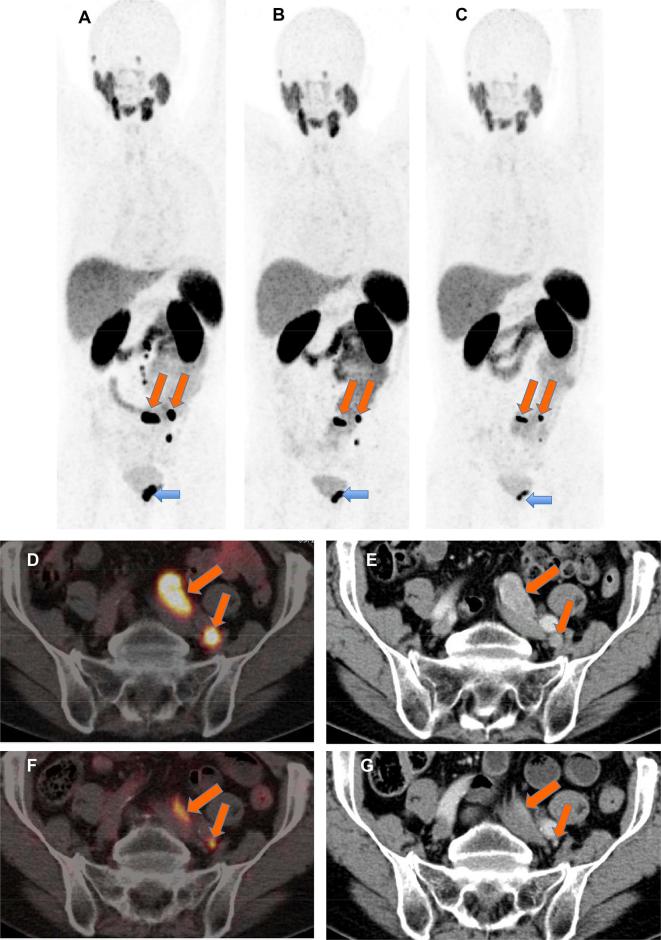
Figure 1.
Figure 1.
A 76-year-old patient with progressive mCRPC s.p. prostatectomy, pelvic lymphadenectomy, ADT as well as enzalutamide and 16 cycles of docetaxel chemotherapy. After 3 cycles of 177Lu-PRLT (cumulative administered activity 21.8 GBq), there was PR of the LNM (oblique arrows) as well as of the primary tumor (horizontal arrow). (A) 68Ga-PSMA MIP image before PRLT; (B) after two cycles and (C), after three cycles; (D,F) axial PET/CT images; (E,G) contrast-enhanced CT images. There was response to PRLT (PR) according to RECIST 1.1 as well as EORTC criteria (reduction of uptake) of the left iliac LNM (D,E, before PRLT; FG, after three PRLT cycles) and of the primary tumor. ADT, androgen deprivation therapy; LNM, lymph node metastases; mCRPC, metastatic castration-resistant prostate cancer; PR, partial remission; PRLT, PSMA radioligand therapy; PSMA, prostate-specific membrane antigen.
Figure 2.
Figure 2.
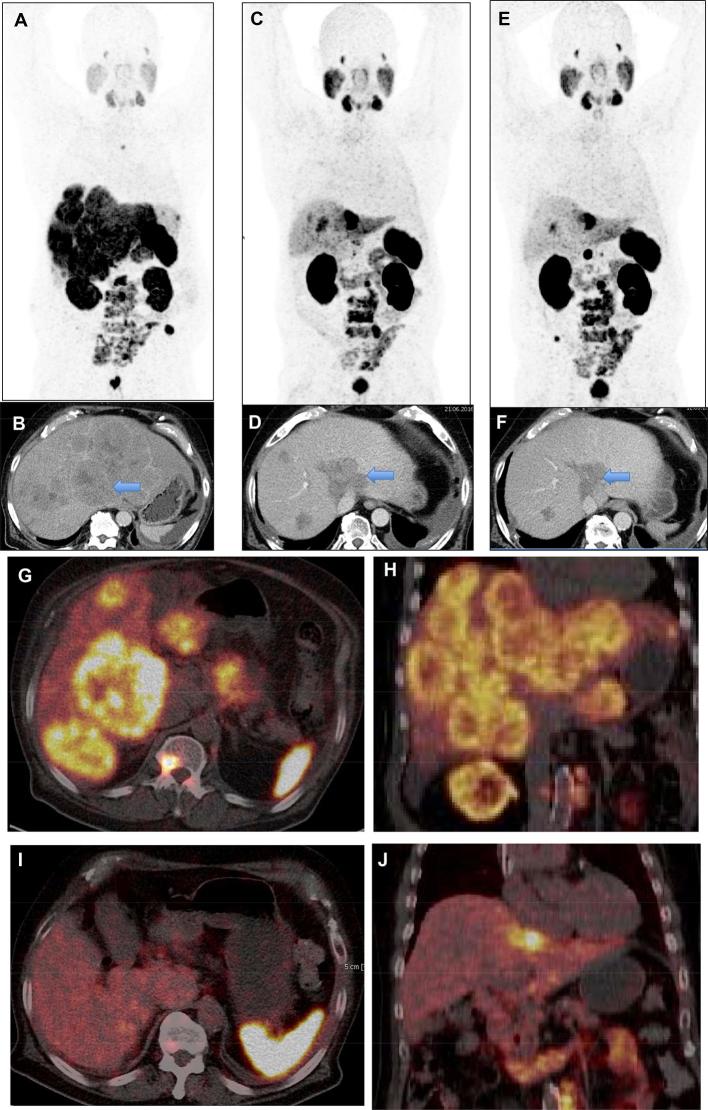
A 75-year-old patient with progressive mCRPC, s.p. prostatectomy, ADT and enzalutamide as well as docetaxel chemotherapy (wheel-chair bound with pain and low Karnofsky performance status) with disseminated osseous as well as extensive liver metastases (hepatomegaly) exhibiting very high PSMA expression. After 3 cycles of 177Lu-PSMA-radioligand therapy (cumulative administered activity 22.7 GBq), excellent response of the multiple liver metastases (PR according to RECIST 1.1 and EORTC criteria) with significant decrease in size of the lesions as well as of the whole liver occurred. The general condition of the patient improved remarkably (coming for follow-up studies driving his own car) and he lived for another 2 years after the last PRLT cycle. (A) 68Ga-PSMA MIP image before PRLT; (C), after two cycles and (E), after three cycles; (B,D,F) contrast-enhanced CT images. (G,I) axial PET/CT images; (H,J) coronal PET/CT images; (G,H) before PRLT; (I,J) after 3 PRLT cycles. ADT, androgen deprivation therapy; LNM, lymph node metastases; mCRPC, metastatic castration-resistant prostate cancer; MIP, maximum intensity protection; PR, partial remission; PRLT, PSMA radioligand therapy.
Figure 3.
Figure 3.
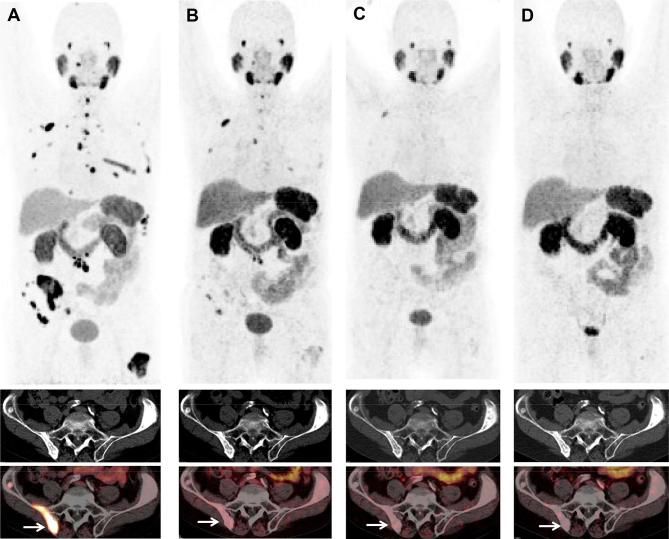
A 77-year-old patient (first diagnosis in 1998) with progressive mCRPC and initial osseous metastases, s.p. orchiectomy, ADT and abiraterone, repeated external beam radiotherapy and chemotherapy with docetaxel and cabazitaxel. After 3 cycles of 177Lu-PSMA PRLT (cumulative administered radioactivity 12.9 GBq) between October 2015 and March 2016, the patient experienced nearly complete remission (with no toxicity), persisting for 2 years after the last cycle. This patient presented with chronic renal insufficiency and G2 anemia before PRLT, which did improve (!) after PRLT. 68Ga-PSMA PET/CT images: (A), October 2015; (B) March 2016; (C), July 2016 and (D) December 2017; upper panel, MIP images; middle panel, CT images revealing no significant change over time in the osteosclerotic iliac bone lesions; lower panel, fused 68Ga-PSMA PET/CT images after PRLT exhibiting a significant decrease in PSMA expression of the metastases (arrow showing metastasis in the right iliac bone), related to treatment response according to molecular imaging criteria. ADT, androgen deprivation therapy; mCRPC, metastatic castration-resistant prostate cancer; MIP, maximum intensity protection; PRLT, prostate-specific membrane antigen; PSMA, prostate-specific membrane antigen.
Figure 4.
Figure 4.
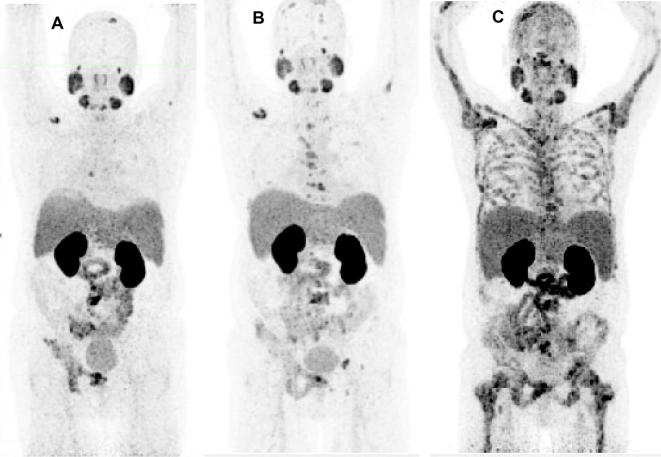
A 56-year-old patient with mCRPC, s.p. orchiectomy and 20 cycles of docetaxel/cabazitaxel chemotherapy (stopped due to severe anemia, neutropenia and fatigue). The patient underwent 177Lu-PSMA RLT as a last line therapy option, however, experiencing progression under PRLT, with disseminated bone and bone marrow involvement (which could be an indication for therapy with the α-emitter 225Ac-PSMA). (A)68Ga-PSMA PET/CT MIP image before PRLT; (B) after two cycles and (C) after four cycles of PRLT. mCRPC,metastatic castration-resistant prostate cancer; MIP, maximum intensity protection; PRLT, PSMA radioligand; PSMA, prostate-specific membrane antigen.
Figure 5.
Figure 5.
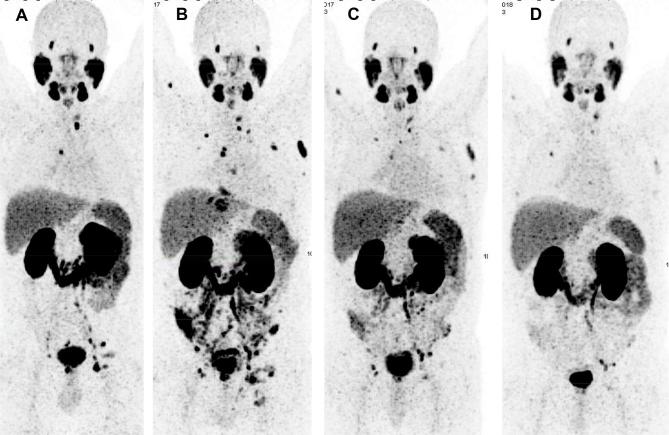
A 60-year-old patient with mCRPC, s.p. brachytherapy, ADT and enzalutamide, experiencing partial remission of the extensive lymph node and bone metastases after 3 cycles (21.2 GBq) of PRLT (A, 68Ga-PSMA PET/CT MIP image after the third cycle). The disease progressed 6 months later (B) and he underwent a second phase (fourth and fifth PRLT) of treatment (salvage PRLT) with 7.9 and 8 GBq, respectively and concurrent treatment with abiraterone. The combination therapy had an effect/PR (C, 68Ga-PSMA PET/CT MIP image after the fourth cycle and D, after the fifth cycle) without any toxicity after a cumulative administered activity of 37.1 GBq. G1 anemia (present before PRLT) improved over time. ADT, androgen deprivation therapy; mCRPC, metastatic castration-resistant prostate cancer; MIP, maximum intensity protection; PRLT, PSMA radioligand therapy; PSMA, prostate-specific membrane antigen.

References

    1. Baum RP, Kulkarni HR, Carreras C. Peptides and receptors in image-guided therapy: theranostics for neuroendocrine neoplasms. Semin Nucl Med 2012; 42: 190–207. doi: 10.1053/j.semnuclmed.2012.01.002 - DOI - PubMed
    1. Baum RP, Kulkarni HR. Theranostics: from molecular imaging using Ga-68 labeled tracers and PET/CT to personalized radionuclide therapy— the Bad Berka experience. Theranostics 2012; 2: 437–47. doi: 10.7150/thno.3645 - DOI - PMC - PubMed
    1. Puranik AD, Kulkarni HR, Baum RP. Companion diagnostics. Cancer J 2015; 21: 213–7. - PubMed
    1. Strosberg J, El-Haddad G, Wolin E, Hendifar A, Yao J, Chasen B. NETTER-1 trial investigators. Phase 3 trial of (177)Lu-Dotatate for midgut neuroendocrine tumors. N Engl J Med 2017; 376: 125–35. - PMC - PubMed
    1. Ferlay J, Soerjomataram I, Dikshit R, Eser S, Mathers C, Rebelo M, et al. Cancer incidence and mortality worldwide: sources, methods and major patterns in GLOBOCAN 2012. Int J Cancer 2015; 136: E359–E386. doi: 10.1002/ijc.29210 - DOI - PubMed

MeSH terms