


Increased Mortality and Reoperation Rates After Treatment for Septic Arthritis of the Knee in People Who Inject Drugs: Nationwide Inpatient Sample, 2000-2013
- PMID: 29762153
- PMCID: PMC6259777
- DOI: 10.1097/01.blo.0000534682.68856.d8
Increased Mortality and Reoperation Rates After Treatment for Septic Arthritis of the Knee in People Who Inject Drugs: Nationwide Inpatient Sample, 2000-2013
Abstract
Background: The United States has a growing opioid epidemic impacting all aspects of health care including orthopaedic surgery. Septic arthritis of the knee is a condition commonly encountered by orthopaedic surgeons related to opioid and injection drug use (IDU). Changes in the frequency of hospitalizations for IDU-related septic arthritis and differences in septic arthritis patient outcomes according to IDU status in the setting of the burgeoning opioid epidemic are unknown.
Questions/purposes: (1) What proportion of patients with septic arthritis of the knee use injection drugs? (2) Are there any differences in complications, reoperations, length of stay, and leaving against medical advice among patients with septic arthritis of the knee with and without IDU? (3) What are the age and racial trends in IDU-related septic arthritis of the knee from 2000 to 2013?
Methods: The Healthcare Cost and Utilization Project, Nationwide Inpatient Sample database of years 2000 to 2013 was utilized for patients between ages 15 and 64 years with a principal discharge diagnosis of native septic arthritis of the lower leg, the vast majority of which represents the knee. The Nationwide Inpatient Sample is the largest publicly available healthcare database in the United States that can show nationally representative clinical trends and outcomes. Septic arthritis was classified as related or unrelated to IDU based on previously published algorithms using billing codes. Patients with IDU-related septic arthritis were more likely to be black or Hispanic, younger, and use Medicare, Medicaid, or self-payment as their primary payment method. The yearly proportion of patients with septic arthritis who used injection drugs was determined. Hospitalization outcomes including length of stay, leaving against medical advice, number of procedures, and mortality rates were compared after adjusting for age, gender, and race in multivariable regression analyses. The yearly change in proportion of IDU-related septic arthritis in each age, race, and gender group was compared over the study period.
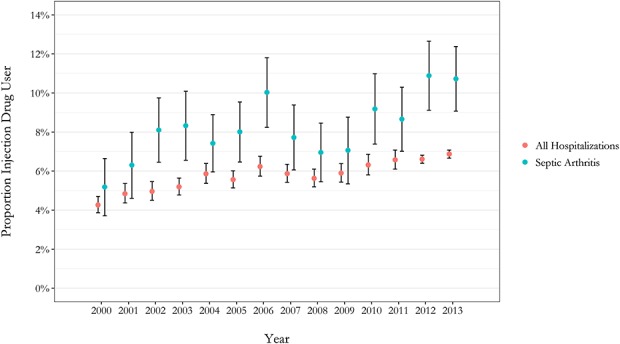
Results: The proportion of patients with IDU-related septic arthritis increased from 5% in 2000 to 11% in 2013. After adjusting for age, gender, and race, patients with IDU-related septic arthritis were more likely to die during hospitalization (adjusted odds ratio [AOR], 2.86; 95% confidence interval [CI], 1.51-5.39; p < 0.001) and undergo repeat arthroscopic (AOR, 1.24; 95% CI, 1.06-1.45; p = 0.007) or open irrigation and débridement (AOR, 1.68; 95% CI, 1.28-2.19; p < 0.001). Patients with IDU-related septic arthritis were more likely to leave against medical advice (AOR, 7.13; 95% CI, 5.56-9.15; p < 0.001) and also had an additional 5 days in length of stay (95% CI, 4.1-5.5; p < 0.001) on average compared with patients with septic arthritis unrelated to IDU. There was an increasing proportion of patients with IDU-related septic arthritis who were aged 15 to 34 years and 55 to 64 years from 2000 to 2013.
Conclusions: IDU is increasingly the cause of septic knee admissions and is associated with higher rates of mortality, reoperations, resource utilization, and leaving against medical advice. Orthopaedic surgeons must adequately screen for IDU among patients with septic arthritis and monitor them closely for reoperation with a low threshold to reaspirate a knee in the postoperative period. Future studies should determine the current use and potential benefits of a multidisciplinary approach, including addiction specialists, to aid in the management of the increasing number of these patients.
Level of evidence: Level III, therapeutic study.
Conflict of interest statement
Each author certifies that he or she, or a member of his or her immediate family, has no commercial associations (eg, consultancies, stock ownership, equity interest, patent/licensing arrangements, etc) that might pose a conflict of interest in connection with the submitted article.
All ICMJE Conflict of Interest Forms for authors and
Figures
References
-
- Agency for Healthcare Research and Quality. HCUP Methods Series: Calculating National Nationwide Inpatient Sample (NIS) Variance for Data Years 2011 and Earlier. 2003. Available at: https://www.hcup-us.ahrq.gov/reports/methods/2003_02.jsp. Accessed February 12, 2018.
-
- Agency for Healthcare Research and Quality. HCUP Methods Series: Calculating National Nationwide Inpatient Sample (NIS) Variance for Data Years 2012 and Later. 2015. Available at: https://www.hcup-us.ahrq.gov/reports/methods/2015_09.jsp. Accessed February 12, 2018.
-
- Agency for Healthcare Research and Quality. Overview of the National (Nationwide) Inpatient Sample (NIS). 2016. Available at: https://www.hcup-us.ahrq.gov/nisoverview.jsp. Accessed February 12, 2018.
-
- Andersen K, Bennedbaek FN, Hansen BL. [Septic arthritis in intravenous drug abuse] [in German]. Ugeskr Laeger. 1994;156:3876–3880. - PubMed
MeSH terms
LinkOut - more resources
Full Text Sources
Other Literature Sources
Medical
Research Materials
