


Transactional sex and incident HIV infection in a cohort of young women from rural South Africa
- PMID: 29762176
- PMCID: PMC6082595
- DOI: 10.1097/QAD.0000000000001866
Transactional sex and incident HIV infection in a cohort of young women from rural South Africa
Abstract
Objective: In sub-Saharan Africa, young women who engage in transactional sex (the exchange of sex for money or gifts) with a male partner show an elevated risk of prevalent HIV infection. We analyse longitudinal data to estimate the association between transactional sex and HIV incidence.
Design: We used longitudinal data from a cohort of 2362 HIV-negative young women (aged 13-20 years) enrolled in a randomized controlled trial in rural, South Africa who were followed for up to four visits over 6 years.
Methods: The effect of transactional sex on incident HIV was analysed using stratified Cox proportional hazards models and cumulative incidence curves. Risk ratios were estimated using log-binomial models to compare the effects across visits.
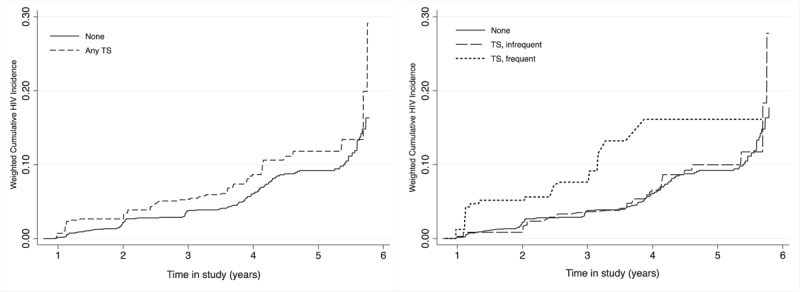
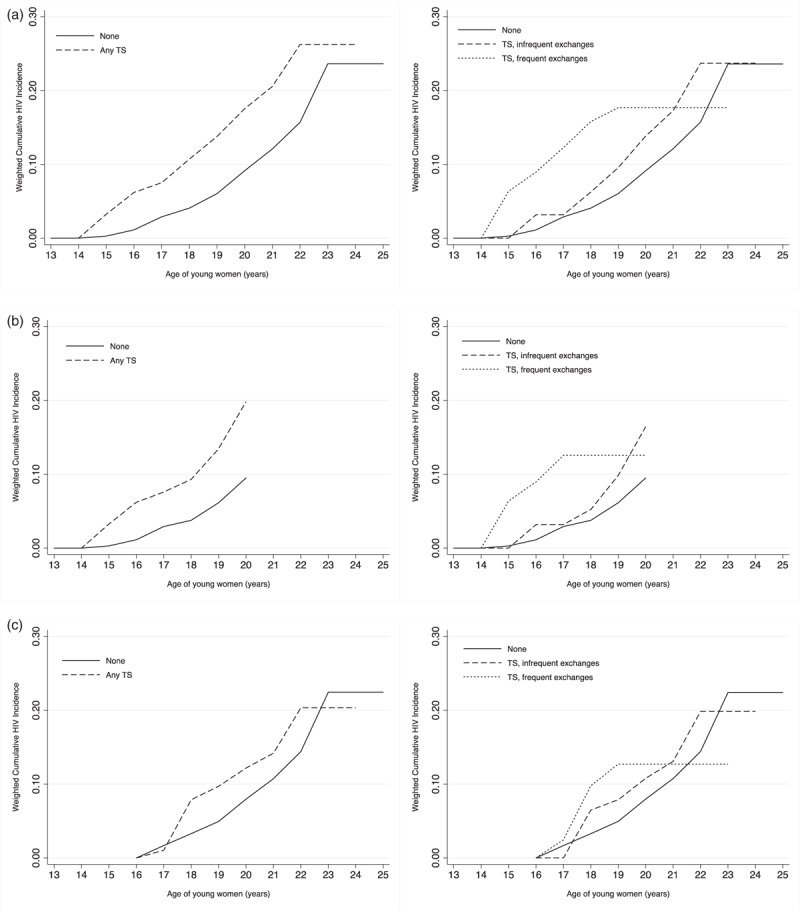
Results: HIV incidence was higher for young women that reported transactional sex (hazard ratio 1.59, 95% confidence interval 1.02-2.19), particularly when money and/or gifts were received frequently (at least weekly) (hazard ratio 2.71, 95% confidence interval 1.44-5.12). We also find that effects were much stronger during the main trial and dissipate at the postintervention visit, despite an increase in both transactional sex and HIV.
Conclusion: Transactional sex elevates the risk of HIV acquisition among young women, especially when it involves frequent exchanges of money and/or gifts. However, the effect was attenuated after the main trial, possibly due to the changing nature of transactional sex and sexual partners as women age. These findings suggest that reducing transactional sex among young women, especially during adolescence, is important for HIV prevention.
Figures
References
-
- UNAIDS. Global AIDS update, 2016. Geneva, Switzerland. http://www.unaids.org/en/resources/documents/2016/Global-AIDS-update-2016 [Accessed 1 February 2018].
-
- Cowan F, Pettifor A. HIV in adolescents in sub-Saharan Africa. Curr Opin HIV AIDS 2009; 4:288–293. - PubMed
Publication types
MeSH terms
Grants and funding
- UM1 AI069423/AI/NIAID NIH HHS/United States
- R01 MH110186/MH/NIMH NIH HHS/United States
- R24 HD050924/HD/NICHD NIH HHS/United States
- T32 AI007001/AI/NIAID NIH HHS/United States
- 085477/Z/08/Z/WT_/Wellcome Trust/United Kingdom
- UM1 AI068619/AI/NIAID NIH HHS/United States
- 058893/Z/99/A/WT_/Wellcome Trust/United Kingdom
- P2C HD050924/HD/NICHD NIH HHS/United States
- UM1 AI068617/AI/NIAID NIH HHS/United States
- UM1 AI068613/AI/NIAID NIH HHS/United States
- 069683/Z/02/Z/WT_/Wellcome Trust/United Kingdom
- 085477/B/08/Z/WT_/Wellcome Trust/United Kingdom
- R01 MH087118/MH/NIMH NIH HHS/United States
LinkOut - more resources
Full Text Sources
Other Literature Sources
Medical
