


Population Serologic Immunity to Human and Avian H2N2 Viruses in the United States and Hong Kong for Pandemic Risk Assessment
- PMID: 29762672
- PMCID: PMC6107991
- DOI: 10.1093/infdis/jiy291
Population Serologic Immunity to Human and Avian H2N2 Viruses in the United States and Hong Kong for Pandemic Risk Assessment
Abstract
Background: Influenza A pandemics cause significant mortality and morbidity. H2N2 viruses have caused a prior pandemic, and are circulating in avian reservoirs. The age-related frequency of current population immunity to H2 viruses was evaluated.
Methods: Hemagglutinin inhibition (HAI) assays against historical human and recent avian influenza A(H2N2) viruses were performed across age groups in Rochester, New York, and Hong Kong, China. The impact of existing cross-reactive HAI immunity on the effective reproduction number was modeled.
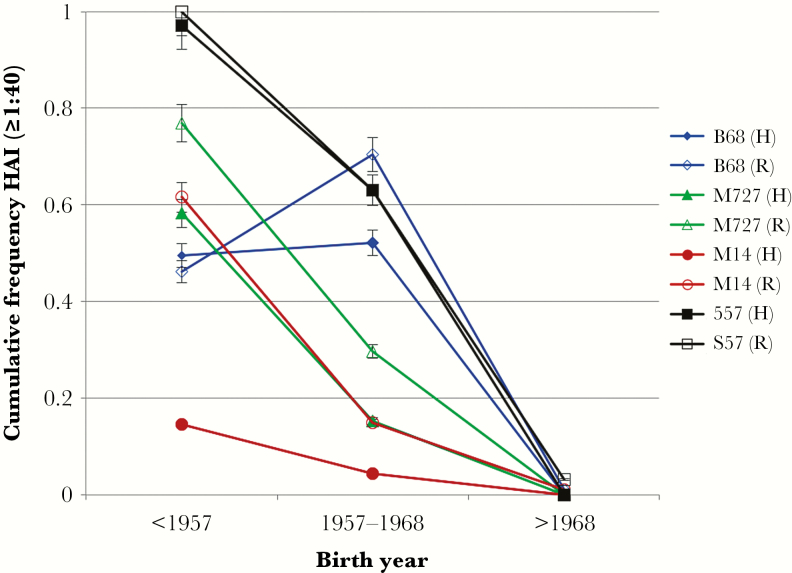
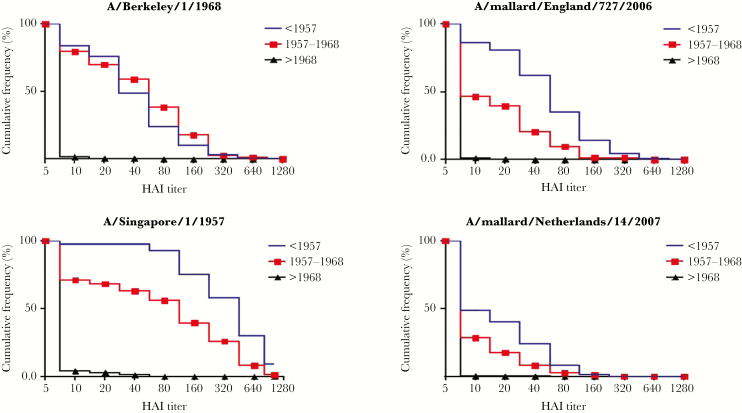
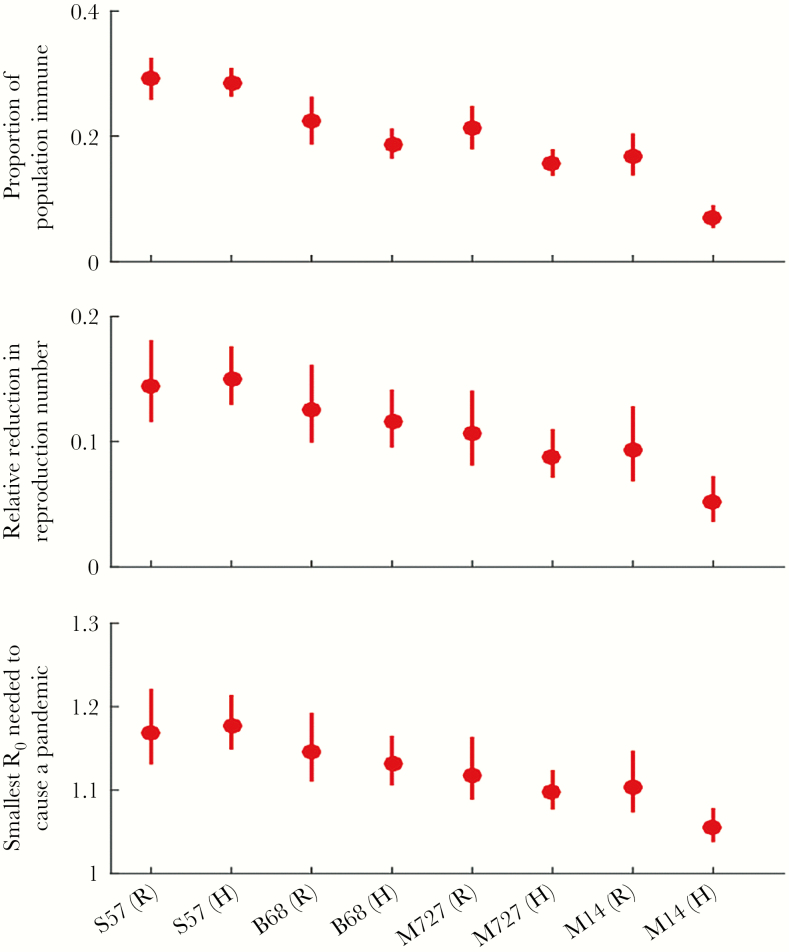
Results: One hundred fifty individual sera from Rochester and 295 from Hong Kong were included. Eighty-five percent of patients born in Rochester and Hong Kong before 1968 had HAI titers ≥1:40 against A/Singapore/1/57, and >50% had titers ≥1:40 against A/Berkeley/1/68. The frequency of titers ≥1:40 to avian H2N2 A/mallard/England/727/06 and A/mallard/Netherlands/14/07 in subjects born before 1957 was 62% and 24%, respectively. There were no H2 HAI titers >1:40 in individuals born after 1968. These levels of seroprevalence reduce the initial reproduction number of A/Singapore/1/1957 or A/Berkeley/1/68 by 15%-20%. A basic reproduction number (R0) of the emerging transmissible virus <1.2 predicts a preventable pandemic.
Conclusions: Population immunity to H2 viruses is insufficient to block epidemic spread of H2 virus. An H2N2 pandemic would have lower impact in those born before 1968.
Figures
References
-
- Johnson NP, Mueller J. Updating the accounts: global mortality of the 1918–1920 “Spanish” influenza pandemic. Bull Hist Med 2002; 76:105–15. - PubMed
-
- Centers for Disease Control and Prevention. Flu season 1999–2000: flu pandemics. https://www.cdc.gov/media/pressrel/r991007f.htm. Accessed 1 December 2016.
-
- Schafer JR, Kawaoka Y, Bean WJ, Suss J, Senne D, Webster RG. Origin of the pandemic 1957 H2 influenza A virus and the persistence of its possible progenitors in the avian reservoir. Virology 1993; 194:781–8. - PubMed
-
- Monto AS, Petrie JG, Cross RT, et al. Antibody to influenza virus neuraminidase: an independent correlate of protection. J Infect Dis 2015; 212:1191–9. - PubMed
Publication types
MeSH terms
Grants and funding
LinkOut - more resources
Full Text Sources
Other Literature Sources
Medical
