


Early prenatal alcohol exposure alters imprinted gene expression in placenta and embryo in a mouse model
- PMID: 29763474
- PMCID: PMC5953443
- DOI: 10.1371/journal.pone.0197461
Early prenatal alcohol exposure alters imprinted gene expression in placenta and embryo in a mouse model
Abstract
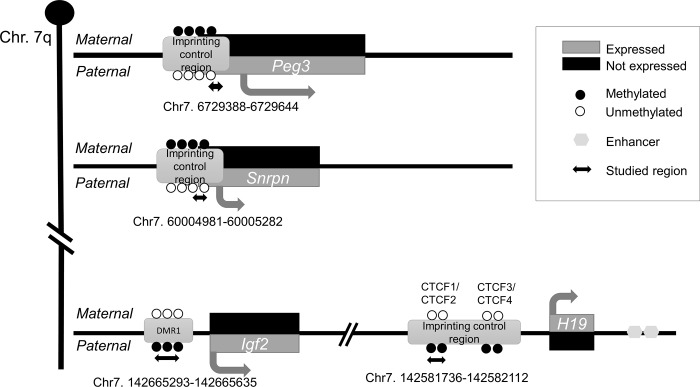
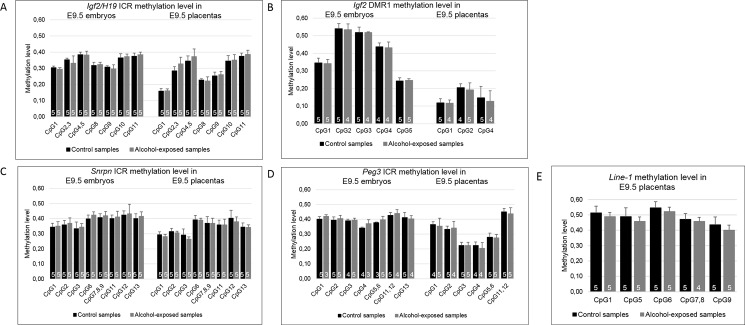
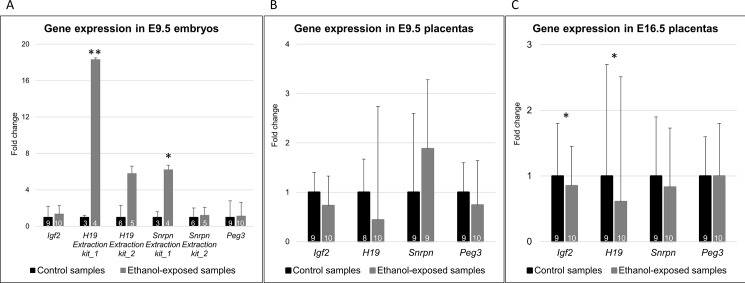
Prenatal alcohol exposure (PAE) can harm the embryonic development and cause life-long consequences in offspring's health. To clarify the molecular mechanisms of PAE we have used a mouse model of early alcohol exposure, which is based on maternal ad libitum ingestion of 10% (v/v) ethanol for the first eight days of gestation (GD 0.5-8.5). Owing to the detected postnatal growth-restricted phenotype in the offspring of this mouse model and both prenatal and postnatal growth restriction in alcohol-exposed humans, we focused on imprinted genes Insulin-like growth factor 2 (Igf2), H19, Small Nuclear Ribonucleoprotein Polypeptide N (Snrpn) and Paternally expressed gene 3 (Peg3), which all are known to be involved in embryonic and placental growth and development. We studied the effects of alcohol on DNA methylation level at the Igf2/H19 imprinting control region (ICR), Igf2 differentially methylated region 1, Snrpn ICR and Peg3 ICR in 9.5 embryonic days old (E9.5) embryos and placentas by using MassARRAY EpiTYPER. To determine alcohol-induced alterations globally, we also examined methylation in long interspersed nuclear elements (Line-1) in E9.5 placentas. We did not observe any significant alcohol-induced changes in DNA methylation levels. We explored effects of PAE on gene expression of E9.5 embryos as well as E9.5 and E16.5 placentas by using quantitative PCR. The expression of growth promoter gene Igf2 was decreased in the alcohol-exposed E9.5 and E16.5 placentas. The expression of negative growth controller H19 was significantly increased in the alcohol-exposed E9.5 embryos compared to controls, and conversely, a trend of decreased expression in alcohol-exposed E9.5 and E16.5 placentas were observed. Furthermore, increased Snrpn expression in alcohol-exposed E9.5 embryos was also detected. Our study indicates that albeit no alterations in the DNA methylation levels of studied sequences were detected by EpiTYPER, early PAE can affect the expression of imprinted genes in both developing embryo and placenta.
Conflict of interest statement
Figures
References
-
- Hoyme HE, Kalberg WO, Elliott AJ, Blankenship J, Buckley D, Marais AS, et al. Updated Clinical Guidelines for Diagnosing Fetal Alcohol Spectrum Disorders. Pediatrics. 2016; 138: e20154256 doi: 10.1542/peds.2015-4256 - DOI - PMC - PubMed
-
- Roozen S, Peters GJ, Kok G, Townend D, Nijhuis J, Curfs L. Worldwide prevalence of fetal alcohol spectrum disorders: a systematic literature review including meta-analysis. Alcohol Clin Exp Res. 2016; 40: 18–32. doi: 10.1111/acer.12939 - DOI - PubMed
-
- Kaminen-Ahola N, Ahola A, Maga M, Mallitt KA, Fahey P, Cox TC, et al. Maternal ethanol consumption alters the epigenotype and the phenotype of offspring in a mouse model. PLoS Genet. 2010; 6: e1000811 doi: 10.1371/journal.pgen.1000811 - DOI - PMC - PubMed
-
- Laufer BI, Mantha K, Kleiber ML, Diehl EJ, Addison SM, Singh SM. Long-lasting alterations to DNA methylation and ncRNAs could underlie the effects of fetal alcohol exposure in mice. Dis Model Mech. 2013; 6: 977–992. doi: 10.1242/dmm.010975 - DOI - PMC - PubMed
Publication types
MeSH terms
Substances
LinkOut - more resources
Full Text Sources
Other Literature Sources
Molecular Biology Databases
Miscellaneous
