


Clinicopathological features, surgical strategy and prognosis of duodenal gastrointestinal stromal tumors: a series of 300 patients
- PMID: 29764388
- PMCID: PMC5952823
- DOI: 10.1186/s12885-018-4485-4
Clinicopathological features, surgical strategy and prognosis of duodenal gastrointestinal stromal tumors: a series of 300 patients
Abstract
Background: The relatively low incidence of duodenal gastrointestinal stromal tumors (GISTs) and the unique anatomy make the surgical management and outcomes of this kind of tumor still under debate. Thus, this study aimed to explore the optimal surgical strategy and prognosis of duodenal GISTs.
Methods: A total of 300 cases of duodenal GISTs were obtained from our center (37 cases) and from case reports or series (263 cases) extracted from MEDLINE. Clinicopathological features, type of resections and survivals of duodenal GISTs were analyzed.
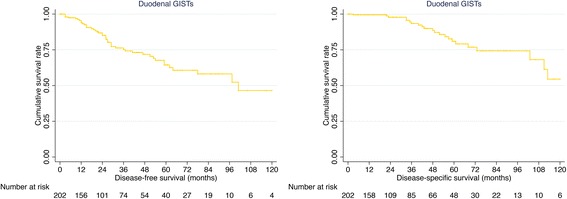
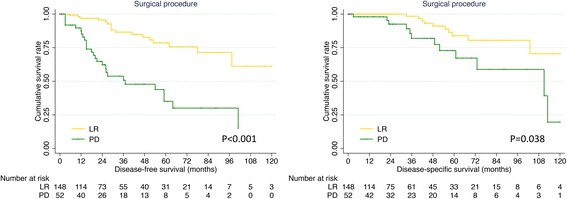
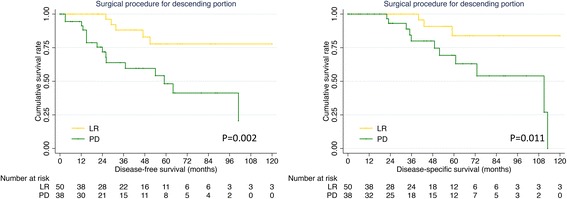
Results: The most common location of duodenal GISTs was descending portion (137/266, 51.5%). The median tumor size was 4 cm (0.1-28). Most patients (66.3%) received limited resection (LR). Pancreaticoduodenectomy (PD) was mainly performed for GISTs with larger tumor size or arose from descending portion (both P < 0.05). For both the entire cohort and tumors located in the descending portion, PD was not an independent risk factor for disease-free survival (DFS) and disease-specific survival (DSS) (both P > 0.05). Duodenal GISTs were significantly different from gastric GISTs with respect to tumor size, mitotic index and NIH risk category (all P < 0.05). The DFS and DSS of duodenal GISTs was significantly worse than that of gastric GISTs (both P < 0.05).
Conclusions: LR was a more prevalent surgical procedure and PD was mainly performed for tumors with larger diameter or located in descending portion. Type of resection was not an independent risk factor for the prognosis of duodenal GISTs. Prognosis of duodenal GISTs was significantly worse than that of gastric GISTs.
Keywords: Duodenum; Features; Gastrointestinal stromal tumor; Prognosis; Surgery.
Conflict of interest statement
Ethics approval and consent to participate
This study was approved by the Ethics Committee of Xijing Hospital, and written informed consent was obtained from the patients in our center.
Competing interests
There are no financial or other relations that could lead to a conflict of interest.
Publisher’s Note
Springer Nature remains neutral with regard to jurisdictional claims in published maps and institutional affiliations.
Figures

References
-
- Miettinen M, Kopczynski J, Makhlouf HR, Sarlomo-Rikala M, Gyorffy H, Burke A, Sobin LH, Lasota J. Gastrointestinal stromal tumors, intramural leiomyomas, and leiomyosarcomas in the duodenum: a clinicopathologic, immunohistochemical, and molecular genetic study of 167 cases. Am J Surg Pathol. 2003;27(5):625–641. - PubMed
-
- Connolly EM, Gaffney E, Reynolds JV. Gastrointestinal stromal tumours. Br J Surg. 2003;90(10):1178–1186. - PubMed
-
- Blay JY, Bonvalot S, Casali P, Choi H, Debiec-Richter M, Dei Tos AP, Emile JF, Gronchi A, Hogendoorn PC, Joensuu H, Le Cesne A, McClure J, Maurel J, Nupponen N, Ray-Coquard I, Reichardt P, Sciot R, Stroobants S, van Glabbeke M, van Oosterom A, Demetri GD. Panelists Gcm. Consensus meeting for the management of gastrointestinal stromal tumors. Report of the GIST consensus conference of 20-21 march 2004, under the auspices of ESMO. Ann Oncol. 2005;16(4):566–578. - PubMed
-
- Singer S, Rubin BP, Lux ML, Chen CJ, Demetri GD, Fletcher CD, Fletcher JA. Prognostic value of KIT mutation type, mitotic activity, and histologic subtype in gastrointestinal stromal tumors. J Clin Oncol. 2002;20(18):3898–3905. - PubMed
Publication types
MeSH terms
Grants and funding
LinkOut - more resources
Full Text Sources
Other Literature Sources
Medical
Molecular Biology Databases
