


Treatment-resistant depression and peripheral C-reactive protein
- PMID: 29764522
- PMCID: PMC6124647
- DOI: 10.1192/bjp.2018.66
Treatment-resistant depression and peripheral C-reactive protein
Abstract
Background: C-reactive protein (CRP) is a candidate biomarker for major depressive disorder (MDD), but it is unclear how peripheral CRP levels relate to the heterogeneous clinical phenotypes of the disorder.AimTo explore CRP in MDD and its phenotypic associations.
Method: We recruited 102 treatment-resistant patients with MDD currently experiencing depression, 48 treatment-responsive patients with MDD not currently experiencing depression, 48 patients with depression who were not receiving medication and 54 healthy volunteers. High-sensitivity CRP in peripheral venous blood, body mass index (BMI) and questionnaire assessments of depression, anxiety and childhood trauma were measured. Group differences in CRP were estimated, and partial least squares (PLS) analysis explored the relationships between CRP and specific clinical phenotypes.
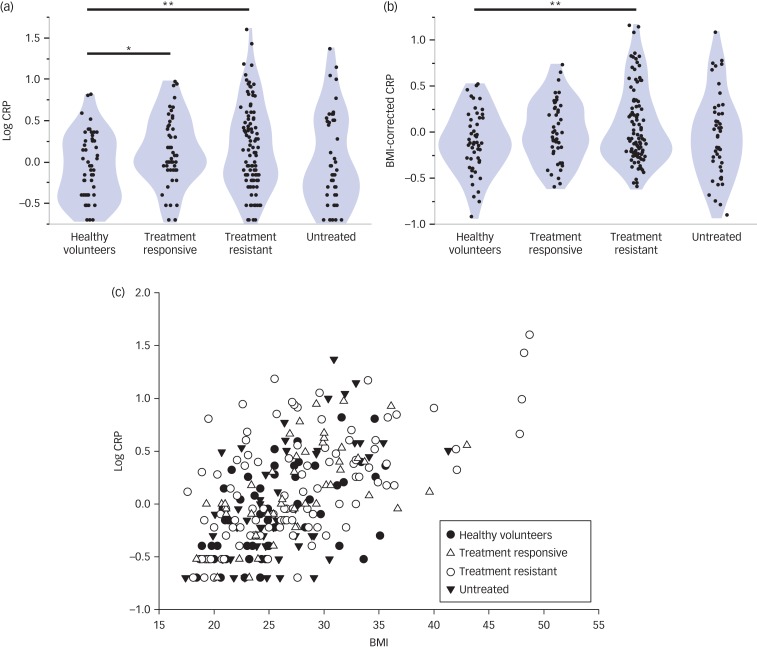
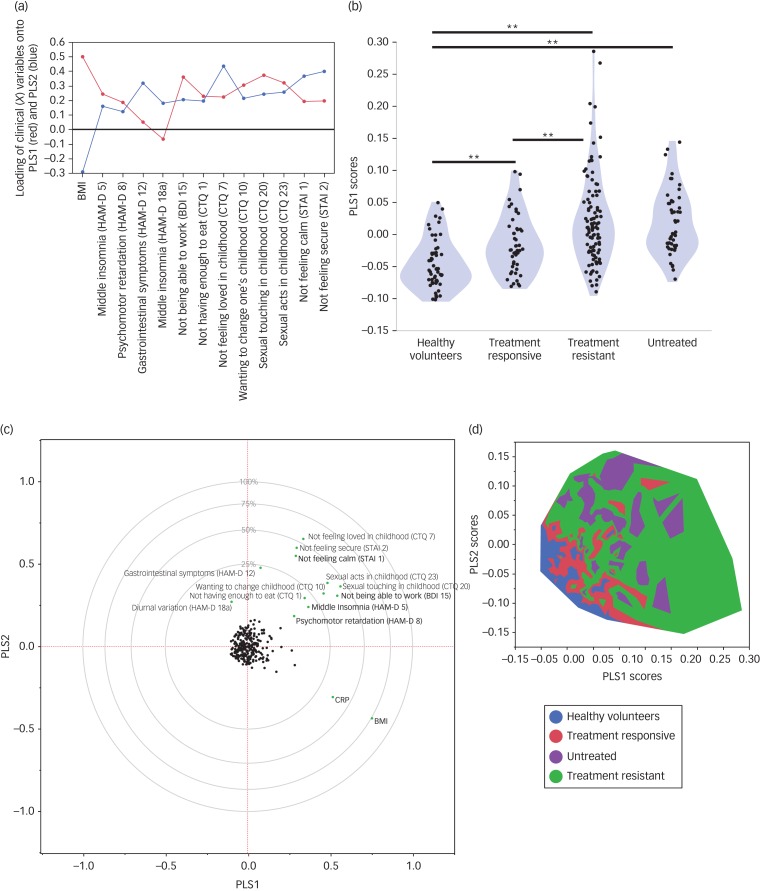
Results: Compared with healthy volunteers, BMI-corrected CRP was significantly elevated in the treatment-resistant group (P = 0.007; Cohen's d = 0.47); but not significantly so in the treatment-responsive (d = 0.29) and untreated (d = 0.18) groups. PLS yielded an optimal two-factor solution that accounted for 34.7% of variation in clinical measures and for 36.0% of variation in CRP. Clinical phenotypes most strongly associated with CRP and heavily weighted on the first PLS component were vegetative depressive symptoms, BMI, state anxiety and feeling unloved as a child or wishing for a different childhood.
Conclusions: CRP was elevated in patients with MDD, and more so in treatment-resistant patients. Other phenotypes associated with elevated CRP included childhood adversity and specific depressive and anxious symptoms. We suggest that patients with MDD stratified for proinflammatory biomarkers, like CRP, have a distinctive clinical profile that might be responsive to second-line treatment with anti-inflammatory drugs.Declaration of interestS.R.C. consults for Cambridge Cognition and Shire; and his input in this project was funded by a Wellcome Trust Clinical Fellowship (110049/Z/15/Z). E.T.B. is employed half time by the University of Cambridge and half time by GlaxoSmithKline; he holds stock in GlaxoSmithKline. In the past 3 years, P.J.C. has served on an advisory board for Lundbeck. N.A.H. consults for GlaxoSmithKline. P.d.B., D.N.C.J. and W.C.D. are employees of Janssen Research & Development, LLC., of Johnson & Johnson, and hold stock in Johnson & Johnson. The other authors report no financial disclosures or potential conflicts of interest.
Figures
References
-
- Bhattacharya A, Derecki NC, Lovenberg TW, Drevets WC. Role of neuro-immunological factors in the pathophysiology of mood disorders. Psychopharmacology (Berl) 2016; 233(9): 1623–36. - PubMed
-
- Strawbridge R, Arnone D, Danese A, Papadopoulos A, Herane Vives A, Cleare AJ. Inflammation and clinical response to treatment in depression: a meta-analysis. Eur Neuropsychopharmacol 2015; 25(10): 1532–43. - PubMed
-
- Maes M, Meltzer HY, Bosmans E, Bergmans R, Vandoolaeghe E, Ranjan R, et al. Increased plasma concentrations of interleukin-6, soluble interleukin-6, soluble interleukin-2 and transferrin receptor in major depression. J Affect Disord 1995; 34(4): 301–9. - PubMed
Publication types
MeSH terms
Substances
Grants and funding
LinkOut - more resources
Full Text Sources
Other Literature Sources
Medical
Research Materials
Miscellaneous
