. 2018 May 15;8(1):7573.
doi: 10.1038/s41598-018-25845-3.

De novo characterization of Phenacoccus solenopsis transcriptome and analysis of gene expression profiling during development and hormone biosynthesis

Affiliations

De novo characterization of Phenacoccus solenopsis transcriptome and analysis of gene expression profiling during development and hormone biosynthesis

Surjeet Kumar Arya et al. Sci Rep. .

Abstract

The cotton mealybug Phenacoccus solenopsis is a devastating pest of cotton causing tremendous loss in the yield of crops each year. Widespread physiological and biological studies on P. solenopsis have been carried out, but the lack of genetic information has constrained our understanding of the molecular mechanisms behind its growth and development. To understand and characterize the different developmental stages, RNA-Seq platform was used to execute de-novo transcriptome assembly and differential gene expression profiling for the eggs, first, second, third instar and adult female stages. About 182.67 million reads were assembled into 93,781 unigenes with an average length of 871.4 bp and an N50 length of 1899 bp. These unigenes sequences were annotated and classified by performing NCBI non-redundant (Nr) database, Kyoto Encyclopedia of Genes and Genomes (KEGG) and Clusters of Orthologous Groups (COG), Gene ontology (GO), the Swiss-Prot protein database (Swiss-Prot), and nearest related organism Acyrthosiphon pisum (pea aphid) database. To get more information regarding the process of metamorphosis, we performed a pairwise comparison of four developmental stages and obtained 29,415 differentially expressed genes. Some of the differentially expressed genes were associated with functional protein synthesis, anti-microbial protection, development and hormone biosynthesis. Functional pathway enrichment analysis of differentially expressed genes showed the positive correlation with specific physiological activities of each stage, and these results were confirmed by qRT-PCR experiments. This study gives a valuable genomics resource of P. solenopsis covering all its developmental stages and will promote future studies on biological processes at the molecular level.


Conflict of interest statement

The authors declare no competing interests.

Figures
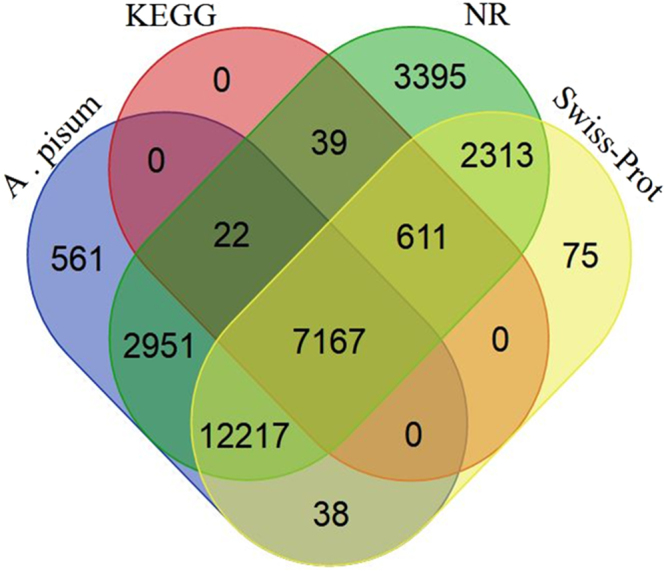
Figure 1
Figure 1
A Venn diagram illustrating shared and unique DEGs annotated in nr, Swissprot, COG, GO and KEGG public databases. Among 33,831 DGEs, 29,415 annotated in at least one of the public databases, including in nr, Swiss-prot, COG KEGG and GO databases, respectively.
Figure 2
Figure 2
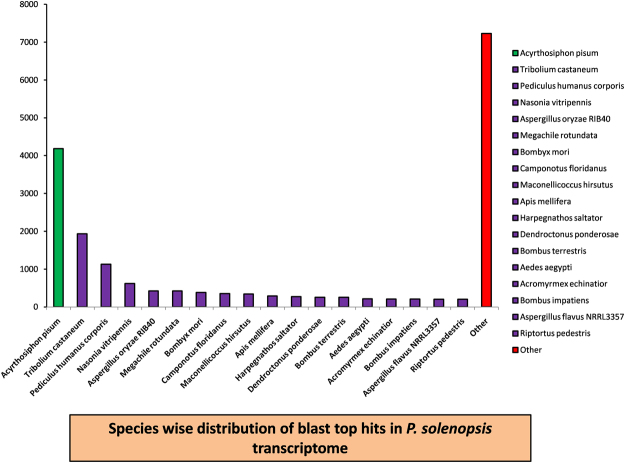
The top-eighteen species distribution of the BLASTX results. Unigenes were aligned with the NCBI-Nr protein database with a cutoff E value < 10−5. Different colors represent different species.
Figure 3
Figure 3
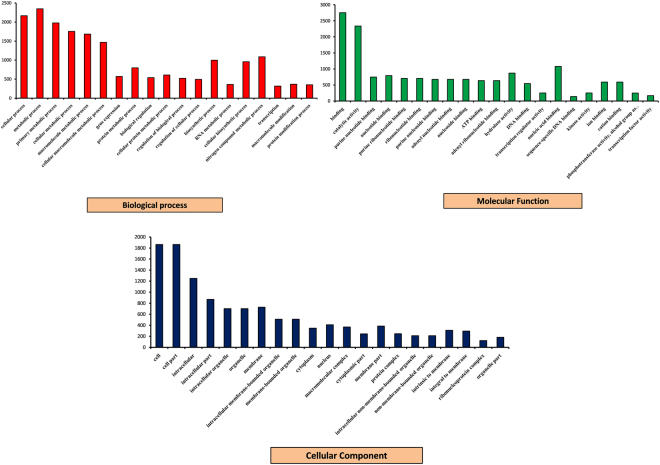
GO unigene categories. The unigenes were annotated in three main categories: biological process (blue), cellular component (red) and molecular function (green). The left side of the y-axis represents the percentage of a specific category of genes for a main category. The right side of the y-axis represents the number of genes in a category.
Figure 4
Figure 4
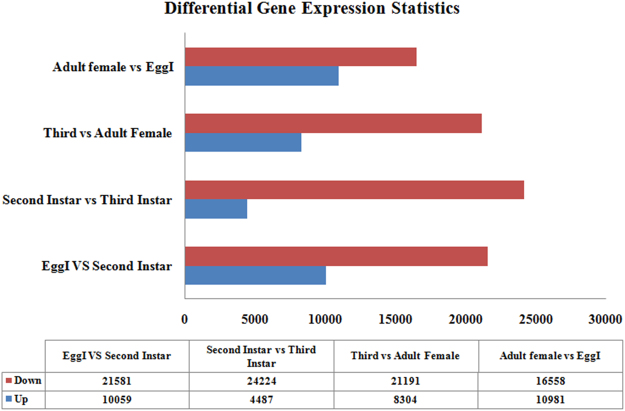
Comparison of the numbers of unigenes in different developmental stages in P. solenopsis. Up-regulated unigenes are marked in red, and down-regulated unigenes are marked in green.
Figure 5
Figure 5
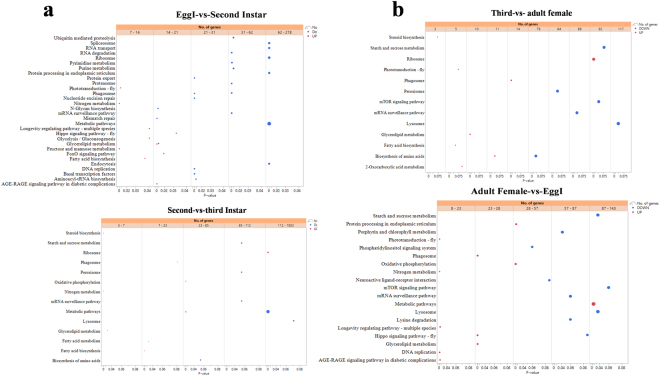
Enrichment analysis of KEGG pathways in comparisons of different stages. The x-axis indicates the p value calculated in enrichment test. Numbers of genes that were up-regulated (red) or down-regulated (blue) in comparisons of (a) EggI vs. Second instar and Second vs. third instar, (b) Third vs. adult and Adult female vs. EggI are shown. The size of circles indicates the number of genes in that pathway. Red circles represented up-regulated genes, while blue circles represented down-regulated genes.
Figure 6
Figure 6
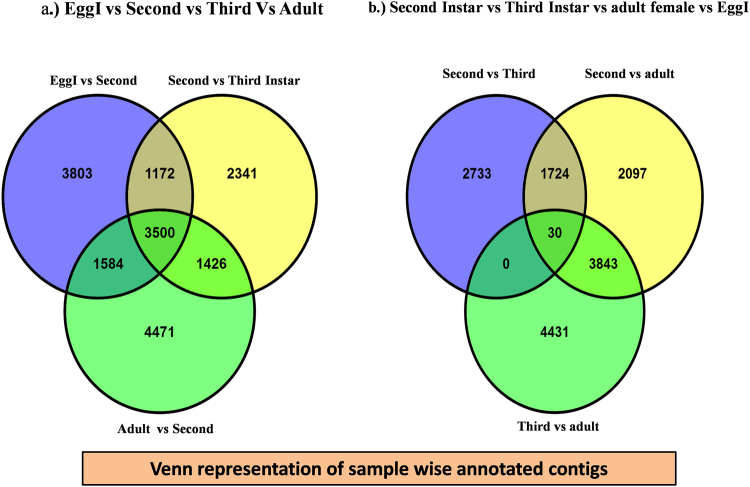
Venn diagrams representing number of differentially expressed genes among developmental stages. (a) Number of genes differentially expressed between the EggI vs. Second Instar vs. Third Instar vs. Adult female, commonly shared or not among stages. (b) Number of genes expressed between Second vs. Third vs. adult female, commonly shared or not among stages.
Figure 7
Figure 7
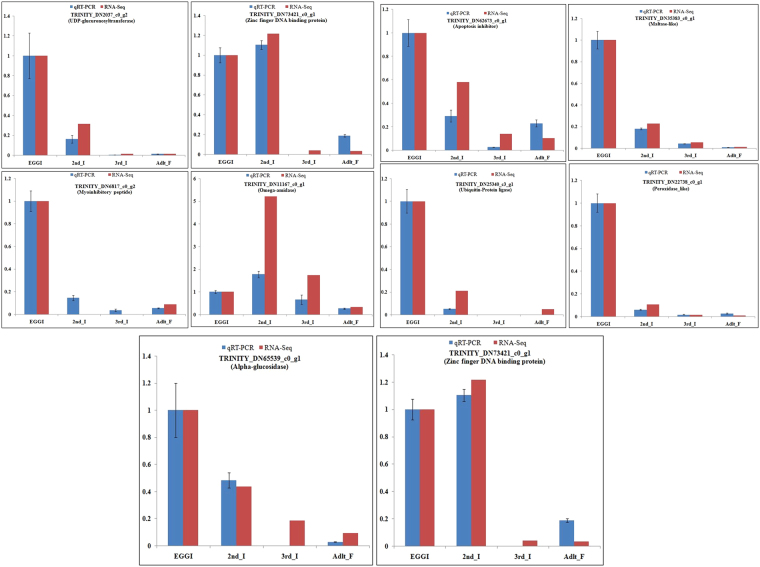
Comparison of qRT-PCR (red bar) and transcriptome (blue bar) expression data for ten randomly selected genes to confirm expression patterns indicated by transcriptome sequencing. Three technical replicates were performed for each of the three biological replicates. The height of each bar chart represents the mean average of sample-specific 2−ΔΔCt values. “1” represents the egg stage, “2” represents the 2nd Instar stage, “3” represents the 3rd instar stage, and “4” represents the adult stages.
Figure 8
Figure 8
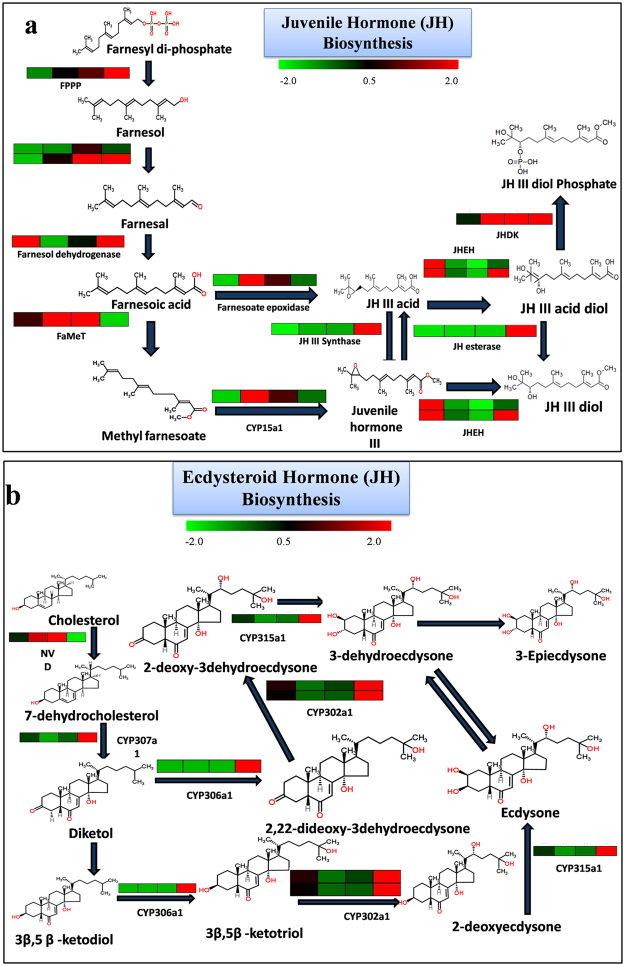
Juvenile hormone and ecdysteroid hormone biosynthesis with number of hits from the P. solenopsis transcriptome. (a) The analysis of the transcriptome identified homologues genes coding for enzymes of the Juvenile Hormone biosynthetic pathway, including Farnesylpyrophosphate synthase (Fpps); Juvenile Hormone Acid Methyltransferase (Jhamt); and Cytochrome P450 (CYP15A1); and for degradation of the Juvenile Hormone, with Juvenile Hormone Epoxide Hydrolase (Jheh); Juvenile Hormone Esterase 1 (jhe1), with respective number of identified hits at e < e−30 by Blastx. Chemical structures obtained from KEGG. (b) The analysis of the transcriptome identified homologues genes coding for enzymes of the Ecdysteoid hormone biosynthetic pathway, including Cholesterol 7-dehydrogenase (Neverland); and a series of cytochrome P450 enzymes encoded by the Halloween genes, such as spook (CYP307A); phantom (CYP306A1); disembodied (CYP302A1); shadow (CYP315A1); and shade (CYP314A1). For ecdysteroid inactivation, a 26-dehydroxylase (CYP18A1), with respective number of identified hits at e < e−30 by Blastx. Chemical structures obtained from KEGG.

References

    1. Hodgson CJ, Abbas G, Arif MJ, Saeed S, Karar H. Phenacoccus solenopsis Tinsley (Sternorrhyncha: Coccoidea: Pseudococcidae), an invasive mealybug damaging cotton in Pakistan and India, with a discussion on seasonal morphological variation. Zootaxa. 2008;1913:1e35.
    1. Abbas G, Arif MJ, Saeed S. Systematic status of a new species of the genus Phenacoccus Cockerell (Pseudococcidae), a serious pest of cotton, Gossypium hirsutum L., in Pakistan. Pak. Entomol. 2005;27:83e84.
    1. Abbas G, Arif MJ, Ashfaq M, Aslam M, Saeed S. Host plants, distribution and overwintering of cotton mealybug (Phenacoccus solenopsis) Homoptera: Pseudococcidae. Int. J. Agric. Biol. 2010;12:421e425.
    1. Vennila S, et al. Biology of the mealybug, Phenacoccus solenopsis on cotton in the laboratory. Journal of Insect Science. 2010;10(1):115. - PMC - PubMed
    1. Nagrare, V. S. et al. Compendium of Cotton Mealybugs. Central Institute for Cotton Research Nagpur, India, 42 pp (2011).

Publication types

MeSH terms

LinkOut - more resources