


Attitude and perception of undergraduate medical students toward the problem-based learning in Chitwan Medical College, Nepal
- PMID: 29765260
- PMCID: PMC5942169
- DOI: 10.2147/AMEP.S160814
Attitude and perception of undergraduate medical students toward the problem-based learning in Chitwan Medical College, Nepal
Abstract
Background: Problem-based learning (PBL) was introduced into Basic Medical Sciences early in the 1980s at Tribhuvan University (TU), Nepal, followed by other universities where didactic lecture method was still followed as the main teaching strategy. Despite gaining its popularity worldwide as integrated teaching learning method, PBL is not given importance in Nepal. This study aimed to assess the attitude and perceptions of undergraduate medical students regarding learning outcomes of PBL and to know their views about role and qualities of effective tutors for its successful implementation.
Methods: This descriptive study was based on a self-administered questionnaire. The first part of the questionnaire measured students' perception and attitude toward benefits of PBL and the second part measured students' perception about role of PBL tutor. Bachelor of Medicine and Bachelor of Surgery (MBBS) first year (2014/2015 academic year) students at Chitwan Medical College, TU, were asked to express their opinions about the importance of learning outcomes by rating each statement on a five-point Likert scale and the responses were combined into three categorical variables: "agree" (strongly agree plus agree), "neutral", and "disagree" (strongly disagree plus disagree). Data were analyzed using SPSS version 21.0.
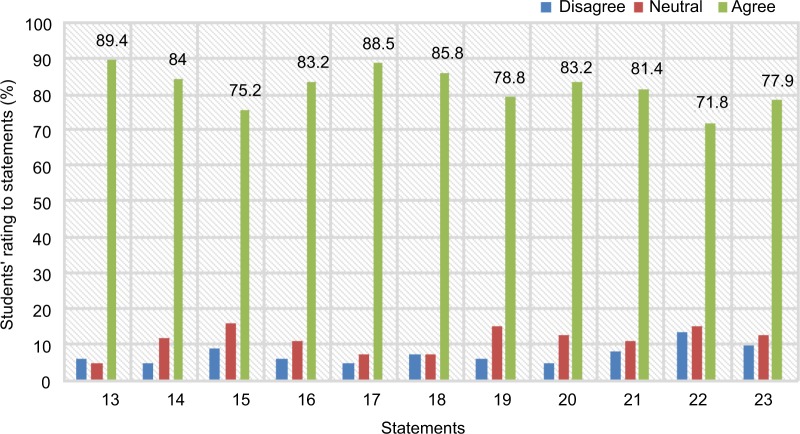
Results: Approximately 85.5% participants agreed that PBL is an interesting method of teaching learning. Most of them (86.7%) accepted that PBL is an interactive and a mutual learning method and improves self-directed learning (83.2%). Although 78% had recommended it better than lecture, many (54.2%) pointed it out as a time-consuming method. The participants were also highly rated (80.5%) to the statement - the tutor's role in enhancing the constructive active learning and maintaining good intra-personal behavior.
Conclusion: Student's attitude toward PBL was positive. They highly appreciated the roles of a tutor as facilitators and motivators for proper activities in PBL session. PBL sessions were considered effective in improving students professional knowledge and refining problem-solving and self-directed learning skills along with enriching teamwork experience.
Keywords: PBL; role of tutor; student’s perception; teaching learning method.
Conflict of interest statement
Disclosure The authors report no conflicts of interest in this work.
Figures
Comment in
-
Problem-based learning as an efficient teaching modality: improvements proposed by UK medical students.Adv Med Educ Pract. 2018 Sep 12;9:657-660. doi: 10.2147/AMEP.S176178. eCollection 2018. Adv Med Educ Pract. 2018. PMID: 30254505 Free PMC article. No abstract available.
References
-
- Barrows HS. Problem-based learning in medicine and beyond: a brief overview. In: Wilkerson L, Gilselaers H, editors. Bringing Problem-based Learning to Higher Education: Theory and Practice. San Fran-cisco, CA: Jossey Bass Inc; 1996.
-
- Yew EH, Schmidt HG. Evidence for constructive, self-regulatory, and collaborative processes in problem-based learning. Adv Health Sci Educ Theory Pract. 2009;14(2):251–273. - PubMed
-
- Dixit H, Sharma SC. The MBBS Programme in Nepal. J Nepal Med Assoc. 2002;41:341–58.
-
- Pradhan B, Ranjit E, Ghimire MR, Dixit H. History of problem based learning in Nepal and experiences at Kathmandu Medical College. J Kathmandu Med Coll. 2012;1(1):37–44.
-
-
Jane in Nepal: Contrasting PBL Tutor Training at PAHS (Nepal) and at the IMP (Canada). Blog.
-
LinkOut - more resources
Full Text Sources
Other Literature Sources
