. 2018 Apr 20;9(30):21156-21165.
doi: 10.18632/oncotarget.24986.

LpMab-23-recognizing cancer-type podoplanin is a novel predictor for a poor prognosis of early stage tongue cancer

Affiliations

LpMab-23-recognizing cancer-type podoplanin is a novel predictor for a poor prognosis of early stage tongue cancer

Akihiro Miyazaki et al. Oncotarget. .

Abstract

Purpose: We report that the reactivity of a novel monoclonal antibody LpMab-23 for human cancer-type podoplanin (PDPN) is a predictor for a poor prognosis of tongue cancer.

Patients and methods: The association between LpMab-23-recognizing cancer-type PDPN expression and clinical/pathological features were analyzed on 60 patients with stage I and II tongue cancer treated with transoral resection of the primary tumor.

Results: In the mode of invasion, the LpMab-23-dull/negative cases were significantly larger in cases with low-grade malignancies and without late cervical lymph node metastasis, than in cases with high-grade malignancies and the metastasis. In the high-grade malignant cases, LpMab-23-positive cases were significantly larger than LpMab-23-dull/negative cases. The Kaplan-Meier curves of the five-year metastasis-free survival rate (MFS) were significantly lower in the LpMab-23 positive patients than in LpMab-23 dull/negative patients. The LpMab-23-dull/negative cases showed the highest MFS in all of the clinical/pathological features and particularly, the MFS of the LpMab-23 positive cases decreased to less than 60% in the first year. In the Cox proportional hazard regression models a comparison of the numbers of LpMab-23 dull/negative with positive cases showed the highest hazard ratio with statistical significance in all of the clinical/pathological features.

Conclusions: LpMab-23 positive cases may be considered to present a useful predictor of poor prognosis for early stage tongue cancer.

Keywords: LpMab-23; antibody; podoplanin; predictor; tongue cancer.


Conflict of interest statement

CONFLICTS OF INTEREST The authors indicate no potential conflicts of interest.

Figures
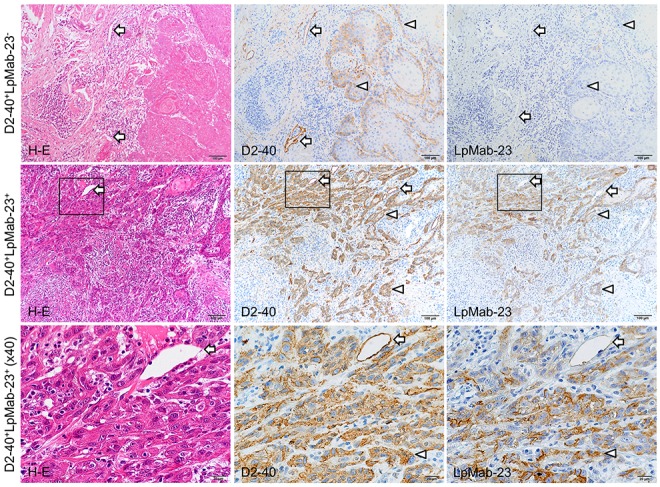
Figure 1
Figure 1. D2-40-positive and LpMab-23-negative/positive early stage tongue squamous cell carcinoma
These sections are visualized by DAB staining for reaction products with D2-40 to normal PDPN and with LpMab-23 for the cancer-specific PDPN with Hematoxylin staining of nuclei (blue). The top row shows panels of a D2-40-positive (middle panel) and LpMab-23-negative (right panel) tongue carcinoma (65 year old female, Grade 1, YK-2, no recurrence, no metastasis). Lymphatic vessels are reacted with D2-40 (arrows) and cells of the cancer at the margins are also D2-40 positive on the cell membrane (arrowheads) while in the adjacent section, neither cancer cells nor lymphatic vessels are LpMab-23 negative (arrowheads). Bars: 100 μm. The middle row shows panels of a D2-40 and LpMab-23-double positive tongue carcinoma (57 year old female, Grade 1, YK-4C, no recurrence, with metastasis). Lymphatic vessels are reacted with D2-40 (arrows) but not with LpMab-23. Almost all of the invasive cancer cells are D2-40 positive with many lymphocyte infiltrations similar to LpMab-23 (arrowheads). Bars: 100 μm. The bottom row shows magnified views of the box highlighted in each panel of the middle row. Almost all cancer cells have both membrane and cytoplasm with the diffusion of LpMab-23 reaction products. Bars: 20 μm.
Figure 2
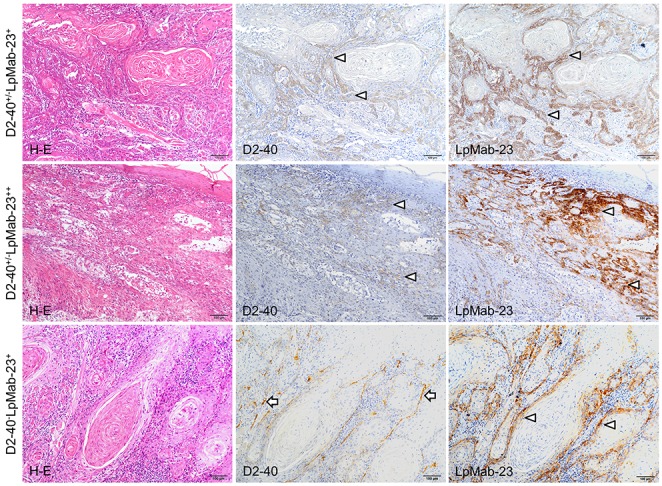
Figure 2. D2-40 dull/negative and LpMab-23 positive early stage tongue squamous cell carcinoma
The sections are visualized by DAB staining for reaction products with D2-40 to normal PDPN and LpMab-23 for the cancer-specific PDPN with Hematoxylin staining of nuclei (blue). The top row shows panels of a D2-40 dull (middle) and LpMab-23-positive (right) tongue carcinoma (77 year old female, Grade 2, YK-4C, no recurrence, with metastasis). The cells of the cancer at the margins are weakly reacted with D2-40 (arrows) while in the adjacent section, the reaction with LpMab-23 (arrows) is stronger than that with D2-40. Bars: 100 μm. The middle row shows panels of a D2-40 dull and LpMab-23-positive tongue carcinoma (79 year old female, Grade 1, YK-4C, no recurrence, with metastasis). The invasive cancer cells showed few reactions with D2-40 (arrows) while in the adjacent section the cells showed strong reaction with LpMab-23 (arrows). Bars: 100 μm. The bottom row shows panels of a D2-40 negative and LpMab-23 positive-tongue carcinoma (77 year old female, Grade 2, YK-4C, no recurrence, with lymph node metastasis). The invasive cancer cells show no reactions with D2-40 while there is lymphangiogenesis with much D2-40-positive lymphatic vasculature found among cancer cells (arrowheads). In the adjacent section the cancer cells show a reaction with LpMab-23 (arrows). Bars: 100 μm.
Figure 3
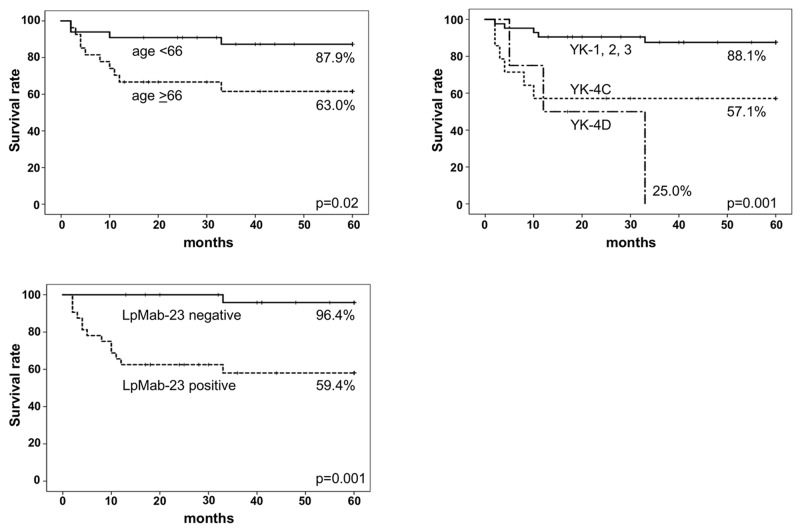
Figure 3. Five-year metastasis-free survival curves (MFS)
The Kaplan–Meier curves of MFS were significantly lower in patients aged 66 years or older (n=27) than in the patients with under 66 years of age (n=33)(p=0.02), lower in the patients with mode of invasion YK-4C (n=14) and 4D (n=4) than in the patients with mode of invasion YK-1/2/3 (n=42)(p=0.001), lower in the patients with LpMab-23 positive (n=32) than in the patients with LpMab-23 negative (n=28)(p=0.001). Particularly, the survival rate of patients with LpMab-23 positive decreased to less than 60% in the first year during 60 months of follow-up (long-rank) as well as the patients with the mode of invasion YK-4C and 4D.

References

    1. Kato Y, Kaneko M, Sata M, Fujita N, Tsuruo T, Osawa M. Enhanced expression of Aggrus (T1alpha/podoplanin), a platelet-aggregation-inducing factor in lung squamous cell carcinoma. Tumour Biol. 2005;26:195–200. - PubMed
    1. Martín-Villar E, Scholl FG, Gamallo C, Yurrita MM, Muñoz-Guerra M, Cruces J, Quintanilla M. Characterization of human PA2.26 antigen (T1alpha-2, podoplanin), a small membrane mucin induced in oral squamous cell carcinomas. Int J Cancer. 2005;113:899–910. - PubMed
    1. Schacht V, Dadras SS, Johnson LA, Jackson DG, Hong YK, Detmar M. Up-regulation of the lymphatic marker podoplanin, a mucin-type transmembrane glycoprotein, in human squamous cell carcinomas and germ cell tumors. Am J Pathol. 2005;166:913–21. - PMC - PubMed
    1. Chuang WY, Yeh CJ, Wu YC, Chao YK, Liu YH, Tseng CK, Chang HK, Liu HP, Hsueh C. Tumor cell expression of podoplanin correlates with nodal metastasis in esophageal squamous cell carcinoma. Histol Histopathol. 2009;24:1021–27. - PubMed
    1. Shimada Y, Ishii G, Nagai K, Atsumi N, Fujii S, Yamada A, Yamane Y, Hishida T, Nishimura M, Yoshida J, Ikeda N, Ochiai A. Expression of podoplanin, CD44, and p63 in squamous cell carcinoma of the lung. Cancer Sci. 2009;100:2054–59. - PMC - PubMed

LinkOut - more resources