Hospital-based violence intervention programs targeting adult populations: an Eastern Association for the Surgery of Trauma evidence-based review
- PMID: 29766064
- PMCID: PMC5891700
- DOI: 10.1136/tsaco-2016-000024
Hospital-based violence intervention programs targeting adult populations: an Eastern Association for the Surgery of Trauma evidence-based review
Abstract
Background: Violent injury and reinjury take a devastating toll on distressed communities. Many trauma centers have created hospital-based violent injury prevention programs (HVIP) to address psychosocial, educational, and mental health needs of injured patients that may contribute to reinjury.
Objectives: To evaluate the overall effectiveness of HVIPs for violent injury prevention. We performed an evidence-based review to answer the following population, intervention, comparator, outcomes (PICO) question: Are HVIPs attending to adult patients (age 18+) treated for intentional injury more effective than the usual care at preventing: intentional violent reinjury and/or death; arrest and/or incarceration; substance abuse and/or mental issues; job and/or school attainment?
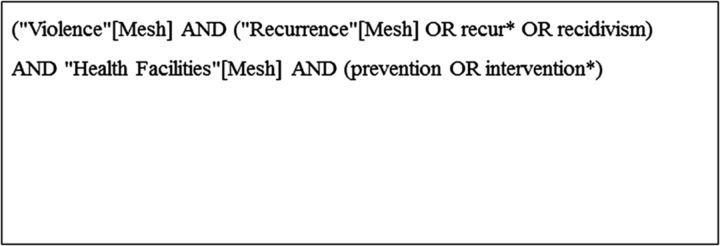
Data sources: PubMed, Web of Science, Google Scholar, and the Cochrane Library were queried for salient articles by a professional librarian on two separate occasions, and related articles were identified from references.
Study eligibility criteria participants interventions: Eligible studies examined adult patients treated for intentional injury in a hospital-based violence prevention program compared to a control group.
Study appraisal and synthesis methods: We used the Grading of Recommendations Assessment, Development, and Evaluation methodology to assess the breadth and quality of the evidence.
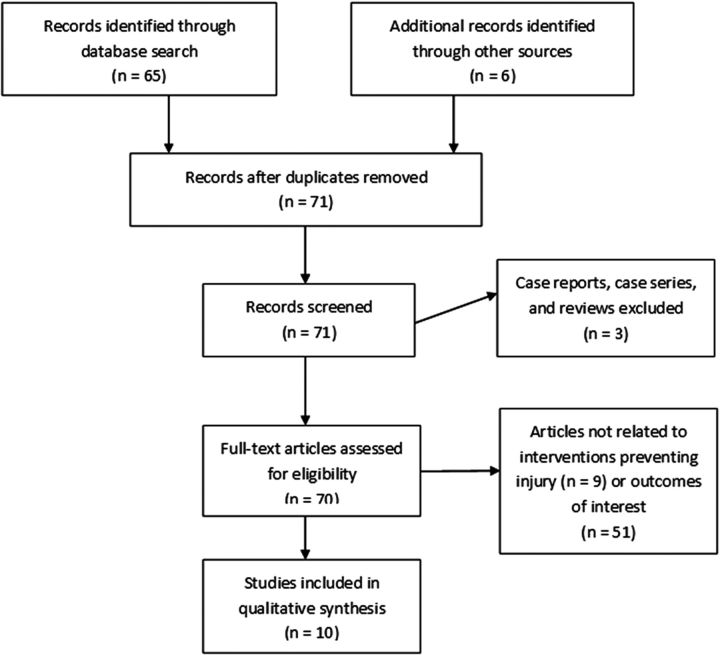
Results: 71 articles were identified. After discarding duplicates, reviews, and those articles that did not address our PICO questions, we ultimately reviewed 10 articles. We found insufficient evidence to recommend adult-focused HVIP interventions.
Limitations: There was a relative paucity of data, and available studies were limited by self-selection bias and small sample sizes.
Conclusions: We make no recommendation with respect to adult-focused HVIP interventions.
Keywords: injury prevention; violence.
Conflict of interest statement
Competing interests: None declared.
Figures
Comment in
-
Hospital-based violence intervention: an emerging practice based on public health principles.Trauma Surg Acute Care Open. 2016 Nov 2;1(1):e000050. doi: 10.1136/tsaco-2016-000050. eCollection 2016. Trauma Surg Acute Care Open. 2016. PMID: 29767023 Free PMC article. No abstract available.
References
-
- Cohn D, Taylor P, Lopez MH, Gallagher CA, Parker K, Maass KT. Gun homicide rate down 49% since 1993 peak; public unaware. Washington: (DC: ): Pew Research Center, 2013. http://www.pewsocialtrends.org/2013/05/07/gun-homicide-rate-down-49-sinc... (accessed Dec 2015).
-
- Papachristos AV, Wildeman C, Roberto E. Tragic, but not random: the social contagion of nonfatal gunshot injuries. Soc Sci Med 2015;125: 139–50. doi:10.1016/j.socscimed.2014.01.056 - DOI - PubMed
-
- Corbin TJ, Purtle J, Rich LJ, Rich JA, Adams EJ, Yee G, Bloom SL. The prevalence of trauma and childhood adversity in an urban, hospital-based violence intervention program. J Health Care Poor Underserved 2013;24:1021–30. doi:10.1353/hpu.2013.0120 - DOI - PubMed
-
- Purtle J, Dicker R, Cooper C, Corbin T, Greene MB, Marks A, Creaser D, Topp D, Moreland D. Hospital-based violence intervention programs save lives and money. J Trauma Acute Care Surg 2013;75:331–3. doi:10.1097/TA.0b013e318294f518 - DOI - PubMed
-
- Liebschutz J, Schwartz S, Hoyte J, Conoscenti L, Christian AB Sr, Muhammad L, Harper D, James T. A chasm between injury and care: experiences of black male victims of violence. J Trauma 2010;69:1372–8. http://dx.doi.org/10.1097/TA.0b013e3181e74fcf - DOI - PMC - PubMed
LinkOut - more resources
Full Text Sources
Other Literature Sources