Improving life expectancy: A 'broken neck' doesn't have to be a terminal diagnosis for the elderly
- PMID: 29766142
- PMCID: PMC5887759
- DOI: 10.1136/tsaco-2018-000174
Improving life expectancy: A 'broken neck' doesn't have to be a terminal diagnosis for the elderly
Abstract
Background: Elderly patients with cervical spine fractures require optimal care. Treatment with a cervical collar or halo instead of surgical fixation may increase mortality. This investigation intends to describe the life expectancy after injury and evaluate the impact of surgical intervention on mortality.
Methods: Patients ≥65 years, with traumatic cervical spine fractures without cord injury were identified in the 1995-2009 California Office of Statewide Health and Planning database. Those with halo placement or surgical spine fixation were identified. Primary outcome was death, studied at the initial admission, 30 days, 1 year, and the entire study period. Univariate and multivariate regressions were performed to identify predictors of death. Kaplan-Meier survival curves were used to describe life expectancy after injury.
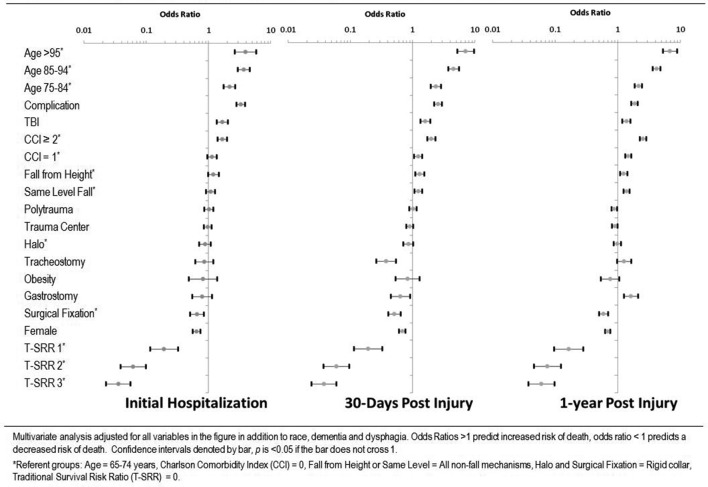
Results: 10 938 patients were identified. Mortality rate was 10% during the initial admission, 28% at 1 year and 50% during the entire study period. A halo was placed in 14% of patients and 12% underwent surgical fixation. Mortality rates during the initial admission were 11% for patients without an intervention, 7% with halo placement and 6% with surgical fixation; at 1 year, these increased to 30%, 26% and 19%, respectively. At 1 year, more than one in four patients above 75 years of age will die.At 1 year spine fixation, female gender and admission to a trauma center predicted a lower risk of death at 1 year (OR 0.59, 0.68; p<0.001 and OR 0.89; p=0.02, respectively). Having a complication, fall mechanism, and traumatic brain injury (OR 1.84, 1.33, 1.37; p<0.001, respectively) were predictors of a higher risk of death. Halo use had no impact on death at 1 year (OR 0.98; p=0.77).
Discussion: Mortality rates after cervical spine fracture in the elderly is high. Surgical fixation is associated with improved survival; remaining true after adjusting for age and comorbidities; suggesting that surgical fixation may improve outcomes in the elderly.
Level of evidence: Level IV.
Keywords: cervical spine; elderly patients; outcomes research.
Conflict of interest statement
Competing interests: None declared.
Figures

References
-
- Vincent GK, Velkoff VA. The next four decades. The older population in the United States: 2010 to 2050 : Population estimates and projections: U.S. Department of Commerce Economics and Statistics Administration USCB, 2010:25–1138.
-
- Committee on Trauma, American College of Surgeons. National trauma data bank annual report 2015. https://www.facs.org/~/media/files/quality%20programs/trauma/ntdb/ntdb%2...
-
- Horn EM, Theodore N, Feiz-Erfan I, Lekovic GP, Dickman CA, Sonntag VK. Complications of halo fixation in the elderly. J Neurosurg Spine 2006;5:46–9. doi:10.3171/spi.2006.5.1.46 - DOI - PubMed
-
- Garfin SR, Botte MJ, Waters RL, Nickel VL. Complications in the use of the halo fixation device. J Bone Joint Surg Am 1986;68:320–5. doi:10.2106/00004623-198668030-00002 - DOI - PubMed
-
- Smith HE, Kerr SM, Maltenfort M, Chaudhry S, Norton R, Albert TJ, Harrop J, Hilibrand AS, Anderson DG, Kopjar B, et al. . Early complications of surgical versus conservative treatment of isolated type II odontoid fractures in octogenarians: a retrospective cohort study. J Spinal Disord Tech 2008;21:535–9. doi:10.1097/BSD.0b013e318163570b - DOI - PubMed
LinkOut - more resources
Full Text Sources
Other Literature Sources
Research Materials