


Social media in the REI clinic: what do patients want?
- PMID: 29766400
- PMCID: PMC6063835
- DOI: 10.1007/s10815-018-1189-2
Social media in the REI clinic: what do patients want?
Abstract
Purpose: To elicit patient preferences for social media utilization and content in the infertility clinic.
Methods: This was a cross-sectional survey study conducted in three US fertility practices. Women presenting to the infertility clinic for an initial or return visit were offered an anonymous voluntary social media survey. The survey elicited patient perception of whether social media use in the infertility clinic is beneficial, and preferences regarding topics of interest.
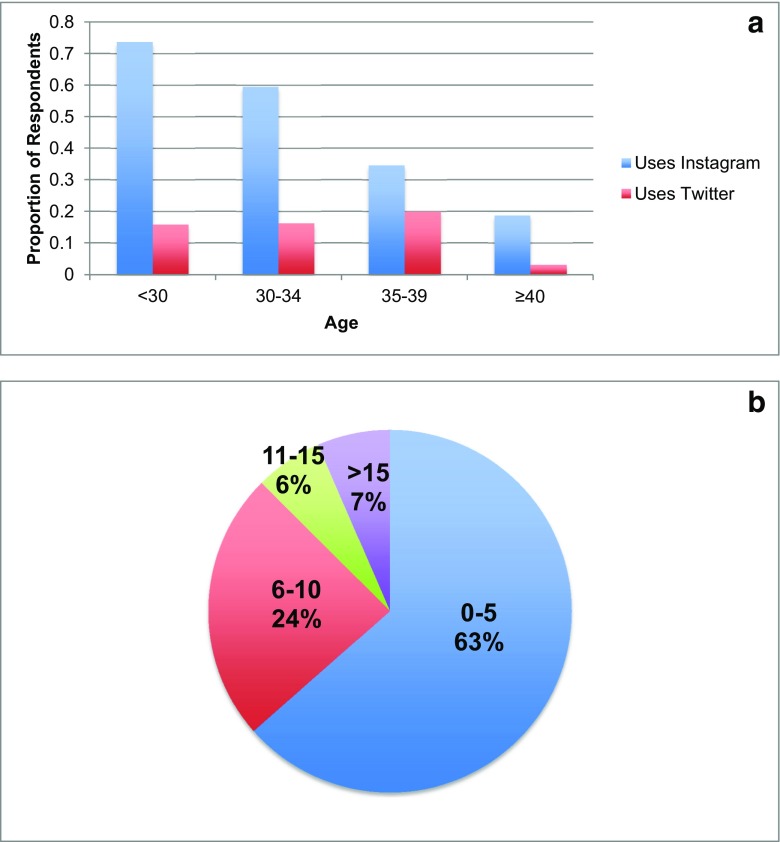
Results: A total of 244 surveys were collected during the study period, of which 54.5% were complete. Instagram is a more popular platform than Twitter across all age groups. Use of both platforms varies by age, with patients ≥ 40 less likely to be active users. The majority of respondents felt that social media provided benefit to the patient experience in the infertility clinic (79.9%). "Education regarding infertility testing and treatment" and "Myths and Facts about infertility" were the most popular topics for potential posts, with 93.4 and 92.0% of patients endorsing interest respectively. The least popular topic was "Newborn photos and birth announcements," with only 47.4% endorsing interest. A little over half of respondents (56.3%) would feel comfortable with the clinic posting a picture of their infant. The vast majority of patients (96.2%) feel comfortable communicating electronically with their infertility clinic.
Conclusion: Patients are interested in the use of social media as a forum for patient education and support in the infertility clinic. Patient preferences regarding post topics should be carefully considered.
Keywords: In vitro fertilization; Infertility; Internet; Patient outreach; Social media.
Conflict of interest statement
Conflict of interest
The authors declare that they have no conflicts of interest.
Ethical approval
All procedures performed in studies involving human participants were in accordance with the ethical standards of the institutional and/or national research committee and with the 1964 Helsinki Declaration and its later amendments or comparable ethical standards. For this type of study, formal consent is not required.
Figures
References
-
- Most famous social network sites worldwide as of August 2017, ranked by number of active users. . 2017. https://www.statista.com/statistics/272014/global-social-networks-ranked.... Accessed 30 Aug 2017.
-
- Center PR. Social media update 2016 2016 http://www.pewinternet.org/2016/11/11/social-media-update-2016/. Accessed 30 Aug 2017.
-
- Stewart JB. Facebook has 50 minutes of your time each day. It wants more. New York Times, 2016. https://www.nytimes.com/2016/05/06/business/facebook-bends-the-rules-of-.... Accessed 28 Aug 2017.
MeSH terms
LinkOut - more resources
Full Text Sources
Other Literature Sources
Medical
Molecular Biology Databases
