. 2018 May 15;23(7):2119-2129.e3.
doi: 10.1016/j.celrep.2018.04.047.

Influenza Virus Mounts a Two-Pronged Attack on Host RNA Polymerase II Transcription

Affiliations

Influenza Virus Mounts a Two-Pronged Attack on Host RNA Polymerase II Transcription

David L V Bauer et al. Cell Rep. .

Abstract

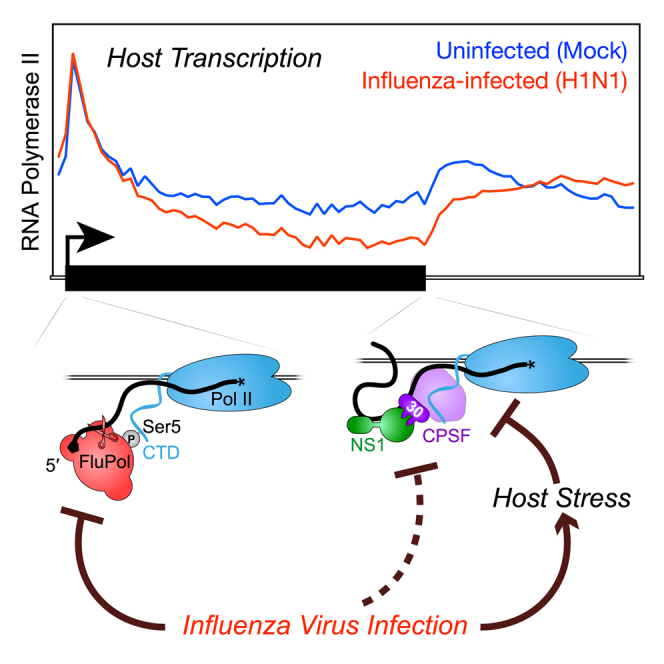
Influenza virus intimately associates with host RNA polymerase II (Pol II) and mRNA processing machinery. Here, we use mammalian native elongating transcript sequencing (mNET-seq) to examine Pol II behavior during viral infection. We show that influenza virus executes a two-pronged attack on host transcription. First, viral infection causes decreased Pol II gene occupancy downstream of transcription start sites. Second, virus-induced cellular stress leads to a catastrophic failure of Pol II termination at poly(A) sites, with transcription often continuing for tens of kilobases. Defective Pol II termination occurs independently of the ability of the viral NS1 protein to interfere with host mRNA processing. Instead, this termination defect is a common effect of diverse cellular stresses and underlies the production of previously reported downstream-of-gene transcripts (DoGs). Our work has implications for understanding not only host-virus interactions but also fundamental aspects of mammalian transcription.

Keywords: DoGs; RNA polymerase II; downstream-of-gene transcripts; influenza; transcription; transcription termination; virus-induced host shutoff.


Figures

None
Graphical abstract
Figure 1
Figure 1
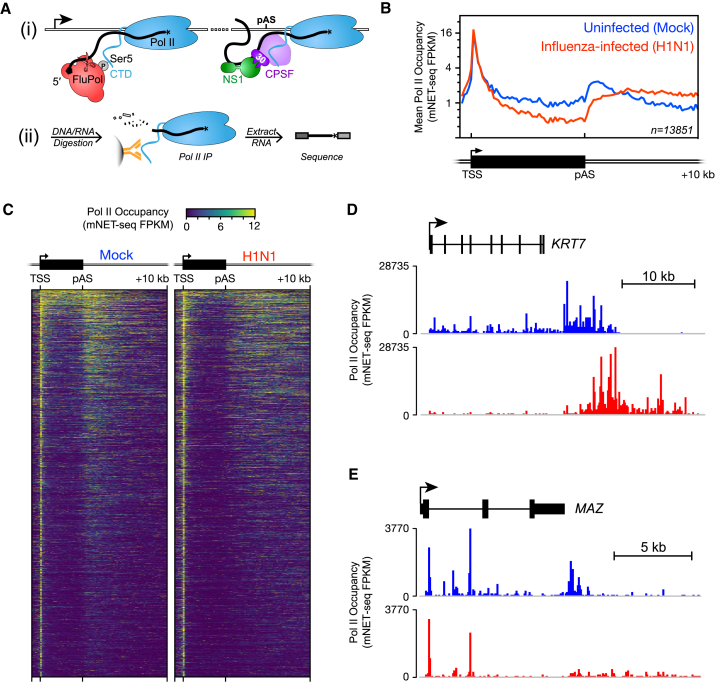
Influenza Virus Infection Dramatically Alters Transcription Dynamics of Host RNA Polymerase II (A) (i) Influenza virus interferes with the host Pol II transcription complex, both at the start of genes where the viral polymerase (FluPol) binds to the Ser5P form of the Pol II CTD to carry out cap snatching, generating capped RNA primers for viral mRNA synthesis, and at the end of genes where the viral NS1 interferes with host 3′ end processing by inhibiting CPSF30. pAS, poly(A) site. (ii) Pol II behavior was profiled genome-wide using mNET-seq (see STAR Methods for details and Figure S1). (B) Meta-profile of Pol II occupancy on all non-overlapping protein-coding genes (n = 13,851) as measured by mNET-seq shows that influenza virus infection simultaneously results in decreased Pol II occupancy downstream of the transcription start site (TSS), as well as a failure of Pol II to terminate downstream of the poly(A) site. FPKM, fragments per kilobase of transcript per million mapped reads. (C) Heatmap of Pol II occupancy of non-overlapping protein-coding genes, with the TSS and poly(A) site of each gene aligned to each other, as illustrated at the top of the panel. Each horizontal line represents a single gene. (D and E) mNET-seq profiles of Pol II occupancy along protein-coding genes KRT7 (D) and MAZ (E). Downstream unexpressed genes (KRT87P and PRRT2) are not shown in the annotation. In (B)–(E), data shown are from a single, representative biological replicate (see Figures S1B–S1D and Table S1 for comparison). See also Figure S1.
Figure 2
Figure 2
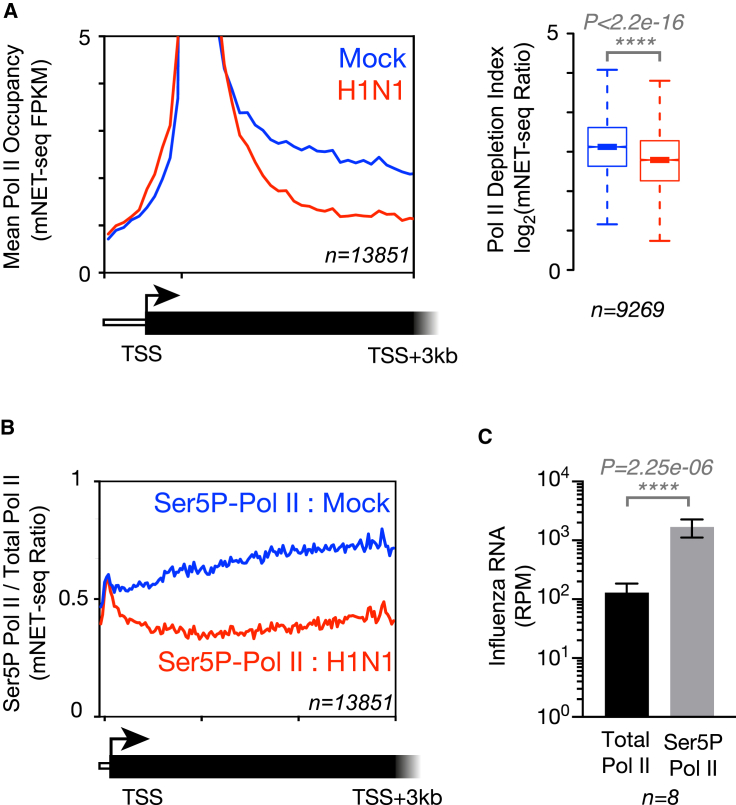
Influenza Virus Infection Causes Decreased Host Pol II Occupancy in Gene Bodies Downstream of Transcription Start Sites. (A) Meta-profile of Pol II occupancy on non-overlapping protein-coding genes shows that Pol II is depleted from gene bodies downstream of transcription start sites (TSSs). Note that the y axis has been enlarged to show detail and that the full height of the profile at the TSS is shown in Figure 1B. Calculation of a Pol II depletion index (see STAR Methods) for each expressed gene and statistical analysis shows a significant depletion of Pol II in gene bodies downstream of the TSS during influenza virus infection. (B) Meta-profile comparing the occupancy of serine 5 phosphorylated CTD isoform of Pol II (Ser5P-Pol II) with levels of total Pol II. The profiles show specific reduction of Ser5P-Pol II downstream of the TSS during influenza virus infection. (C) Levels of the eight influenza viral RNA segments co-immunoprecipitating with Ser5P-Pol II relative to levels with total Pol II are more than 1,000-fold higher as measured by mNET-seq. This is consistent with FluPol specifically binding Ser5P-Pol II to carry out cap snatching (Lukarska et al., 2017). Error bars indicate SD among the eight viral RNA segments. Data shown are from a single, representative biological replicate. See also Figure S2.
Figure 3
Figure 3
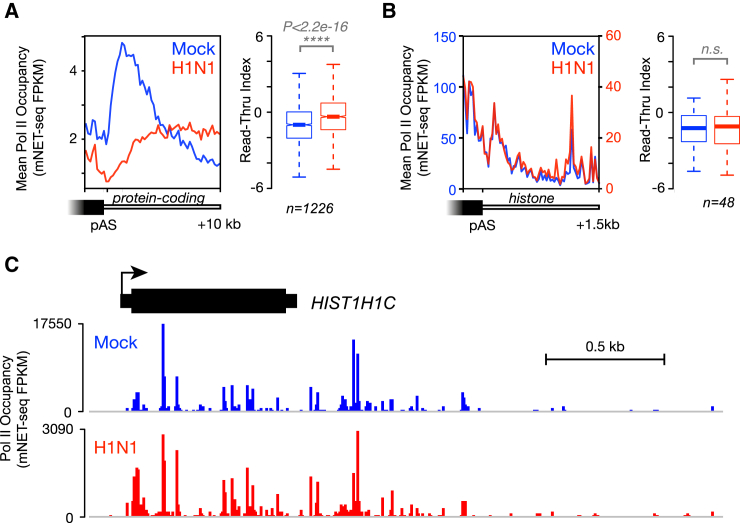
Pol II Fails to Terminate Downstream of Protein-Coding Genes During Influenza Virus Infection (A) Meta-profiles of Pol II occupancy at the 3′ end of expressed protein-coding genes with a single poly(A) site as well as statistical analysis of Pol II read-through on each gene (read-through index; see STAR Methods) show that there is a significant defect in Pol II termination during influenza virus infection. (B) Meta-profiles of Pol II occupancy at the 3′ end of histone genes and statistical analysis of histone gene read-through indices show that Pol II termination is not affected downstream of histone genes, which are processed differently to canonical mRNAs (Kolev and Steitz, 2005). Although overall levels of Pol II occupancy on histone genes drop during influenza virus infection, the pattern of Pol II behavior remains the same. Note that the meta-profile y axis scales for Mock (left, blue) and H1N1 (right, red) differ. (C) mNET-seq profile of Pol II occupancy along a histone gene, HIST1H1C. Data shown are from a single, representative biological replicate.
Figure 4
Figure 4
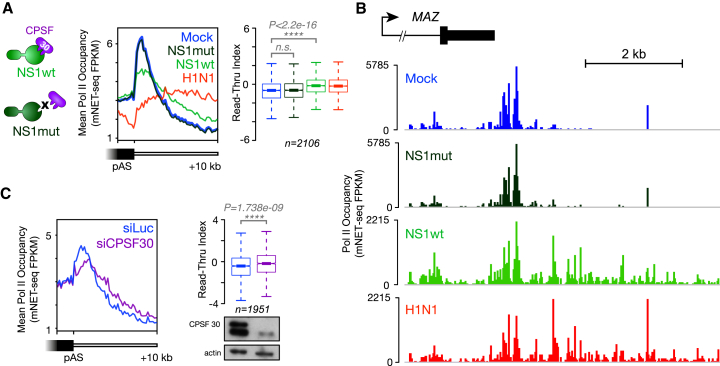
The Influenza Virus NS1 Protein Induces a Host Pol II Termination Defect (A) Induced expression of the viral NS1 protein (NS1wt) or a CPSF30-binding mutant (NS1mut) in HEK293 cells was compared with influenza virus infection (H1N1) or uninduced and uninfected cells (Mock). Meta-profiles of Pol II occupancy at the 3′ end of expressed protein-coding genes with a single poly(A) site as well as statistical analysis of Pol II read-through on each gene reveal that the viral NS1 protein alone induces a Pol II termination defect downstream of poly(A) sites. Note that in contrast to viral infection, NS1 expression does not deplete Pol II in gene bodies, as reflected by the difference in baseline Pol II occupancy prior to the poly(A) site. (B) mNET-seq profiles of Pol II occupancy at the 3′ end of a protein-coding gene, MAZ. The unexpressed downstream PRRT2 gene is not shown in the annotation. (C) siRNA knockdown of CPSF30 also produces a Pol II termination defect similar to NS1 protein expression. The meta-profiles of Pol II occupancy at the 3′ end of expressed protein-coding genes with a single poly(A) site are shown, as well as statistical analysis of Pol II read-through on each gene are shown, and a western blot (see STAR Methods) confirming successful CPSF30 knockdown. Data shown are from a single, representative biological replicate.
Figure 5
Figure 5
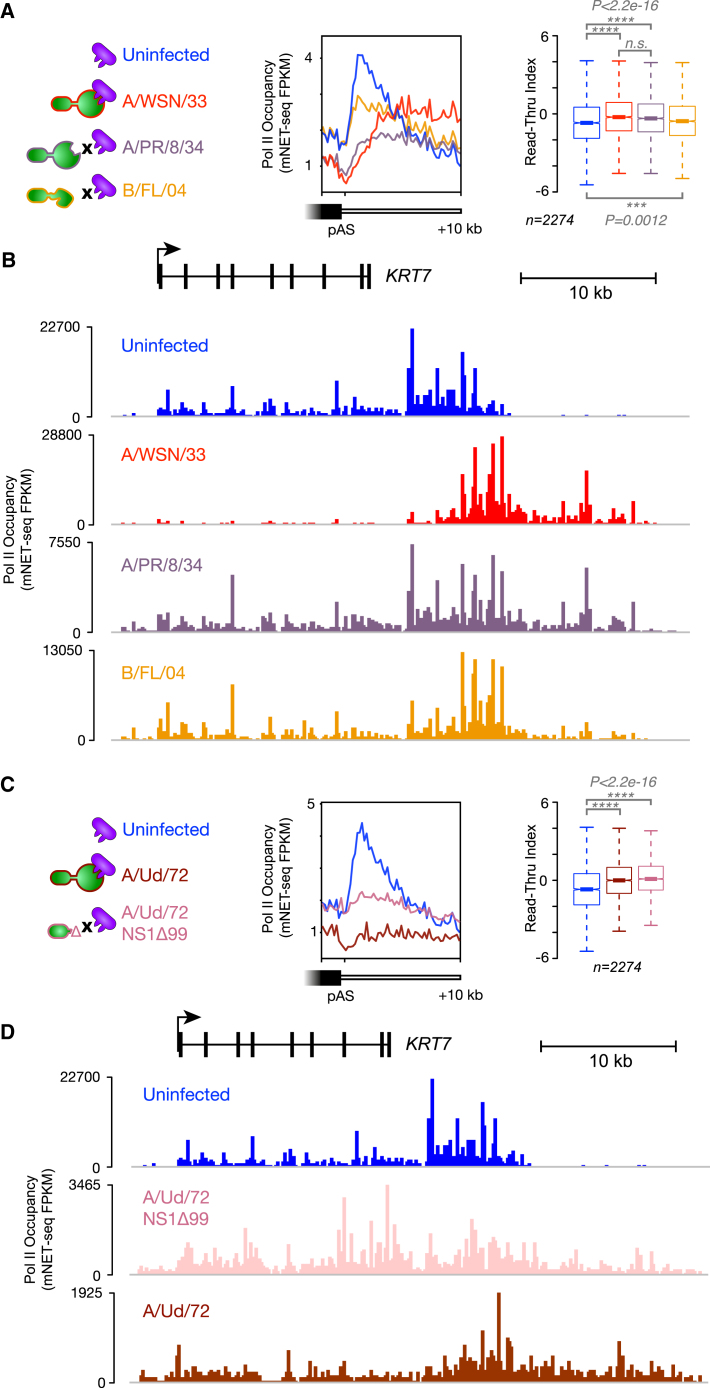
Influenza Virus Infection Causes a Host Pol II Termination Defect Independently of NS1-CPSF30 Interaction (A) The closely related H1N1 strains (A/WSN/33 and A/PR/8/34) encode NS1 proteins that differ in the ability of their C-terminal effector domains to bind CPSF30. Evolutionarily distinct influenza B viruses, including B/Florida/04/2006 (B/FL/04), encode an unrelated effector domain that does not bind CPSF30. Meta-profiles of Pol II occupancy at the 3′ end of expressed protein-coding genes with a single poly(A) site as well as statistical analysis of Pol II read-through on each gene during viral infection show that all three viruses induce a significant failure of Pol II to terminate downstream of poly(A) sites. (B) mNET-seq profiles of Pol II occupancy at the 3′ end of a protein-coding gene, KRT7. The unexpressed downstream gene, KRT87P, is not shown in the annotation. (C) The H3N2 influenza virus (A/Udorn/72) encodes an NS1 protein with an effector domain that binds CPSF30. Infections were performed in parallel with a mutant virus of the same strain in which the NS1 protein is truncated to remove the effector domain (NS1Δ99). Meta-profiles of Pol II occupancy at the 3′ end of expressed protein-coding genes with a single poly(A) site as well as statistical analysis of Pol II read-through on each gene during viral infection show that both the wild-type and the mutant viruses induce a strong termination defect. (D) mNET-seq profiles of Pol II occupancy during H3N2 viral infection at the 3′ end of a protein-coding gene, KRT7. The unexpressed downstream gene, KRT87P, is not shown in the annotation. Data shown are from a single mNET-seq biological replicate. See also Figure S3.
Figure 6
Figure 6
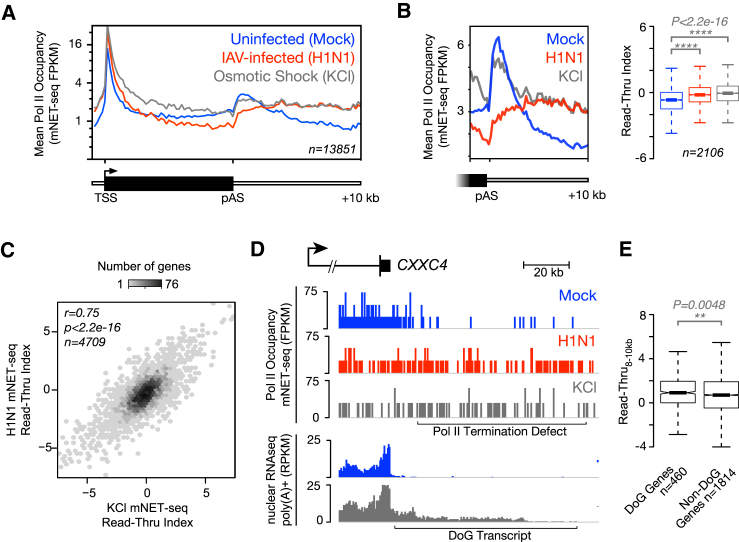
Pol II Termination Defects During Influenza Virus Infection and Osmotic Shock Are Linked to Downstream-of-Gene Transcript Production (A) Meta-profiles of Pol II occupancy on all non-overlapping protein-coding genes (n = 13,851) comparing influenza virus infection and osmotic shock. Osmotic shock does not cause Pol II to be depleted in gene bodies, but it causes a failure of Pol II to terminate downstream of the poly(A) site that appears markedly similar to that during influenza virus infection. (B) Meta-profiles of Pol II occupancy at the 3′ end of expressed protein-coding genes with a single poly(A) site as well as statistical analysis of Pol II read-through on each gene demonstrate that both osmotic shock and influenza virus infection cause a significant amount of read-through transcription. (C) Comparison of the read-through index of each gene during influenza virus infection to the read-through index of each gene during osmotic shock shows that the two indices are correlated (Pearson’s r = 0.75). (D) mNET-seq profiles of Pol II occupancy at the 3′ end of the previously characterized (Vilborg et al., 2015) DoG-producing gene CXXC4 show that regions downstream of genes where Pol II fails to terminate during viral infection and osmotic shock overlap with regions of DoG production. DoGs are produced during influenza virus infection (see Figure S4). (E) Genes previously reported to produce DoGs during osmotic shock tend to have a greater extent of Pol II read-through during influenza virus infection, reflected in a significant difference in their read-through indices 8–10 kb downstream of their poly(A) site. Data shown are from a single, representative biological replicate. See also Figure S4.

References

    1. Bercovich-Kinori A., Tai J., Gelbart I.A., Shitrit A., Ben-Moshe S., Drori Y., Itzkovitz S., Mandelboim M., Stern-Ginossar N. A systematic view on influenza induced host shutoff. eLife. 2016;5:600. - PMC - PubMed
    1. Brannan K., Kim H., Erickson B., Glover-Cutter K., Kim S., Fong N., Kiemele L., Hansen K., Davis R., Lykke-Andersen J., Bentley D.L. mRNA decapping factors and the exonuclease Xrn2 function in widespread premature termination of RNA polymerase II transcription. Mol. Cell. 2012;46:311–324. - PMC - PubMed
    1. Buratowski S. Connections between mRNA 3′ end processing and transcription termination. Curr. Opin. Cell Biol. 2005;17:257–261. - PubMed
    1. Casañal A., Kumar A., Hill C.H., Easter A.D., Emsley P., Degliesposti G., Gordiyenko Y., Santhanam B., Wolf J., Wiederhold K. Architecture of eukaryotic mRNA 3′-end processing machinery. Science. 2017;358:1056–1059. - PMC - PubMed
    1. Chan A.Y., Vreede F.T., Smith M., Engelhardt O.G., Fodor E. Influenza virus inhibits RNA polymerase II elongation. Virology. 2006;351:210–217. - PubMed

Publication types

Substances

LinkOut - more resources