Review
. 2018 Aug;38(8):1276-1292.
doi: 10.1177/0271678X18776802. Epub 2018 May 17.

The therapeutic potential of the mesenchymal stem cell secretome in ischaemic stroke

Affiliations
Review

The therapeutic potential of the mesenchymal stem cell secretome in ischaemic stroke

Catriona J Cunningham et al. J Cereb Blood Flow Metab. 2018 Aug.

Abstract

Mesenchymal stem cells (MSCs) hold great potential as a regenerative therapy for stroke, leading to increased repair and functional recovery in animal models of cerebral ischaemia. While it was initially hypothesised that cell replacement was an important mechanism of action of MSCs, focus has shifted to their paracrine actions or the so called "bystander" effect. MSCs secrete a wide array of growth factors, chemokines, cytokines and extracellular vesicles, commonly referred to as the MSC secretome. There is evidence suggesting the MSC secretome can promote repair through a number of mechanisms including preventing cell apoptosis, modulating the inflammatory response and promoting endogenous repair mechanisms such as angiogenesis and neurogenesis. In this review, we will discuss the in vitro approaches currently being employed to drive the MSC secretome towards a more anti-inflammatory and regenerative phenotype. We will then examine the role of the secretome in promoting repair and improving recovery in preclinical models of cerebral ischaemia.

Keywords: Cell therapy; mesenchymal stem cell; repair; secretome; stroke.


Figures
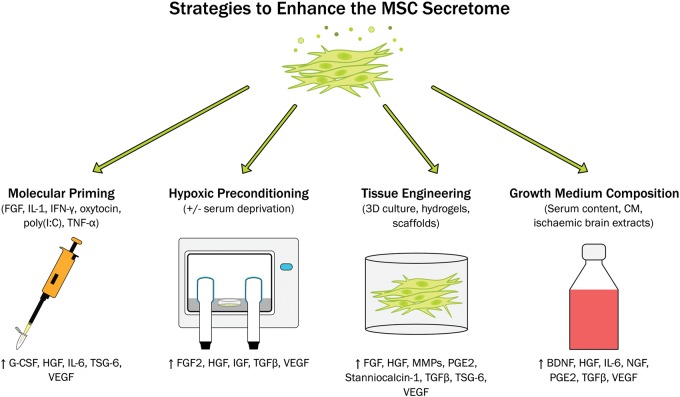
Figure 1.
Figure 1.
Summary of in vitro approaches that have been utilised to enhance the therapeutic potential of mesenchymal stem cell secretome. BDNF: brain-derived neurotrophic factor; FGF: fibroblast growth factor; G-CSF: granulocyte-colony stimulating factor; HGF: hepatocyte growth factor; IFN-γ: interferon gamma; IGF: insulin-like growth factor; IL: interleukin; MMPs: matrix metalloproteinases; NGF: nerve growth factor; PGE2: prostaglandin E2; TGF-β: transforming growth factor beta; TNF-α: tissue necrosis factor alpha; TSG-6: TNF-α–stimulated gene 6 protein; VEGF: vascular endothelial growth factor.
Figure 2.
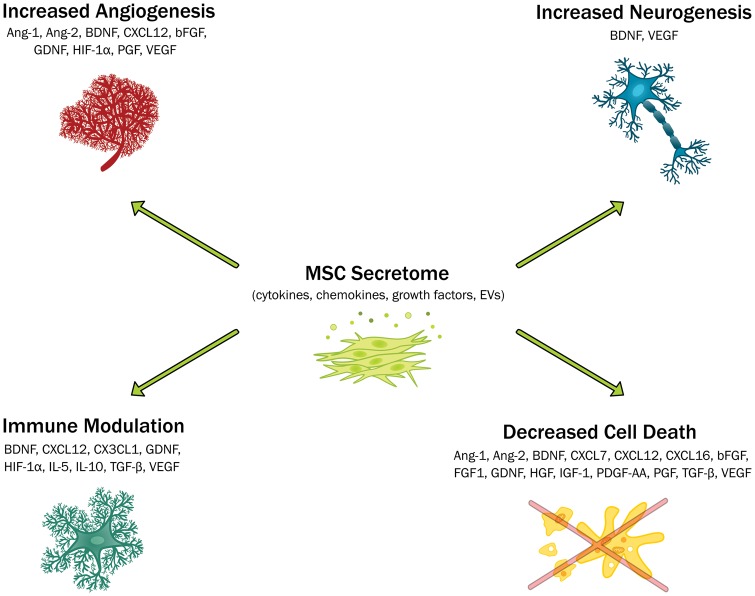
Figure 2.
The role of the mesenchymal stem cell secretome in promoting repair and recovery after ischaemic stroke. The main mechanisms of action are highlighted along with the proposed mediators. Ang: angiopoietin; BDNF: brain-derived neurotrophic factor; CXCL: chemokine C-X-C motif ligand; CX3CR1: CX3C chemokine receptor 1; bFGF: basic fibroblast growth factor; GDNF: glial cell line-derived neurotrophic factor; HGF: hepatocyte growth factor; HIF-1α: Hypoxia-inducible factor 1-alpha; IGF-1: insulin-like growth factor 1; IL: interleukin; PDGF-AA: platelet-derived growth factor AA; PGF: placental growth factor; TGF-β: transforming growth factor beta: VEGF: vascular endothelial growth factor.

References

    1. World Health Organisation. Global status report on noncommunicable diseases. Report, Switzerland: World Health Organisation, 2014.
    1. Feigin VL, Forouzanfar MH, Krishnamurthi R, et al. Global and regional burden of stroke during 1990–2010: findings from the Global Burden of Disease Study 2010. Lancet 2014; 383: 245–255. - PMC - PubMed
    1. Banerjee S, Williamson DA, Habib N, et al. The potential benefit of stem cell therapy after stroke: an update. Vasc Health Risk Manag 2012; 8: 569–580. - PMC - PubMed
    1. McMeekin P, White P, James MA, et al. Estimating the number of UK stroke patients eligible for endovascular thrombectomy. Eur Stroke J 2017; 2: 319–326. - PMC - PubMed
    1. Bianco P, Robey PG, Simmons PJ. Mesenchymal stem cells: revisiting history, concepts, and assays. Cell Stem Cell 2008; 2: 313–319. - PMC - PubMed

Publication types

MeSH terms