Review
. 2018;24(18):2012-2022.
doi: 10.2174/1381612824666180515125654.

Defense Mechanisms Against Acid Exposure by Dental Enamel Formation, Saliva and Pancreatic Juice Production

Affiliations
Review

Defense Mechanisms Against Acid Exposure by Dental Enamel Formation, Saliva and Pancreatic Juice Production

Robert Racz et al. Curr Pharm Des. 2018.

Abstract

The pancreas, the salivary glands and the dental enamel producing ameloblasts have marked developmental, structural and functional similarities. One of the most striking similarities is their bicarbonate-rich secretory product, serving acid neutralization. An important difference between them is that while pancreatic juice and saliva are delivered into a lumen where they can be collected and analyzed, ameloblasts produce locally precipitating hydroxyapatite which cannot be easily studied. Interestingly, the ion and protein secretion by the pancreas, the salivary glands, and maturation ameloblasts are all two-step processes, of course with significant differences too. As they all have to defend against acid exposure by producing extremely large quantities of bicarbonate, the failure of this function leads to deteriorating consequences. The aim of the present review is to describe and characterize the defense mechanisms of the pancreas, the salivary glands and enamel-producing ameloblasts against acid exposure and to compare their functional capabilities to do this by producing bicarbonate.

Keywords: Salivary gland; acid; acinar cell; ameloblast; bicarbonate; defense; dental enamel; ductal cell; pancreas..


Figures

Fig. (1)
Fig. (1)
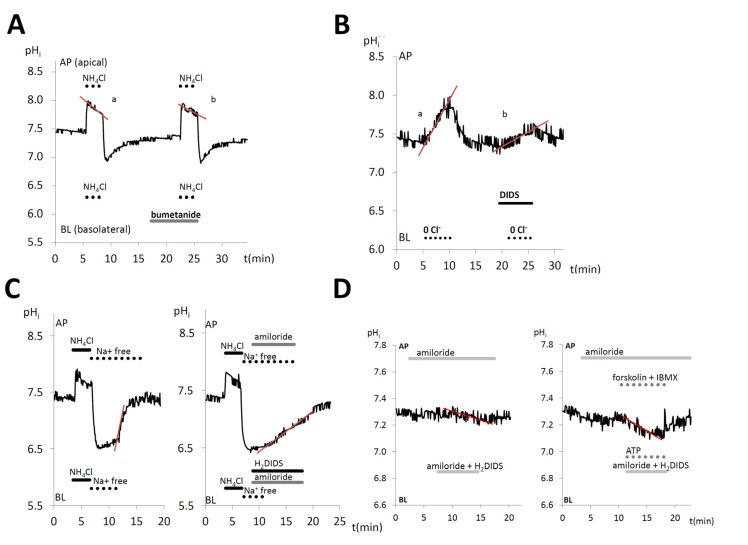
Exemplary records of intracellular pH changes to demonstrate the applicability of molecular physiological microfluorometry for evaluating cellular pH regulatory and bicarbonate transport functions. All experiments shown here were performed in the presence of bicarbonate. (A) Compensation of pHi changes in HAT-7 cells exposed bilaterally to NH4Cl (alkali load). A partial pHi compensation (a) can be observed. Inhibition of pHi compensation can be seen (b) in the presence of basolateral (BL) bumetanide, a selective blocker of the Na+/K+/Cl cotransporter. (B) Chloride withdrawal experiment to investigate anion exchangers. An increase in pHi (a) can be seen in HAT-7 cells upon basolateral Cl withdrawal, most probably as a result of HCO3 influx. After the restoration of BL Cl, pHi returns to the baseline. A smaller pHi increase (b) can be seen when the specific inhibitor, DIDS is administered basolaterally before a second Cl withdrawal, suggesting the presence of a HCO3/Cl exchanger. (C) Sodium withdrawal experiment to investigate bicarbonate/proton transporters. HAT-7 cells are exposed bilaterally to NH4Cl followed by withdrawal of NH4Cl and Na+ (acid load). A fast recovery of pHi can be seen (a) following basolateral restoration of extracellular Na+. A slower pHi recovery (b) can be observed following the restoration of Na+ in the presence of basolateral (BL) amiloride and H2DIDS to block NHE1 exchanger and NBCe1 cotransporter, respectively. (D) The effect of HCO3 secretion can be perceived in the form of a slow intracellular acidification (pHi drop). Basolateral HCO3 uptake in HAT-7 cells was inhibited by simultaneous application of H2DIDS and amiloride. Amiloride was also included in the apical (AP) perfusate to inhibit any apical Na+/H+ exchanger activity. Typical pHi traces obtained in unstimulated control conditions (a), and in cells that were stimulated with ATP, forskolin, and 3-isobutyl-1-methylxanthine (IBMX) (b).
Fig. (2)
Fig. (2)
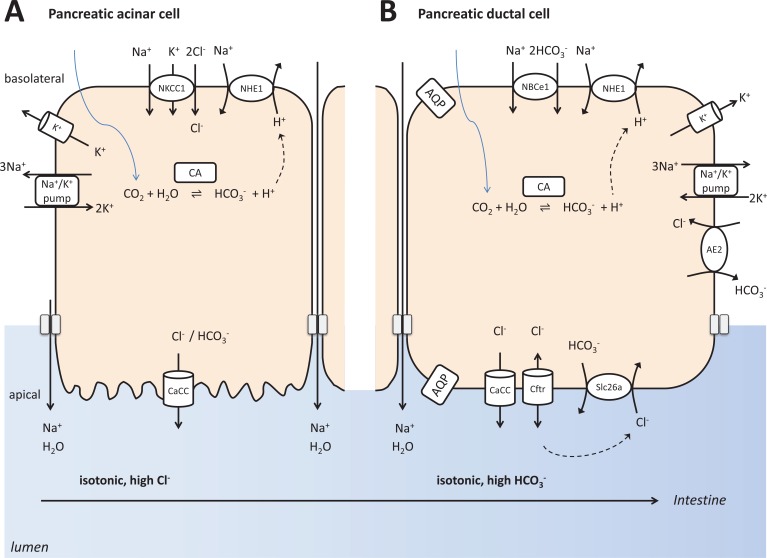
Simplified model depicting pancreatic ductal and acinar fluid, bicarbonate and electrolyte secretion. The bottom of the figure shows that pancreas secretes bicarbonate to neutralize acidity in the intestinal lumen. (A) Pancreatic acinar cells secrete numerous digestive proteins. In addition, these cells secrete an isotonic fluid, rich in NaCl. The main mechanism behind is the transcellular, vectorial transport of Cl for which the Na+/K+/Cl cotransporter mediates the basolateral Cl uptake in the expense of the Na+/K+ ATPase generated Na+ gradient. Apical membrane Cl channels contribute to the luminal secretion of Cl down its electrochemical gradient driven by the intracellular Cl accumulation produced by basolateral Cl uptake. Opening of basolateral K+ channels serves to keep electrochemical neutrality when Cl leaves the cell apically. Apical Cl- transport also results in paracellular Na+ passage through tight junctions toward the lumen. Water follows NaCl passively also through tight junctions. (B) Pancreatic duct cells secrete an isotonic, fluid having very high bicarbonate concentration. The basolateral bicarbonate uptake is achieved by the inward Na+-HCO3- cotransporter and the activity of carbonic anhydrase supported by proton extrusion through Na+/H+ exchangers. Apical bicarbonate secretion is mediated by cystic fibrosis transmembrane conductance regulator (CFTR) and by HCO3/Cl exchangers of the SLC26 family. CFTR conducts not only Cl but also bicarbonate at a lesser extent. The necessary Cl recycling is facilitated by direct interactions between CFTR and SLC26 exchangers. Importantly, there is no or very little Na+/K+/Cl cotransporter activity in pancreatic ducts, therefore, intracellular Cl concentration is low. As a result, pancreatic juice is rich in bicarbonate, its concentration could be up to 150 mMol to neutralize the acid released by the process of acinar exocytosis, and to buffer the large quantity of gastric acid that enters the duodenum from the stomach.
Fig. (3)
Fig. (3)
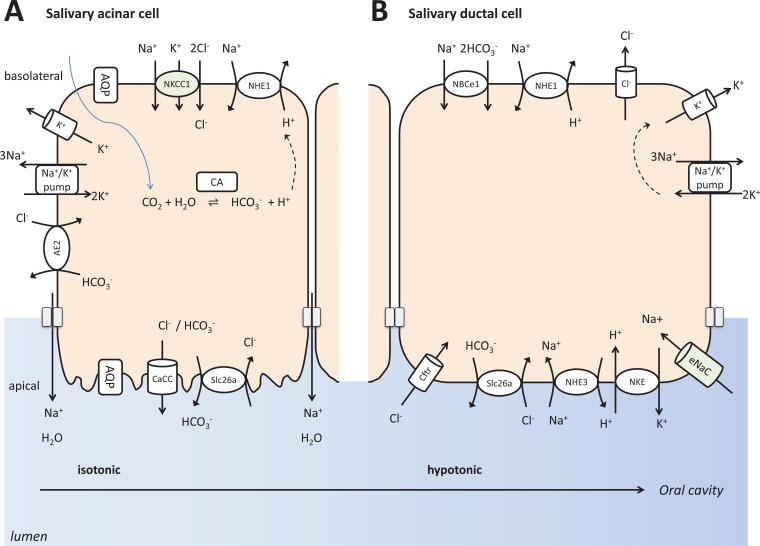
Simplified model depicting pancreatic ductal and acinar fluid, bicarbonate and electrolyte secretion. The bottom of the figure shows that salivary glands secrete bicarbonate to neutralize acidity in the oral lumen. (A) Salivary acinar cells secrete an isotonic fluid that also contain various proteins: serous acinar cells excrete α-amylase, while mucous acini produce mucin. The other major function of salivary acinar cells is electrolyte and fluid secretion, creating an isotonic fluid. Similar to the pancreatic acinar cells, basolateral uptake of Cl through Na+ /K+/Cl cotransporters is supported by Na+/ K+ ATPase provided gradients. Subsequently, apical secretion of Cl is mediated by calcium-activated chloride channels (CaCC). Parallel opening of basolateral K+ channels is necessary to keep intracellular electroneutrality. Cl is followed by Na+ via the paracellular pathway. Then water follows passively through aquaporin water channels and also paracellularly into the lumen. Salivary acinar cells also secrete a modest level of bicarbonate, primarily through apical exchange to already secreted Cl to intracellularly accumulated bicarbonate via SLC26 anion exchangers. (B) Salivary duct cells make a hypotonic fluid that is poor in Na+ and Cl but relatively rich in K+ and HCO3 by absorbing Na+ and Cl, and to a lower degree secreting K+ and bicarbonate. Na+ reabsorption is achieved by apical epithelial Na+ channels (ENaC) allowing Na+ reuptake from the lumen. Then the Na+/ K+ ATPase extrudes the accumulated Na+ basolaterally. Cl is also reabsorbed by a transcellular process. Apical Cl entry into the cell is primarily facilitated by CFTR. Ductal cells effectively absorb Na+ and Cl, but practically impermeable for water as it lacks aquaporin water channels and their tight junctions are also resistant to water passage. The outcome is a highly hypotonic saliva, reaching the oral cavity at basal secretion. During parasympathetic stimulation, the highly accelerated flow rate does not permit complete Na+ and Cl reuptake resulting less hypotonic salivary juice, relatively high in bicarbonate. This fluid serves to buffer oral acidification by food and drink, or gastric reflux.
Fig. (4)
Fig. (4)
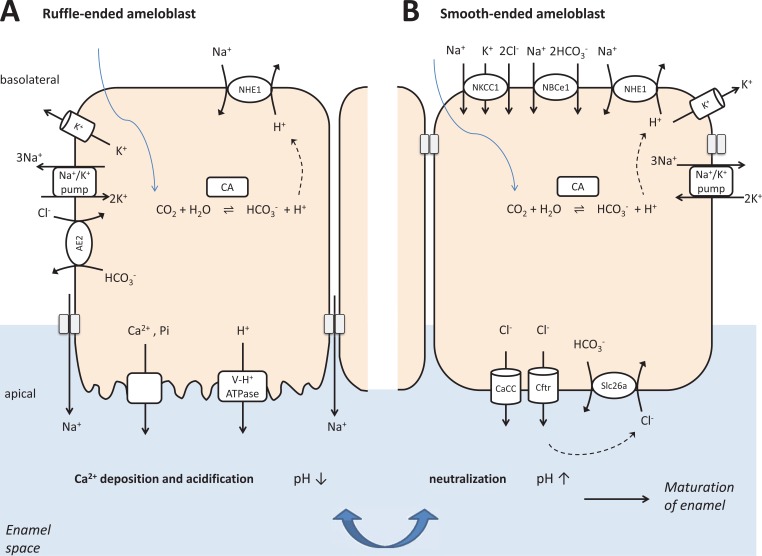
Simplified model depicting bicarbonate and electrolyte secretion in ruffle-ended and smooth-ended ameloblast cells. The bottom of the figure shows that ameloblasts secrete bicarbonate to neutralize acidity in the mineralizing enamel space. (A) Ruffle-ended ameloblast cells secrete Ca2+ and phosphate ions into the enamel space. Ca2+ is mostly taken up by the store-operated calcium entry pathway basolaterally and transported out of the cells at the apical pole by NCKX4 and NCX exchangers. Phosphate transport probably occurs via Na+-dependent phosphate (Pi) transporters. The pH is slowly decreasing during mineralization because a great quantity of protons liberated during the formation of hydroxyapatite crystals and also, probably by an active process, the apical activity of V-type H+ ATPases. (B) Smooth-ended ameloblast cells reorganize the tight junctions to neutralize luminal acidity in the enamel space by bicarbonate. Intracellular bicarbonate accumulation is facilitated by the basolateral electrogenic Na+/ HCO3 cotransport and by carbonic anhydrase-supported by proton extrusion through Na+/H+ exchangers. The main mechanism of intracellular Cl accumulation is probably the activity of Na+/K+/Cl cotransporter driven by the Na+/K+ ATPase generated Na+ gradient. Apically, Cl and to a lesser extent bicarbonate leave the ameloblasts via both cAMP activated CFTR and Ca2+-activated chloride-channels. Bicarbonate can also be exchanged to already secreted Cl at the apical side by SLC26A exchangers. The cyclical changes from ruffle-ended to smooth-ended cell morphology and the ability to modulate pH in the enamel space ultimately allow the continuous expansion of hydroxyapatite crystal formation, to reach an extremely high level of mineralization.

References

    1. Lee M.G., Ohana E., Park H.W., Yang D., Muallem S. Molecular mechanism of pancreatic and salivary gland fluid and HCO3 secretion. Physiol. Rev. 2012;92(1):39–74. - PMC - PubMed
    1. Steward M.C., Ishiguro H., Case R.M. Mechanisms of bicarbonate secretion in the pancreatic duct. Annu. Rev. Physiol. 2005;67:377–409. - PubMed
    1. Varga G. Physiology of the salivary glands. Surgery. 2015;33:581–586.
    1. Varga G., DenBesten P., Rácz R., Zsembery Á. Importance of bicarbonate transport in pH control during amelogenesis - need for functional studies. Oral Dis. 2017 - PMC - PubMed
    1. Ahuja M., Schwartz D.M., Tandon M., et al. Orai1-mediated antimicrobial secretion from pancreatic acini shapes the gut microbiome and regulates gut innate immunity. Cell Metab. 2017;25(3):635–646. - PMC - PubMed

Publication types