. 2018 May 15;27(148):170102.
doi: 10.1183/16000617.0102-2017. Print 2018 Jun 30.

Pulmonary function tests as outcomes for systemic sclerosis interstitial lung disease

Affiliations

Pulmonary function tests as outcomes for systemic sclerosis interstitial lung disease

Melissa Caron et al. Eur Respir Rev. .

Abstract

Interstitial lung disease (ILD) is the leading cause of morbidity and mortality in systemic sclerosis (SSc). We performed a systematic review to characterise the use and validation of pulmonary function tests (PFTs) as surrogate markers for systemic sclerosis-associated interstitial lung disease (SSc-ILD) progression.Five electronic databases were searched to identify all relevant studies. Included studies either used at least one PFT measure as a longitudinal outcome for SSc-ILD progression (i.e. outcome studies) and/or reported at least one classical measure of validity for the PFTs in SSc-ILD (i.e. validation studies).This systematic review included 169 outcome studies and 50 validation studies. Diffusing capacity of the lung for carbon monoxide (DLCO) was cumulatively the most commonly used outcome until 2010 when it was surpassed by forced vital capacity (FVC). FVC (% predicted) was the primary endpoint in 70.4% of studies, compared to 11.3% for % predicted DLCO Only five studies specifically aimed to validate the PFTs: two concluded that DLCO was the best measure of SSc-ILD extent, while the others did not favour any PFT. These studies also showed respectable validity measures for total lung capacity (TLC).Despite the current preference for FVC, available evidence suggests that DLCO and TLC should not yet be discounted as potential surrogate markers for SSc-ILD progression.


Conflict of interest statement

Conflict of interest: M. Caron reports grants from the Fonds de Recherche du Québec (Santé PhD Studentship) and from the Canadian Institutes of Health Research (GSD–146268) during the conduct of the study. S. Hoa reports grants from the Université de Montréal Rheumatology Clinical Fellowship Program (Abbvie educational grant) and from the Arthritis Society's Postdoctoral Fellowship Award, during the conduct of the study.

Figures
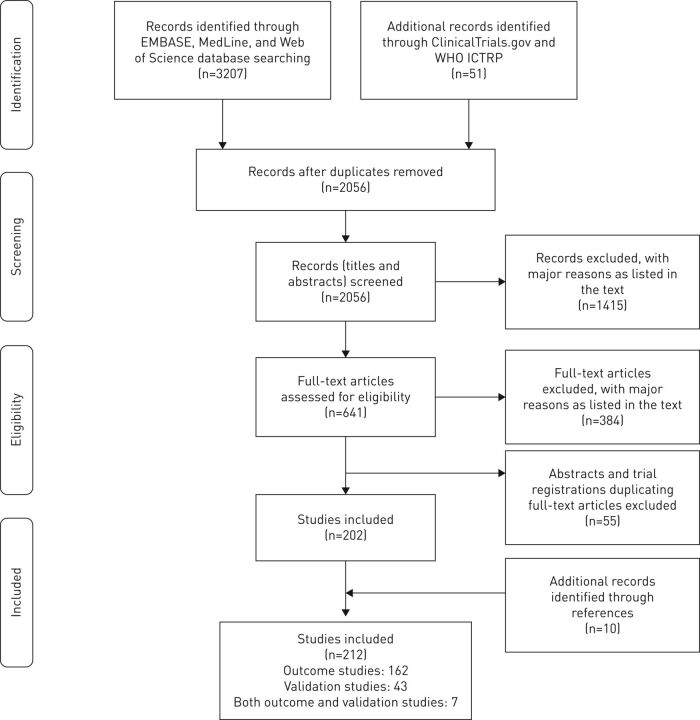
FIGURE 1
FIGURE 1
A preferred reporting items for systematic reviews and meta-analyses (PRISMA) flow diagram outlining the study selection process. WHO: World Health Organization; ICTRP: International Clinical Trials Registry Platform. Adapted from [9].
FIGURE 2
FIGURE 2
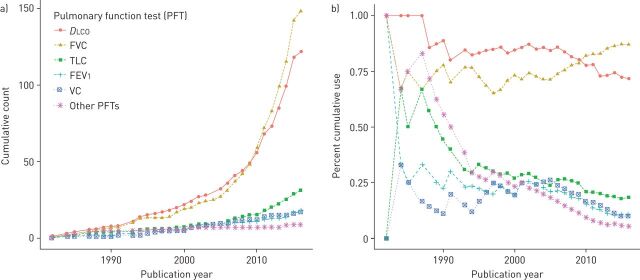
a) Cumulative count and b) percent cumulative use of the different pulmonary function test (PFT) measures as longitudinal outcomes for systemic sclerosis-associated interstitial lung disease progression. For each year, percent cumulative use was calculated by dividing the cumulative use of each PFT measure by the cumulative number of published articles. No distinctions were made between absolute and % predicted PFT values. All variations of diffusing capacity of the lung for carbon monoxide (DLCO) were grouped together into one all-encompassing DLCO measure. Other PFTs included measures of forced expiratory flow over the mid-half of forced vital capacity (FVC), forced expiratory volume in 1 s (FEV1)/FVC, FEV1/vital capacity (VC), functional residual capacity, residual volume and total lung capacity (TLC).
FIGURE 3
FIGURE 3
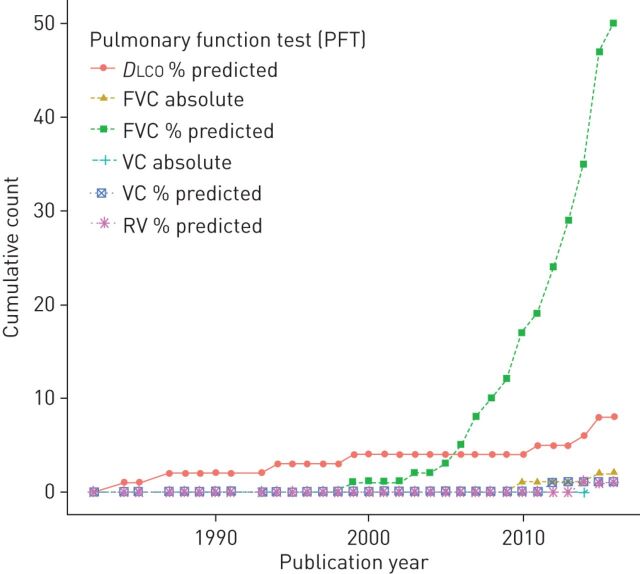
Cumulative count of the different primary pulmonary function test (PFT) outcomes in longitudinal studies of systemic sclerosis-associated interstitial lung disease progression. Four studies which used forced vital capacity (FVC) but which did not make a distinction between absolute and % predicted values were excluded from this figure. DLCO: diffusing capacity of the lung for carbon monoxide; VC: vital capacity; RV: residual volume.
FIGURE 4
FIGURE 4
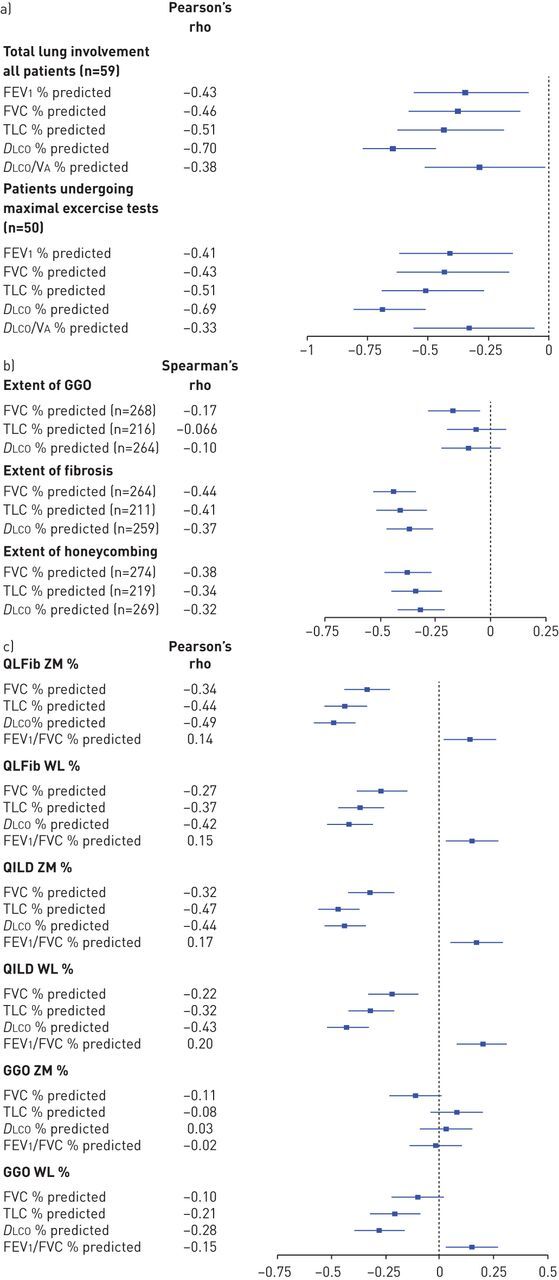
Forest plots of the correlation between high-resolution computed tomography (HRCT) scores and pulmonary function test values. The 95% CIs were calculated using the Fisher transformation. a) In the study by Wells [180] total abnormal lung involvement on HRCT was measured to the nearest 5%, while b) in the study by Zamora [210] the scoring method was not reported. c) Finally, in the study by Tashkin [221], HRCT scans were scored using quantitative imaging analyses and diffusing capacity of the lung for carbon monoxide (DLCO) was corrected for haemoglobin. While the number of subjects included in the analyses was not reported, it was assumed that all 261 systemic sclerosis subjects that underwent HRCT testing were included in the correlation analyses [221]. VA: alveolar volume; FEV1: forced expiratory volume in 1 s; FVC: forced vital capacity; GGO: ground-glass opacity; QILD: quantitative interstitial lung disease; QLFib: quantitative extent of lung fibrosis; TLC: total lung capacity; WL: whole lung; ZM: zone of maximal involvement.
FIGURE 5
FIGURE 5
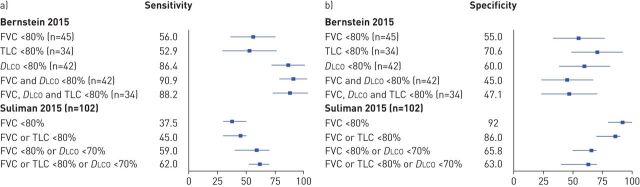
Forest plot of the a) sensitivity and b) specificity of different pulmonary function test screening algorithms for the presence of systemic sclerosis-associated interstitial lung disease [159, 213]. For the study by Bernstein [213], 95% CIs were calculated using reported measures of sensitivity, specificity, positive predictive value and negative predictive value. DLCO: diffusing capacity of the lung for carbon monoxide; FVC: forced vital capacity; TLC: total lung capacity.

References

    1. Gabrielli A, Avvedimento EV, Krieg T. Scleroderma. N Engl J Med 2009; 360: 1989–2003. - PubMed
    1. Katsumoto TR, Whitfield ML, Connolly MK. The pathogenesis of systemic sclerosis. Annu Rev Pathol 2011; 6: 509–537. - PubMed
    1. Seibold J. Scleroderma. In: Harris ED, Budd RC, Firestein GS, Genovese MC, Sergent JS, Ruddy S, Sledge CB, eds. Kelley's Textbook of Rheumatology. 7th Edn. Philadelphia, Elsevier, 2005; pp. 1279–1308.
    1. Schoenfeld SR, Castelino FV. Interstitial lung disease in scleroderma. Rheum Dis Clin North Am 2015; 41: 237–248. - PMC - PubMed
    1. Steele R, Hudson M, Lo E, et al. . Clinical decision rule to predict the presence of interstitial lung disease in systemic sclerosis. Arthritis Care Res (Hoboken) 2012; 64: 519–524. - PubMed

Publication types

MeSH terms