Clinical Trial
. 2018 May 17;3(10):e99145.
doi: 10.1172/jci.insight.99145.

Heat shock protein peptide complex-96 vaccination for newly diagnosed glioblastoma: a phase I, single-arm trial

Clinical Trial

Heat shock protein peptide complex-96 vaccination for newly diagnosed glioblastoma: a phase I, single-arm trial

Nan Ji et al. JCI Insight. .

Abstract

Background: Heat shock protein peptide complex-96 (HSPPC-96) triggers adaptive and innate antitumor immune responses. The safety and efficacy of HSPPC-96 vaccination was examined in patients with newly diagnosed glioblastoma multiforme (GBM).

Methods: In this open-label, single-arm, phase I study, adult patients were vaccinated with HSPPC-96 in combination with the standard treatment for newly diagnosed GBM after surgical resection. Primary endpoints were frequency of adverse events and progression-free survival (PFS) at 6 months. Secondary endpoints included overall survival (OS), PFS, and tumor-specific immune response (TSIR).

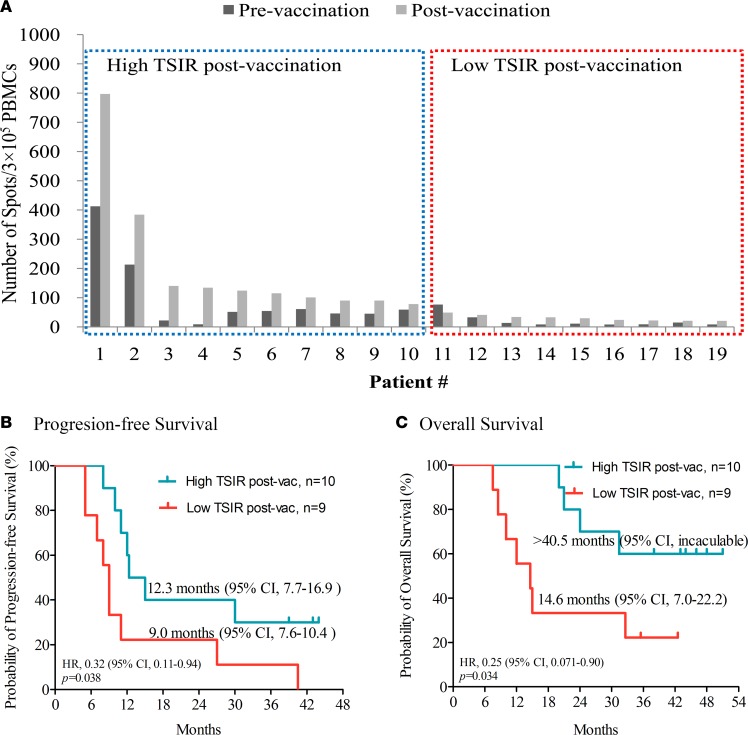
Results: A total of 20 patients with newly diagnosed GBM were enrolled from September 2013 to February 2015. No grade 3 or 4 vaccine-related adverse events were noted. After a median follow-up of 42.3 months, PFS was 89.5% (95% CI, 66.9%-98.7%) at 6 months, median PFS was 11.0 months (95% CI, 8.2-13.8), and median OS was 31.4 months (95% CI, 14.9-47.9). TSIR was significantly increased by 2.3-fold (95% CI, 1.7-3.2) after vaccination. Median OS for patients with high TSIR after vaccination was >40.5 months (95% CI, incalculable) as compared with 14.6 months (95% CI, 7.0-22.2) for patients with low TSIR after vaccination (hazard ratio, 0.25; 95% CI, 0.071-0.90; P = 0.034). A multivariate Cox regression model revealed TSIR after vaccination as a primary independent predicator for survival.

Conclusion: The HSPPC-96 vaccination, combined with the standard therapy, is a safe and effective strategy for treatment of newly diagnosed GBM patients. TSIR after vaccination would be a good indicator predicting the vaccine efficacy.

Trial registration: ClinicalTrials.gov NCT02122822.

Funding: National Key Technology Research and Development Program of the Ministry of Science and Technology of China (2014BAI04B01, 2014BAI04B02), Beijing Natural Science Foundation (7164253), Beijing Talents Fund (2014000021469G257), and Shenzhen Science and Technology Innovation Committee (JSGG20170413151359491).

Keywords: Brain cancer; Clinical Trials; Vaccines.


Conflict of interest statement

Conflict of interest: The authors have declared that no conflict of interest exists.

Figures

Figure 1
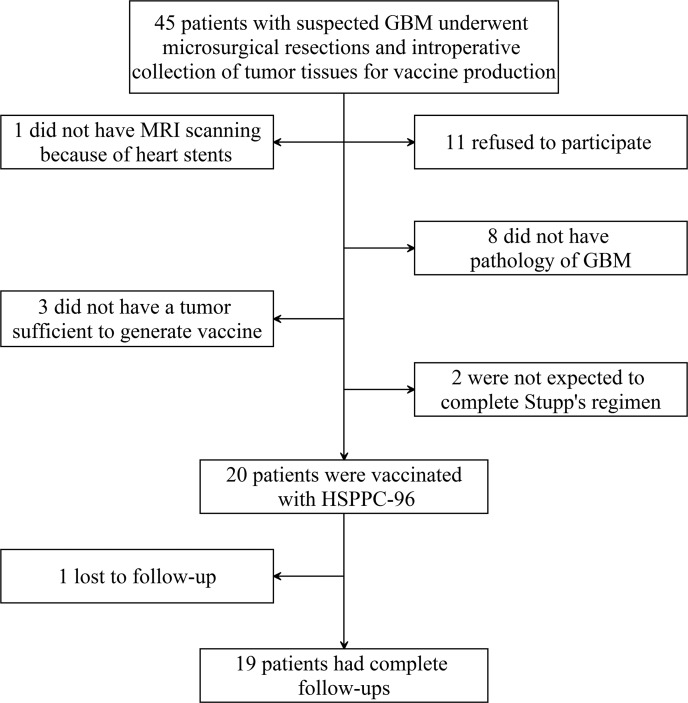
Figure 1. Overview of patient flow and disposition in this trial.
Figure 2
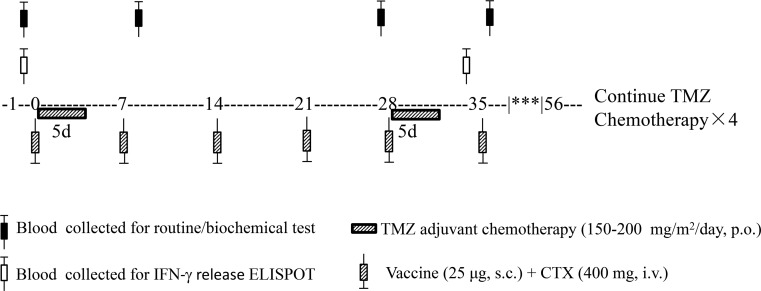
Figure 2. Scheme of HSPPC-96 vaccination for treating newly diagnosed GBM.
IFN-γ release ELISPOT, IFN-γ release enzyme-linked immunospot assay; TMZ, temozolomide; p.o., oral administration; s.c., subcutaneously; CTX, cyclophosphamide.
Figure 3
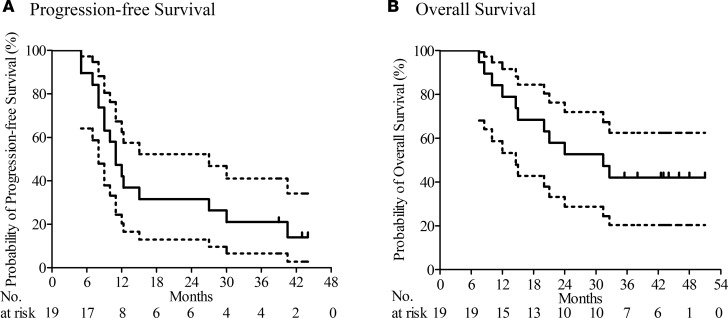
Figure 3. Clinical activity after HSPPC-96 vaccination.
Kaplan-Meier estimates of (A) progression-free survival and (B) overall survival in 19 patients receiving the HSPPC-96 vaccine for the treatment of newly diagnosed GBMs. Vertical lines indicate time points at which patients were censored. Dotted lines indicate the 95% CI.
Figure 4
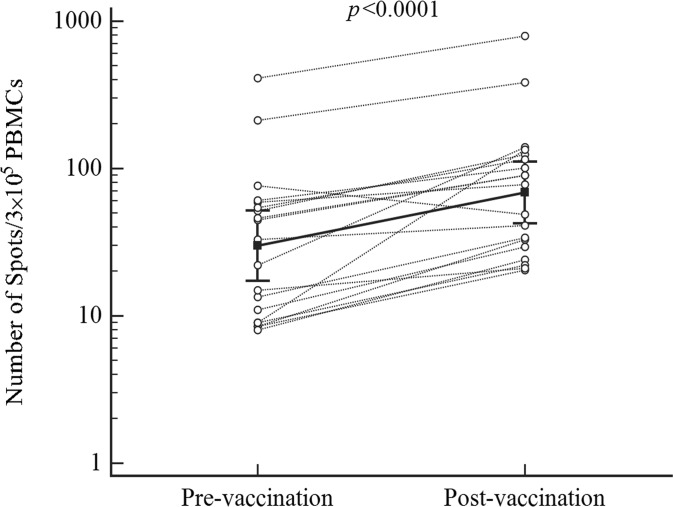
Figure 4. Tumor-specific immune response before and after HSPPC-96 vaccination.
Tumor-specific immune response was evaluated by the number of stimulated peripheral blood mononuclear cells (PBMCs) in response to autologous tumor lysate (measured by an IFN-γ release enzyme-linked immunospot assay). Open circles represent the mean amounts from two repeated assays of each patient. Solid squares indicate the mean amounts of all included patients. Paired t test was applied to evaluate the difference (n = 19). Error bars denote 95% CI.
Figure 5
Figure 5. Association between clinical activity and immunological response.
(A) Based on the tumor-specific immune response (TSIR) after vaccination, patients were divided into a high TSIR after vaccination (post-vac) group (TSIR post-vac ≥ median) and a low TSIR after vaccination group (TSIR post-vac < median). (B and C) Kaplan-Meier estimates of (B) progression-free survival and (C) overall survival in 19 GBM patients, divided into high and low TSIR post-vac groups. Log-rank test was applied to estimate the difference. Vertical lines indicate time points at which patients were censored.

References

    1. Stupp R, et al. Radiotherapy plus concomitant and adjuvant temozolomide for glioblastoma. N Engl J Med. 2005;352(10):987–996. doi: 10.1056/NEJMoa043330. - DOI - PubMed
    1. Stupp R, et al. Effects of radiotherapy with concomitant and adjuvant temozolomide versus radiotherapy alone on survival in glioblastoma in a randomised phase III study: 5-year analysis of the EORTC-NCIC trial. Lancet Oncol. 2009;10(5):459–466. doi: 10.1016/S1470-2045(09)70025-7. - DOI - PubMed
    1. Hoos A. Development of immuno-oncology drugs - from CTLA4 to PD1 to the next generations. Nat Rev Drug Discov. 2016;15(4):235–247. doi: 10.1038/nrd.2015.35. - DOI - PubMed
    1. D’Errico G, Machado HL, Sainz B. A current perspective on cancer immune therapy: step-by-step approach to constructing the magic bullet. Clin Transl Med. 2017;6(1):3. doi: 10.1186/s40169-016-0130-5. - DOI - PMC - PubMed
    1. Sampson JH, Maus MV, June CH. Immunotherapy for brain tumors. J Clin Oncol. 2017;35(21):2450–2456. doi: 10.1200/JCO.2017.72.8089. - DOI - PubMed

Publication types

Associated data