Chlamydia in Canada, 2010-2015
- PMID: 29770099
- PMCID: PMC5864312
- DOI: 10.14745/ccdr.v44i02a03
Chlamydia in Canada, 2010-2015
Abstract
Background: Chlamydia is the most commonly reported notifiable sexually transmitted infection in Canada. Rates have been steadily increasing since 1997.
Objective: To summarize trends in chlamydia rates for the period 2010-2015 in Canada.
Methods: Laboratory-confirmed cases of chlamydia were reported to the Public Health Agency of Canada by all the Canadian provinces and territories. The overall national rate was computed, as were rates per sex, age group and province/territory.
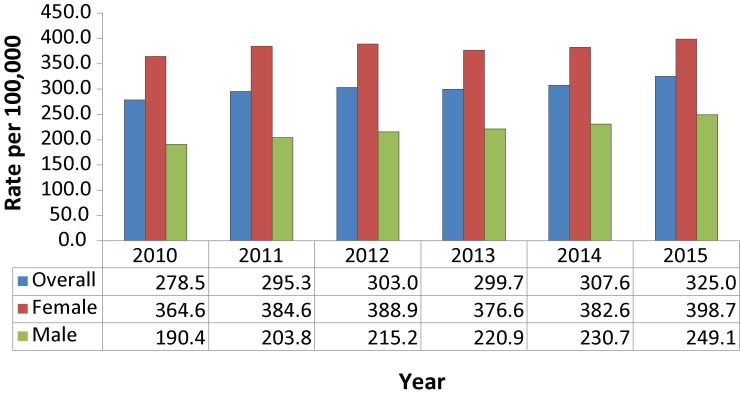
Results: In 2015, a total of 116,499 cases of chlamydia were reported in Canada, corresponding to a rate of 325 cases per 100,000 population. Females accounted for the majority (two-thirds) of chlamydia infections from 2010 to 2015. However, rates among males rose faster during this time period. Youth and young adults aged 15-29 years had the highest rates in 2015. While increased rates were observed over time for most age groups, adults aged 40 years and older had the greatest increase (51%) between 2010 and 2015. Chlamydia rates increased in most provinces during this period, with the highest rates being reported by the Northwest Territories and Nunavut in 2015.
Conclusion: Between 2010 and 2015, chlamydia rates increased by 16.7% and were highest among females and young adults. Although a number of factors may account for this rising trend, the possibility of a true increase in incidence cannot be ruled out. Ongoing monitoring of chlamydia and research into the reasons for the observed changes will help guide sexually transmitted infection (STI) prevention and control activities.
Conflict of interest statement
Conflict of interest: None.
Figures

References
-
- Newman L, Rowley J, Vander Hoorn S, Wijesooriya NS, Unemo M, Low N et al. Global estimates of the prevalence and incidence of four curable sexually transmitted infections in 2012 based on systematic review and global reporting. PLoS One 2015. Dec;10(12):e0143304. 10.1371/journal.pone.0143304 - DOI - PMC - PubMed
-
- Expert Working Group for the Canadian Guidelines on Sexually Transmitted Infections. Chlamydial infections. In: Wong T, Latham-Carmanico C, editors. Canadian Guidelines on Sexually Transmitted Infections, 2010. Ottawa (ON): Public Health Agency of Canada; 2010. https://www.canada.ca/en/public-health/services/infectious-diseases/sexu...
-
- Rebbapragada A, Kaul R. More than their sum in your parts: the mechanisms that underpin the mutually advantageous relationship between HIV and sexually transmitted infections. Drug Discov Today Dis Mech 2007;4(4):237–46. 10.1016/j.ddmec.2007.12.003 - DOI
-
- Totten S, MacLean R, Payne E, Severini A. Chlamydia and lymphogranuloma venereum in Canada: 2003-2012. Summary Report. Can Commun Dis Rep 2015;41(2):20–5. Available from: https://www.canada.ca/en/public-health/services/reports-publications/can... - PMC - PubMed