Review
. 2018 Mar 27:2018:2389523.
doi: 10.1155/2018/2389523. eCollection 2018.

Targeting Oxidatively Induced DNA Damage Response in Cancer: Opportunities for Novel Cancer Therapies

Affiliations
Review

Targeting Oxidatively Induced DNA Damage Response in Cancer: Opportunities for Novel Cancer Therapies

Pierpaola Davalli et al. Oxid Med Cell Longev. .

Abstract

Cancer is a death cause in economically developed countries that results growing also in developing countries. Improved outcome through targeted interventions faces the scarce selectivity of the therapies and the development of resistance to them that compromise the therapeutic effects. Genomic instability is a typical cancer hallmark due to DNA damage by genetic mutations, reactive oxygen and nitrogen species, ionizing radiation, and chemotherapeutic agents. DNA lesions can induce and/or support various diseases, including cancer. The DNA damage response (DDR) is a crucial signaling-transduction network that promotes cell cycle arrest or cell death to repair DNA lesions. DDR dysregulation favors tumor growth as downregulated or defective DDR generates genomic instability, while upregulated DDR may confer treatment resistance. Redox homeostasis deeply and capillary affects DDR as ROS activate/inhibit proteins and enzymes integral to DDR both in healthy and cancer cells, although by different routes. DDR regulation through modulating ROS homeostasis is under investigation as anticancer opportunity, also in combination with other treatments since ROS affect DDR differently in the patients during cancer development and treatment. Here, we highlight ROS-sensitive proteins whose regulation in oxidatively induced DDR might allow for selective strategies against cancer that are better tailored to the patients.


Figures
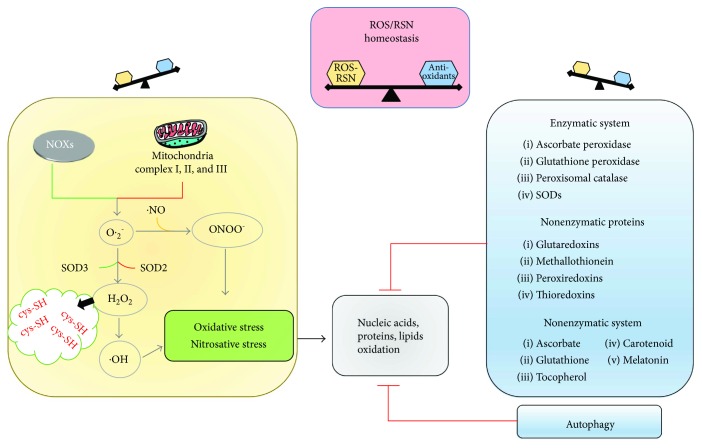
Figure 1
Figure 1
Reactive oxygen species (ROS) and reactive nitrogen species (RNS) balance is critical in maintaining cellular homeostasis. Excessive levels of ROS (O2⨪, OH, and H2O2) and/or RNS (ONOO) affect the redox homeostasis, inducing oxidation of cellular nucleic acids, proteins, and lipids. The cells activate several antioxidant systems to maintain the intracellular redox equilibrium, including an enzymatic system (ascorbate peroxidase, glutathione peroxidase, peroxisomal catalase, and SODs) that works in concert with other nonenzymatic proteins (glutaredoxins, metallothionein, peroxiredoxins, and thioredoxins) and an nonenzymatic system (ascorbate, carotenoid, glutathione, melatonin, and tocopherol). In addition, autophagy is a very sensitive antioxidant system. NOXs = NADPH oxidases; cys-SH = cysteine-SH.
Figure 2
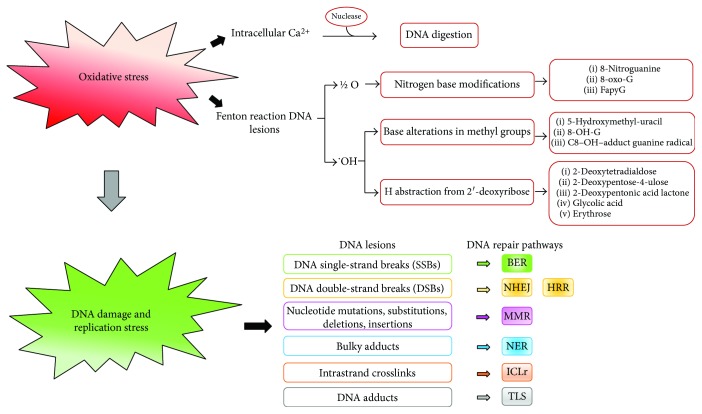
Figure 2
Oxidative stress (OS) causes DNA damage with consequent activation of DNA repair pathways. OS induces DNA damages by two major reactions: increase of the intracellular calcium levels, activating DNA digestion, and Fenton reaction. DNA damage triggers the main DNA repair pathways: BER: base excision repair; NHEJ: nonhomologous end joining; HRR: homologous recombination repair; MMR: mismatch repair; NER: nucleotide excision repair; ICL: intrastrand crosslink; TLS: translation synthesis.
Figure 3
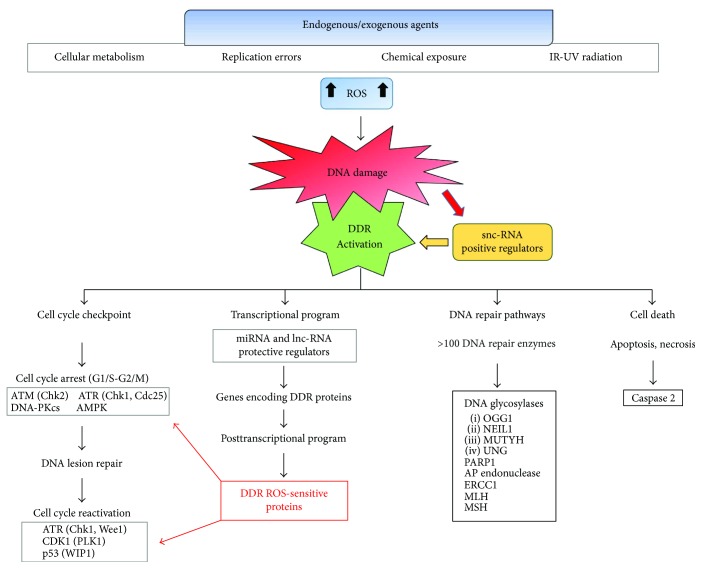
Figure 3
Reactive oxygen species (ROS) generated by endogenous and exogenous agents cause DNA damage and activation of DNA damage response (DDR). DDR activation arrests the cell cycle progression to repair DNA lesions and activate a program encoding ROS-sensitive proteins involved in DDR. ATM, ATR, DNA-PKs, AMPK, Chk1, and Chk2 represent the sensors and transducers that coordinate DDR. Their signals converge on effectors, as tumor suppressor p53, Cdc25 protein phosphatase, and WEE1 tyrosine kinase. DNA repair pathways occur by several DNA repair enzymes such as DNA glycosylases, PARP1, AP endonuclease, ERCC1, MLH, and MSH. DDR triggers apoptosis or necrosis when the DNA damage cannot be repaired. DDR-targeted proteins, whose inhibitors are currently in clinical trials, are indicated in bold. snc-RNAs = small noncoding RNAs; lnc-RNAs = long noncoding RNAs; ATM = ataxia telangiectasia-mutated protein; ATR = ATM- and Rad3-related; AMPK = AMP-activated protein kinase; CDK = cyclin-dependent kinase; DNA-PKcs = dependent protein kinase catalytic subunit; PLK1 = polo-like kinase 1; WIP1 = wild-type p53-induced protein 1; PARP = poly (ADP-ribose) polymerase; AP endonuclease = apurinic/apyrimidinic endonuclease; MLH = MutL homolog; MSH = MutS homolog.

References

    1. Siegel R. L., Miller K. D., Jemal A. Cancer statistics, 2017. CA: a Cancer Journal for Clinicians. 2017;67(1):7–30. doi: 10.3322/caac.21387. - DOI - PubMed
    1. Hanahan D., Weinberg R. A. Hallmarks of cancer: the next generation. Cell. 2011;144(5):646–674. doi: 10.1016/j.cell.2011.02.013. - DOI - PubMed
    1. Groenendijk F. H., Bernards R. Drug resistance to targeted therapies: déjà vu all over again. Molecular Oncology. 2014;8(6):1067–1083. doi: 10.1016/j.molonc.2014.05.004. - DOI - PMC - PubMed
    1. Dickreuter E., Cordes N. The cancer cell adhesion resistome: mechanisms, targeting and translational approaches. Biological Chemistry. 2017;398(7):721–735. doi: 10.1515/hsz-2016-0326. - DOI - PubMed
    1. Konrad C. V., Murali R., Varghese B. A., Nair R. The role of cancer stem cells in tumor heterogeneity and resistance to therapy. Canadian Journal of Physiology and Pharmacology. 2017;95(1):1–15. doi: 10.1139/cjpp-2016-0079. - DOI - PubMed

MeSH terms

Substances

LinkOut - more resources