State Indoor Tanning Laws and Prevalence of Indoor Tanning Among US High School Students, 2009-2015
- PMID: 29771612
- PMCID: PMC5993371
- DOI: 10.2105/AJPH.2018.304414
State Indoor Tanning Laws and Prevalence of Indoor Tanning Among US High School Students, 2009-2015
Abstract
Objectives: To examine the association between state indoor tanning laws and indoor tanning behavior using nationally representative samples of US high school students younger than 18 years.
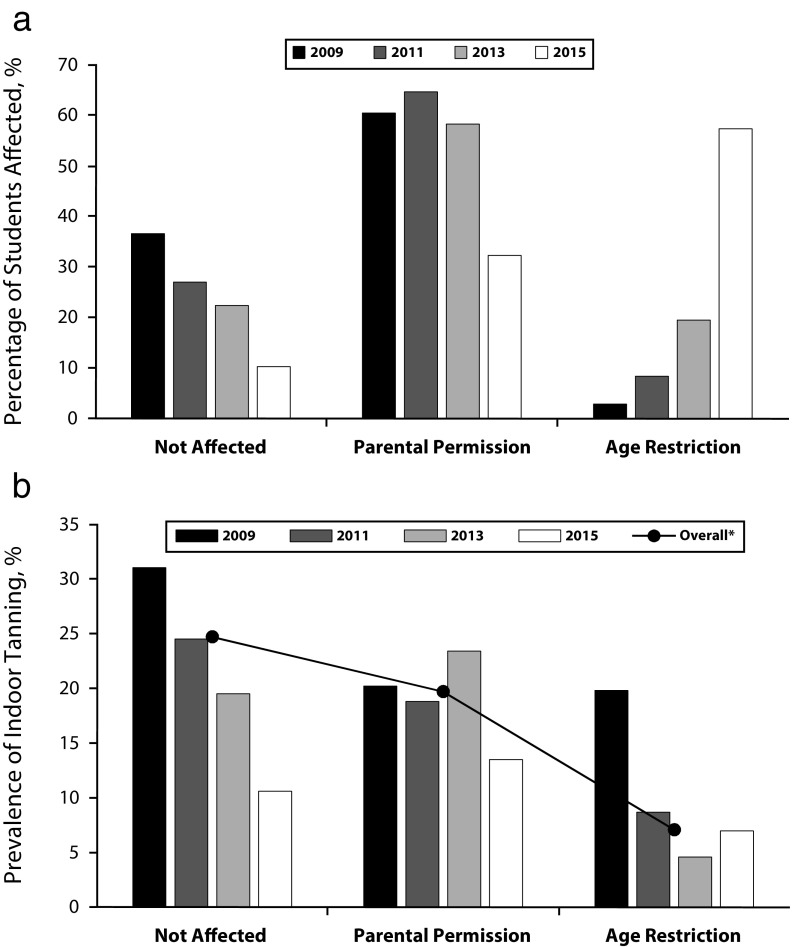
Methods: We combined data from the 2009, 2011, 2013, and 2015 national Youth Risk Behavior Surveys (n = 41 313) to analyze the association between 2 types of state indoor tanning laws (age restriction and parental permission) and the prevalence of indoor tanning during the 12 months before the survey, adjusting for age, race/ethnicity, and survey year, and stratified by gender.
Results: Age restriction laws were associated with a 47% (P < .001) lower indoor tanning prevalence among female high school students. Parental permission laws were not found to be associated with indoor tanning prevalence among either female or male high school students.
Conclusions: Age restriction laws could contribute to less indoor tanning, particularly among female high school students. Such reductions may reduce the health and economic burden of skin cancer.
Figures
Comment in
-
Effect of Parental Permission and Age Restriction Laws on US Adolescent Indoor Tanning Trends.Am J Public Health. 2018 Jul;108(7):851-853. doi: 10.2105/AJPH.2018.304458. Am J Public Health. 2018. PMID: 29874511 Free PMC article. No abstract available.
-
The Story Behind the Sharp Decline in US Tanning Bed Rates.Am J Public Health. 2018 Aug;108(8):971-973. doi: 10.2105/AJPH.2018.304521. Am J Public Health. 2018. PMID: 29995485 Free PMC article. No abstract available.
References
-
- US Cancer Statistics Working Group. United States cancer statistics—the official federal cancer statistics. 2016. Available at: https://www.cdc.gov/cancer/npcr/uscs/index.htm. Accessed May 26, 2017.
-
- Department of Health and Human Services. The Surgeon General’s Call to Action to Prevent Skin Cancer. Washington, DC: US Department of Health and Human Services; 2014.
MeSH terms
Grants and funding
LinkOut - more resources
Full Text Sources
Other Literature Sources
Medical