


Existence and functionality of national immunisation technical advisory groups in Africa from 2010 to 2016
- PMID: 29771634
- PMCID: PMC6284504
- DOI: 10.1080/21645515.2018.1475815
Existence and functionality of national immunisation technical advisory groups in Africa from 2010 to 2016
Abstract
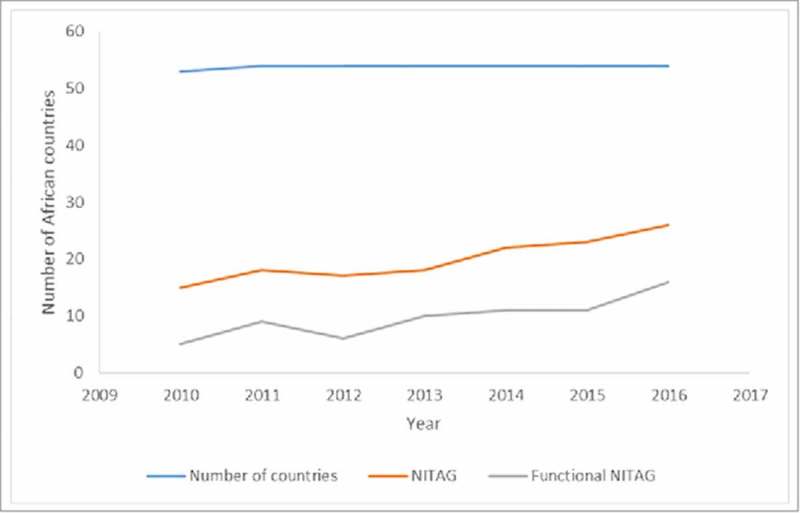
We describe the existence and functionality of National Immunisation Technical Advisory Groups (NITAGs) in Africa between 2010 and 2016, using data from the WHO-UNICEF Joint Reporting Form. The number of African countries with NITAGs increased from 15 (28%) in 2010 to 26 (48%) in 2016. Countries with a functioning NITAG increased from 5(9%) in 2010 to 16 (30%) in 2016. In 2016, 13 of the 27 (48%) low-income African countries reported having a NITAG; seven (54%) of them functional. Thirteen of the 26 (50%) middle-income countries reported having a NITAG; nine (69%) of them functional. In 2016, six of the seven African countries (86%) in the WHO Eastern Mediterranean Region had a NITAG, with three (50%) functional. In the WHO African Region, 20 of the 47 countries (43%) had NITAGs; 13 (65%) of them functional. Substantial investments should be made to ensure that every African country has a functional NITAG.
Keywords: Global Vaccine Action Plan; National Immunisation Technical Advisory Groups; WHO-UNICEF Joint Reporting Form.
Figures
References
-
- Andre FE, Booy R, Bock HL, Clemens J, Datta SK, John TJ, Lee BW, Lolekha S, Peltola H, Ruff TA, et al.. Vaccination greatly reduces disease, disability, death and inequity worldwide. Bull World Health Organ. World Health Organization. 2008. February;86(2):140–6. doi: 10.2471/BLT.07.040089. - DOI - PMC - PubMed
-
- Moxon ER, Das P, Greenwood B, Heymann DL, Horton R, Levine OS, Plotkin S, Nossal G, et al.. A call to action for the new decade of vaccines. Lancet (London, England). Elsevier. 2011. July 23;378(9788):298–302. - PubMed
-
- World Health Organization GIVS: Global Immunization Vision and Strategy: 2006–2015. 2005.
-
- Okwo-Bele JM. Integrating Immunization With Other Health Interventions For Greater Impact: The Right Strategic Choice. J Infect Dis. Oxford University Press. 2012. March 1;205(suppl 1):S4–5. - PubMed
Publication types
MeSH terms
LinkOut - more resources
Full Text Sources
Other Literature Sources
