


The Neural Basis of Timing: Distributed Mechanisms for Diverse Functions
- PMID: 29772201
- PMCID: PMC5962026
- DOI: 10.1016/j.neuron.2018.03.045
The Neural Basis of Timing: Distributed Mechanisms for Diverse Functions
Abstract
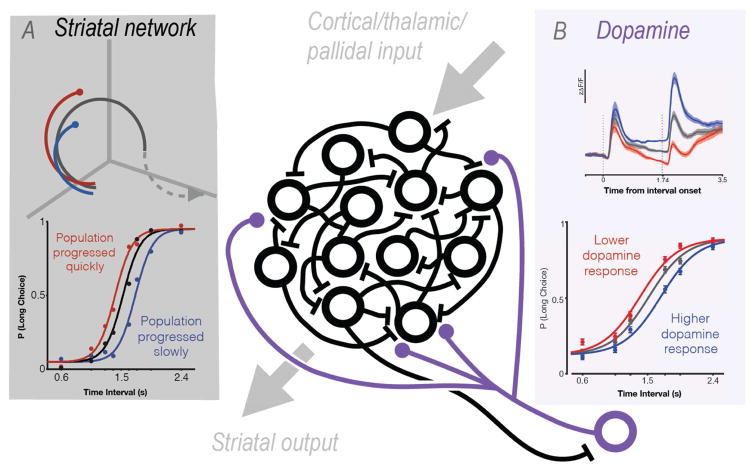
Timing is critical to most forms of learning, behavior, and sensory-motor processing. Converging evidence supports the notion that, precisely because of its importance across a wide range of brain functions, timing relies on intrinsic and general properties of neurons and neural circuits; that is, the brain uses its natural cellular and network dynamics to solve a diversity of temporal computations. Many circuits have been shown to encode elapsed time in dynamically changing patterns of neural activity-so-called population clocks. But temporal processing encompasses a wide range of different computations, and just as there are different circuits and mechanisms underlying computations about space, there are a multitude of circuits and mechanisms underlying the ability to tell time and generate temporal patterns.
Copyright © 2018 Elsevier Inc. All rights reserved.
Figures



References
-
- Abeles M. Local cortical circuits: an electrohysiological study. Berlin: Springer; 1982.
-
- Aschoff J. On the perception of time during prolonged temporal isolation. Hum Neurobiol. 1985;4:41–52. - PubMed
Publication types
MeSH terms
Grants and funding
LinkOut - more resources
Full Text Sources
Other Literature Sources
