


The Association of Dietary Fiber Intake with Cardiometabolic Risk in Four Countries across the Epidemiologic Transition
- PMID: 29772682
- PMCID: PMC5986507
- DOI: 10.3390/nu10050628
The Association of Dietary Fiber Intake with Cardiometabolic Risk in Four Countries across the Epidemiologic Transition
Abstract
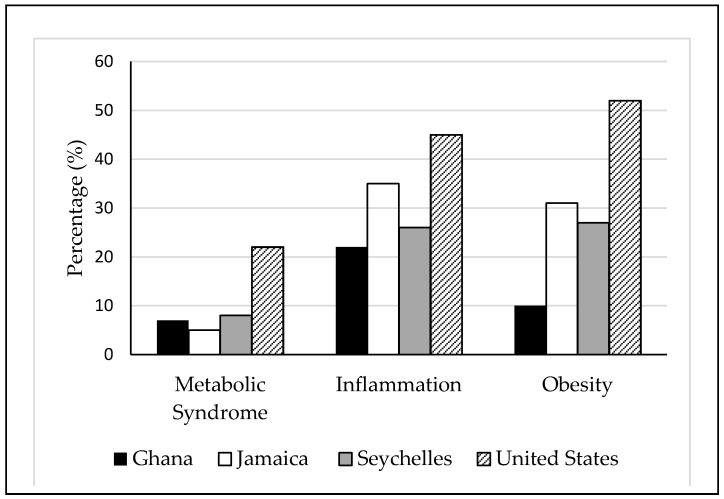
The greatest burden of cardiovascular disease is now carried by developing countries with cardiometabolic conditions such as metabolic syndrome, obesity and inflammation believed to be the driving force behind this epidemic. Dietary fiber is known to have protective effects against obesity, type 2 diabetes, cardiovascular disease and the metabolic syndrome. Considering the emerging prevalence of these cardiometabolic disease states across the epidemiologic transition, the objective of this study is to explore these associations of dietary fiber with cardiometabolic risk factors in four countries across the epidemiologic transition. We examined population-based samples of men and women, aged 25⁻45 of African origin from Ghana, Jamaica, the Seychelles and the USA. Ghanaians had the lowest prevalence of obesity (10%), while Jamaicans had the lowest prevalence of metabolic syndrome (5%) across all the sites. Participants from the US presented with the highest prevalence of obesity (52%), and metabolic syndrome (22%). Overall, the Ghanaians consumed the highest dietary fiber (24.9 ± 9.7 g), followed by Jamaica (16.0 ± 8.3 g), the Seychelles (13.6 ± 7.2 g) and the lowest in the USA (14.2 ± 7.1 g). Consequently, 43% of Ghanaians met the fiber dietary guidelines (14 g/1000 kcal/day), 9% of Jamaicans, 6% of Seychellois, and only 3% of US adults. Across all sites, cardiometabolic risk (metabolic syndrome, inflammation and obesity) was inversely associated with dietary fiber intake, such that the prevalence of metabolic syndrome was 13% for those in the lowest quartile of fiber intake, compared to 9% those in the highest quartile of fiber intake. Notably, twice as many of participants (38%) in the lowest quartile were obese compared to those in the highest quartile of fiber intake (18%). These findings further support the need to incorporate strategies and policies to promote increased dietary fiber intake as one component for the prevention of cardiometabolic risk in all countries spanning the epidemiologic transition.
Keywords: cardiometabolic risk; dietary fiber; epidemiologic transition; metabolic syndrome; obesity.
Conflict of interest statement
The authors declare no conflict of interest.
Figures
References
-
- Benjamin E.J., Blaha M.J., Chiuve S.E., Cushman M., Das S.R., Deo R., de Ferranti S.D., Floyd J., Fornage M., Gillespie C., et al. Heart Disease and Stroke Statistics—2017 Update: A Report From the American Heart Association. Circulation. 2017;135:e146–e603. doi: 10.1161/CIR.0000000000000485. - DOI - PMC - PubMed
MeSH terms
Substances
Grants and funding
LinkOut - more resources
Full Text Sources
Other Literature Sources
Medical
Miscellaneous
