Review
. 2018 May 17;10(5):267.
doi: 10.3390/v10050267.

Drug Delivery Strategies for Antivirals against Hepatitis B Virus

Affiliations
Review

Drug Delivery Strategies for Antivirals against Hepatitis B Virus

Latavia Singh et al. Viruses. .

Abstract

Chronic hepatitis B virus (HBV) infection poses a significant health challenge due to associated morbidity and mortality from cirrhosis and hepatocellular cancer that eventually results in the breakdown of liver functionality. Nanotechnology has the potential to play a pivotal role in reducing viral load levels and drug-resistant HBV through drug targeting, thus reducing the rate of evolution of the disease. Apart from tissue targeting, intracellular delivery of a wide range of drugs is necessary to exert a therapeutic action in the affected organelles. This review encompasses the strategies and techniques that have been utilized to target the HBV-infected nuclei in liver hepatocytes, with a significant look at the new insights and most recent advances in drug carriers and their role in anti-HBV therapy.

Keywords: Hepatitis B virus; asialoglycoprotein receptor; cell-penetrating peptides; hepatocyte; intracellular drug delivery; liver targeting; nanoparticles.


Conflict of interest statement

The authors declare no conflict of interest.

Figures
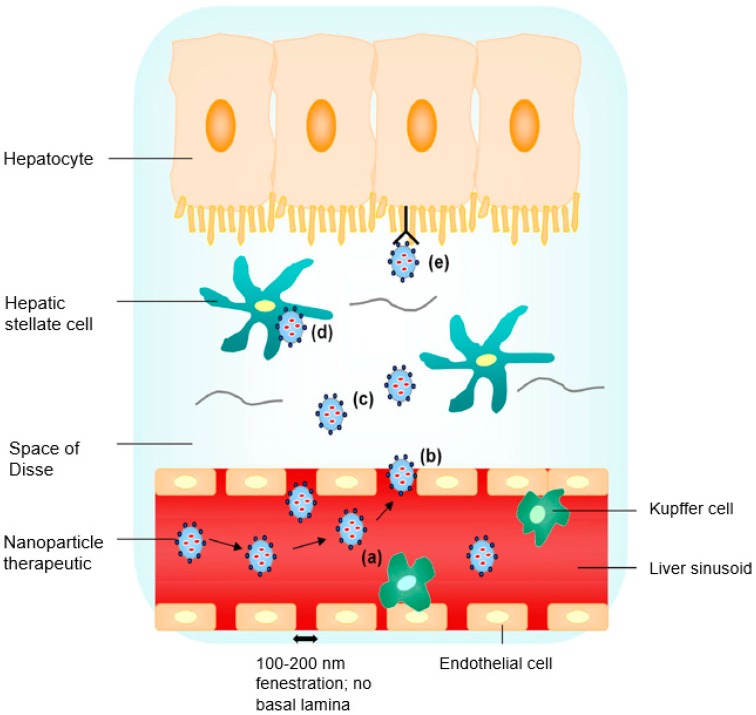
Figure 1
Figure 1
Liver targeting by nanoparticle (NP) therapeutics: (a) nanosized particles of less than 200 nm with specific functionalities aid in the evasion of premature Kupffer cell clearance; (b) nanosized particles extravasate into the space of Disse through sinusoidal fenestrations in basal lamina absence; (c) a high local concentration of NP therapeutics diffusing across the loosely organized extracellular matrix in the space of Disse; (d) nonspecific endocytic uptake; and (e) receptor-mediated uptake by the hepatocyte (reproduced with permission from [14], © Elsevier B.V. Ltd., 2010).
Figure 2
Figure 2
(1) PLGA–CHS nanoparticle binding efficiency and loading capacity to adsorb pDNA. (A) PLGA–CHS–pDNA complexes with increasing amounts of PLGA–CHS NS were prepared and analyzed for pDNA immobilization ability. Electrophoresis was carried out using 1% agarose gel in TAE buffer containing 0.5 μg/mL ethidium bromide at pH 8. (B) The amounts of free DNA were related to naked pDNA (100% mobile) run on the same gel. To quantify the pDNA-immobilization ability, the PLGA–CHS NS/pDNA ratios (w/w) required for 100% immobilization are compared in this graph (solid bars = percentage of free DNA; white bars = 100% immobilization). (2) Confocal laser microscopic images of HepG2.2.15 cells following 48 h transfection with (A) plain-PLGA–pDNA NS and (B) CHS–PLGA–pDNA NS. Scale bar = 75 μm (reproduced with permission from [76], © Elsevier B.V. Ltd. 2011).
Figure 3
Figure 3
Biodistribution of siRNAs in HBV transgenic mice. Representative fluorescence images obtained from samples harvested 10 min after injection of lipoplexes containing Alexa Fluor 750-labeled siRNAs. Three mice (i–iii) received intravenous injection of the uncomplexed naked labeled siRNA (A), and three mice (i–iii) received labeled siRNA within polyglutamate-containing lipoplexes (B). One mouse, which received a saline injection, served as the negative control (C). Fluorescence detectable in livers (Li), lungs (Lu), kidneys (Ki), and spleens (S) are shown in the top row of images. Microscopy of frozen sections from liver and kidney samples are also shown below. The scale bar indicates 50 μm. Quantitation of fluorescence, radiant efficiency, was measured in the organs of mice given naked guanidinopropyl (GP3)-siRNA3 or lipoplexed GP3-siRNA3 (D). Data are represented as the mean radiant efficiency (±SEM) for each organ from the three animals (reproduced with permission from [88], © 2015 Elsevier B.V.).
Figure 4
Figure 4
(1) Evaluation of cell-penetrating activity of the peptides in the HepG2.2.15 cells by confocal microscope detection. (A) HepG2.2.15 cells were treated with 10 μM of FITC-R7-GSLLGRMKGA peptide for 30 min. Nuclei were stained with DAPI (blue); (B) shows an enlargement of the white-frame area in (A); in (C), the HepG2.2.15 cells were treated by 10 μM of FITC-GSLLGRMKGA control peptide without R7. (2) Analysis of HBV core protein in HepG2.2.15 cells treated with peptides. Cells were treated with 10 μM of peptides for three days and stained by immunofluorescent staining (upper). Cells were scanned by confocal microscope for subcellular distribution of core protein (red). The core protein was also quantified by Western blot analysis (lower). Optical densities of the core protein were analyzed using QuantityOne software. All values are means ± SD of results from three independent experiments. Values significantly different from control peptide group are indicated by a Student’s t-test. * p < 0.05; ** p < 0.01 (reproduced with permission from [95]).

References

    1. Ghany M.G., Perrillo R., Li R., Belle S.H., Janssen H.L., Terrault N.A., Shuhart M.C., Lau D.T., Kim W.R., Fried M.W., et al. Characteristics of adults in the hepatitis B research network in North America reflect their country of origin and hepatitis B virus genotype. Clin. Gastroenterol. Hepatol. 2015;13:183–192. doi: 10.1016/j.cgh.2014.06.028. - DOI - PMC - PubMed
    1. Terrault N.A., Lok A.S.F., McMahon B.J., Chang K.-M., Hwang J.P., Jonas M.M., Brown R.S., Jr., Bzowej N.H., Wong J.B. Update on Prevention, Diagnosis, and Treatment of Chronic Hepatitis B: AASLD 2018 Hepatitis B Guidance. Hepatology. 2018;67:1560–1599. doi: 10.1002/hep.29800. - DOI - PMC - PubMed
    1. Ruiz-Sancho A., Sheldon J., Soriano V. Telbivudine: A new option for the treatment of chronic hepatitis B. Expert Opin. Biol. Ther. 2007;7:751–761. doi: 10.1517/14712598.7.5.751. - DOI - PubMed
    1. Leucuta S.E. Subcellular drug targeting, pharmacokinetics and bioavailability. J. Drug Target. 2014;22:95–115. doi: 10.3109/1061186X.2013.848453. - DOI - PubMed
    1. Cuestas M.L., Mathet V.L., Oubiña J.R., Sosnik A. Drug delivery systems and liver targeting for improved pharmacotherapy of the hepatitis B virus (HBV) infection. Pharm. Res. 2010;27:1184–1202. doi: 10.1007/s11095-010-0112-z. - DOI - PubMed

Publication types

MeSH terms
