


Characterization of Cyclodextrin/Volatile Inclusion Complexes: A Review
- PMID: 29772824
- PMCID: PMC6100373
- DOI: 10.3390/molecules23051204
Characterization of Cyclodextrin/Volatile Inclusion Complexes: A Review
Abstract
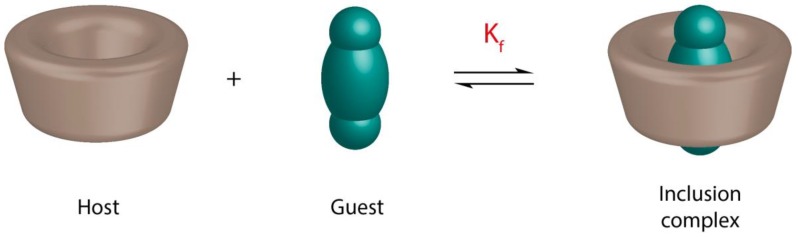
Cyclodextrins (CDs) are a family of cyclic oligosaccharides that constitute one of the most widely used molecular hosts in supramolecular chemistry. Encapsulation in the hydrophobic cavity of CDs positively affects the physical and chemical characteristics of the guests upon the formation of inclusion complexes. Such a property is interestingly employed to retain volatile guests and reduce their volatility. Within this scope, the starting crucial point for a suitable and careful characterization of an inclusion complex is to assess the value of the formation constant (Kf), also called stability or binding constant. This task requires the application of the appropriate analytical method and technique. Thus, the aim of the present paper is to give a general overview of the main analytical tools used for the determination of Kf values for CD/volatile inclusion complexes. This review emphasizes on the advantages, inconvenients and limits of each applied method. A special attention is also dedicated to the improvement of the current methods and to the development of new techniques. Further, the applicability of each technique is illustrated by a summary of data obtained from the literature.
Keywords: HPLC; ITC; NMR; SH-GC; TOC; UV-Visible; cyclodextrin; fluorescence; formation constant; phase solubility; volatiles.
Conflict of interest statement
The authors declare no conflict of interest.
Figures
References
-
- Kfoury M., Hadaruga N., Hadaruga D., Fourmentin S. Encapsulations. Elsevier; New York, NY, USA: 2016. Cyclodextrins as encapsulation material for flavors and aroma; pp. 127–192. Nanotechnology in the AgriFood Industry.
-
- Cabral Marques H.M. A review on cyclodextrin encapsulation of essential oils and volatiles. Flavour Fragr. J. 2010;25:313–326. doi: 10.1002/ffj.2019. - DOI
-
- Rakmai J., Cheirsilp B., Mejuto J.C., Torrado-Agrasar A., Simal-Gándara J. Physico-chemical characterization and evaluation of bio-efficacies of black pepper essential oil encapsulated in hydroxypropyl-beta-cyclodextrin. Food Hydrocoll. 2017;65:157–164. doi: 10.1016/j.foodhyd.2016.11.014. - DOI
-
- Rakmai J., Cheirsil B., Torrado-Agrasar A., Simal-Gándara J., Mejuto J.C. Encapsulation of yarrow essential oil in hydroxypropyl-beta-cyclodextrin: Physiochemical characterization and evaluation of bio-efficacies. CyTA J. Food. 2017;15:409–417. doi: 10.1080/19476337.2017.1286523. - DOI
Publication types
MeSH terms
Substances
LinkOut - more resources
Full Text Sources
Other Literature Sources
Miscellaneous
