. 2018 May 22;71(20):2293-2302.
doi: 10.1016/j.jacc.2018.03.462.

Genetic Etiology for Alcohol-Induced Cardiac Toxicity

Affiliations

Genetic Etiology for Alcohol-Induced Cardiac Toxicity

James S Ware et al. J Am Coll Cardiol. .

Abstract

Background: Alcoholic cardiomyopathy (ACM) is defined by a dilated and impaired left ventricle due to chronic excess alcohol consumption. It is largely unknown which factors determine cardiac toxicity on exposure to alcohol.

Objectives: This study sought to evaluate the role of variation in cardiomyopathy-associated genes in the pathophysiology of ACM, and to examine the effects of alcohol intake and genotype on dilated cardiomyopathy (DCM) severity.

Methods: The authors characterized 141 ACM cases, 716 DCM cases, and 445 healthy volunteers. The authors compared the prevalence of rare, protein-altering variants in 9 genes associated with inherited DCM. They evaluated the effect of genotype and alcohol consumption on phenotype in DCM.

Results: Variants in well-characterized DCM-causing genes were more prevalent in patients with ACM than control subjects (13.5% vs. 2.9%; p = 1.2 ×10⁻⁵), but similar between patients with ACM and DCM (19.4%; p = 0.12) and with a predominant burden of titin truncating variants (TTNtv) (9.9%). Separately, we identified an interaction between TTN genotype and excess alcohol consumption in a cohort of DCM patients not meeting ACM criteria. On multivariate analysis, DCM patients with a TTNtv who consumed excess alcohol had an 8.7% absolute reduction in ejection fraction (95% confidence interval: -2.3% to -15.1%; p < 0.007) compared with those without TTNtv and excess alcohol consumption. The presence of TTNtv did not predict phenotype, outcome, or functional recovery on treatment in ACM patients.

Conclusions: TTNtv represent a prevalent genetic predisposition for ACM, and are also associated with a worse left ventricular ejection fraction in DCM patients who consume alcohol above recommended levels. Familial evaluation and genetic testing should be considered in patients presenting with ACM.

Keywords: alcohol; dilated cardiomyopathy; genetics; titin; variant.


Figures

None
Graphical abstract
Figure 1
Figure 1
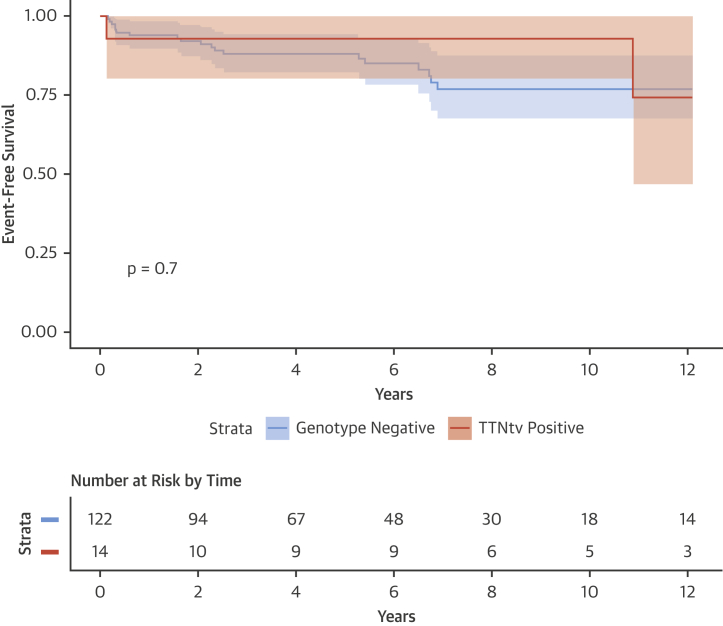
Survival Analysis of ACM Cases According to Genotype Survival curves show freedom from composite primary endpoint (all-cause mortality or cardiac transplant) between ACM cases stratified by genetic status: TTNtv positive (cases with a truncating variant in titin) or TTNtv negative. Event-free survival is measured from time of diagnosis. There is no significant difference between groups. Curves are compared using the log-rank test. ACM = alcoholic cardiomyopathy; TTNtv = titin truncating variant.
Figure 2
Figure 2
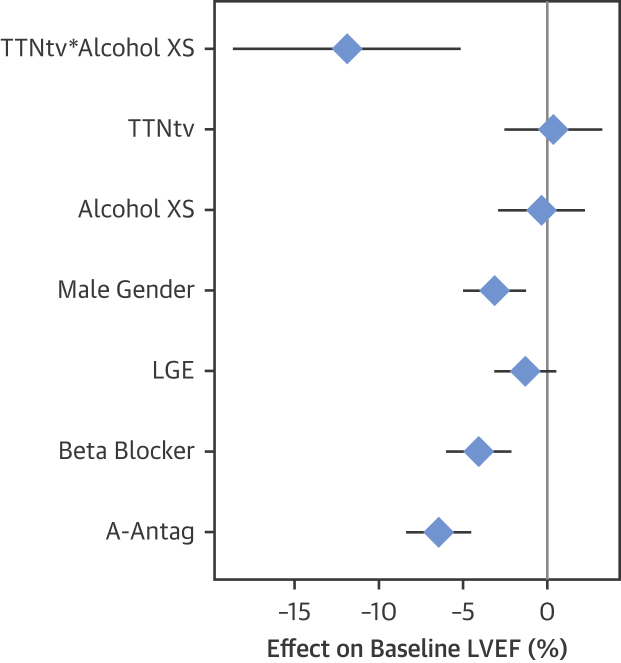
Alcohol and TTNtv Act in Combination, and Together Are Associated With a Lower Baseline LVEF in Patients With DCM Forest plot showing regression coefficient and 95% confidence intervals from the multivariable linear regression model evaluating the effects of TTNtv and excess alcohol consumption on baseline LVEF. The effect on LVEF is shown as absolute difference in LVEF (% = expressed as percentage of end-diastolic volume) between groups. A-Antag = aldosterone antagonist; Alcohol XS = excess alcohol consumption (binary variable indicating consumption >21 U/week for men, >14 U/week for women); LGE = late gadolinium enhancement (indicative of mid-wall fibrosis) on cardiovascular magnetic resonance; LVEF = left ventricular ejection fraction; TTNtv = presence of truncating variant in titin; TTNtv*Alcohol XS = interaction term representing individuals with both a TTNtv and a history of excess alcohol consumption.
Central Illustration
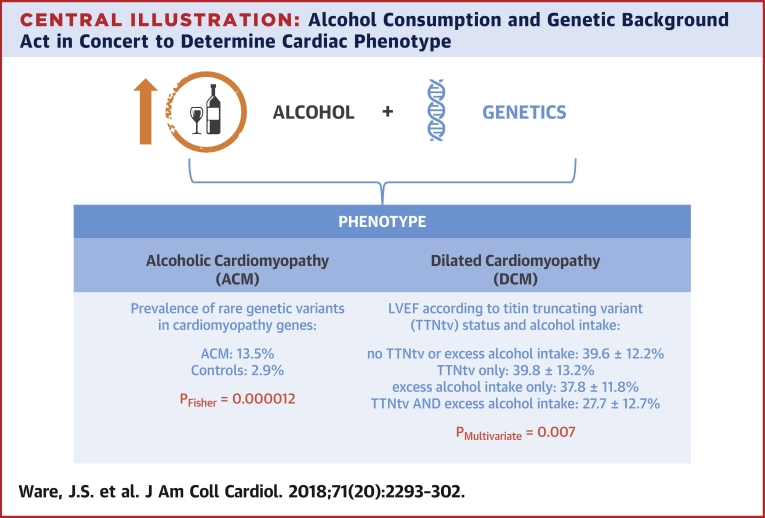
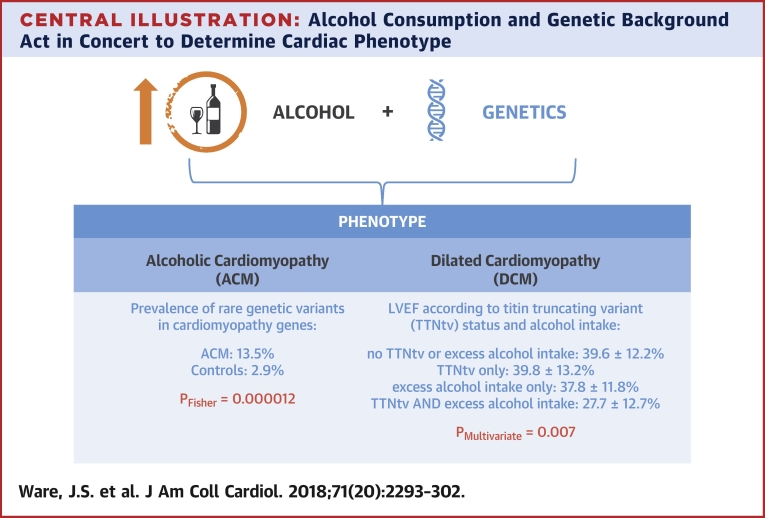
Alcohol Consumption and Genetic Background Act in Concert to Determine Cardiac Phenotype ACM patients exhibit a higher prevalence of rare variants in DCM-associated genes than control subjects. In DCM patients, neither the presence of a TTNtv nor excess alcohol consumption had a significant effect on baseline LVEF in isolation, but the combination was associated with a significantly lower baseline LVEF. Values shown are absolute ejection fraction in each group. The p value is derived from multivariate analysis. ACM = alcoholic cardiomyopathy; DCM = dilated cardiomyopathy; LVEF = left ventricular ejection fraction; TTNtv = titin truncating variant.
Figure 3
Figure 3
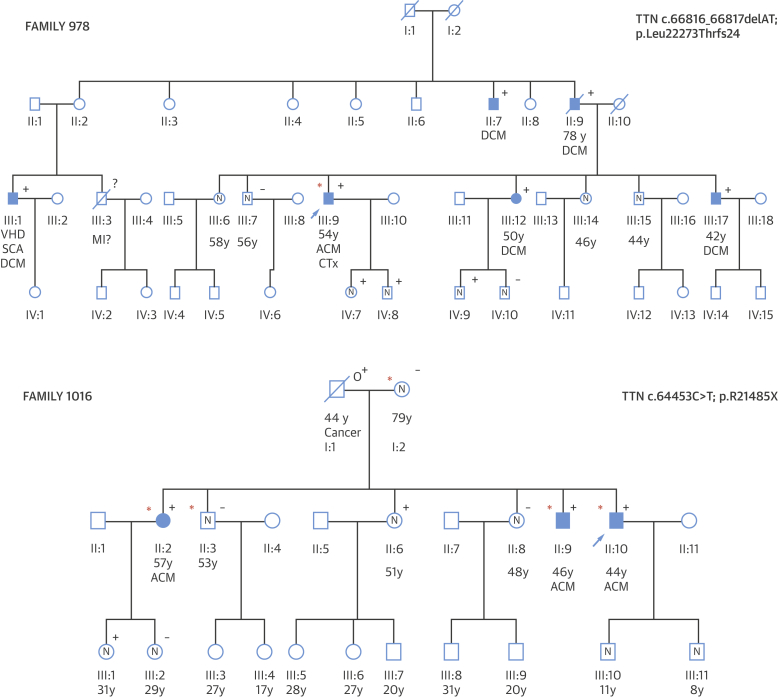
Family Pedigrees Illustrating Coexistence of ACM and DCM and the Combined Effect of Excessive Alcohol Consumption and Genetic Background (Top) Family 978: coexistence of ACM and DCM. The proband (arrow) was diagnosed with ACM and underwent cardiac transplantation. When genetic and clinical familial evaluation was performed, multiple individuals without excessive alcohol consumption were diagnosed with DCM and found to carry TTN truncating variants. (Bottom) Family 1016: combined effect of excessive alcohol consumption and genetic background. The proband (arrow) was diagnosed with ACM at age 44 years and was identified as carrying a TTNtv variant (TTN c.64453C>T; p.R21485X). One brother and 1 sister with prolonged heavy alcohol consumption (red asterisk) and TTNtv also show ACM. Two family members with TTNtv but no regular alcohol intake, and 2 individuals with prolonged heavy alcohol consumption but without TTNtv, did not show cardiac involvement. Standard pedigree notation is used: squares and circles indicate male and female subjects, respectively, a strike-through indicates a deceased individual, an arrow indicates the proband in each family, and filled symbols indicate affected individuals with ACM or DCM. Symbols containing an N represent individuals confirmed as unaffected. +/− symbols indicate genetic evaluation: + indicates carry TTNtv; are noncarriers, o+ are obligate carriers. Red asterisks indicate cases with documented prolonged heavy alcohol consumption. CTx = cardiac transplant; DCM = dilated cardiomyopathy; MI = myocardial infarction; SCA = sudden cardiac arrest; VHD = valvular heart disease; other abbreviations as in Figure 1.

Comment in

References

    1. Urbano-Marquez A., Estruch R., Navarro-Lopez F., Grau J.M., Mont L., Rubin E. The effects of alcoholism on skeletal and cardiac muscle. N Engl J Med. 1989;320:409–415. - PubMed
    1. Fernandez-Sola J. Cardiovascular risks and benefits of moderate and heavy alcohol consumption. Nat Rev Cardiol. 2015;12:576–587. - PubMed
    1. Guzzo-Merello G., Segovia J., Dominguez F. Natural history and prognostic factors in alcoholic cardiomyopathy. J Am Coll Cardiol HF. 2015;3:78–86. - PubMed
    1. George A., Figueredo V.M. Alcoholic cardiomyopathy: a review. J Card Fail. 2011;17:844–849. - PubMed
    1. Xi B., Veeranki S.P., Zhao M., Ma C., Yan Y., Mi J. Relationship of alcohol consumption to all-cause, cardiovascular, and cancer-related mortality in U.S. adults. J Am Coll Cardiol. 2017;70:913–922. - PubMed

Publication types