


Childhood sleep and adolescent chronic fatigue syndrome (CFS/ME): evidence of associations in a UK birth cohort
- PMID: 29773208
- PMCID: PMC5974860
- DOI: 10.1016/j.sleep.2018.01.005
Childhood sleep and adolescent chronic fatigue syndrome (CFS/ME): evidence of associations in a UK birth cohort
Abstract
Objective/background: Sleep abnormalities are characteristic of chronic fatigue syndrome (CFS, also known as 'ME'), however it is unknown whether sleep might be a causal risk factor for CFS/ME.
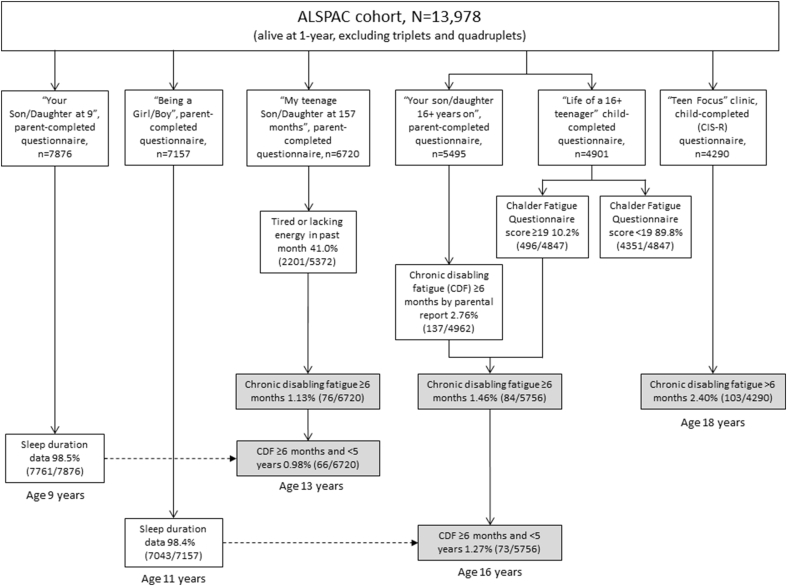
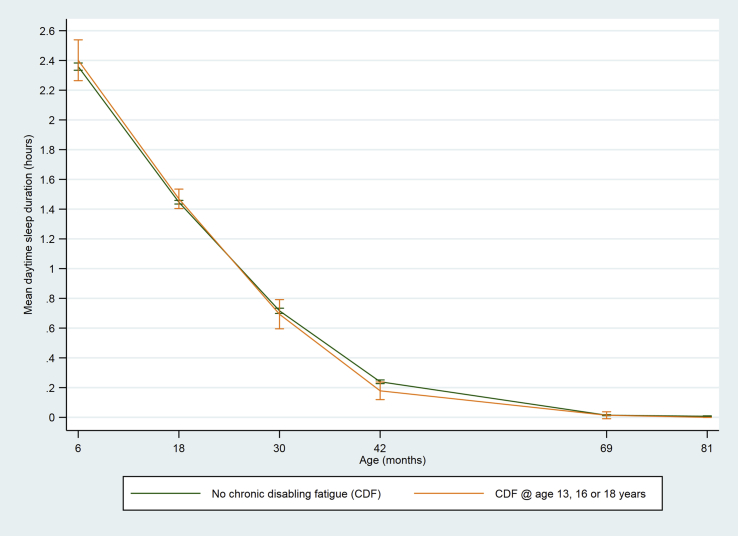
Patients/methods: We analysed data from the Avon Longitudinal Study of Parents and Children (ALSPAC) birth cohort. We describe sleep patterns of children aged 6 months to 11 years, who were subsequently classified as having (or not having) 'chronic disabling fatigue' (CDF, a proxy for CFS/ME) between the ages 13 and 18 years, and we investigated the associations of sleep duration at age nine years with CDF at age 13 years, as well as sleep duration at age 11 years with CDF at age 16 years.
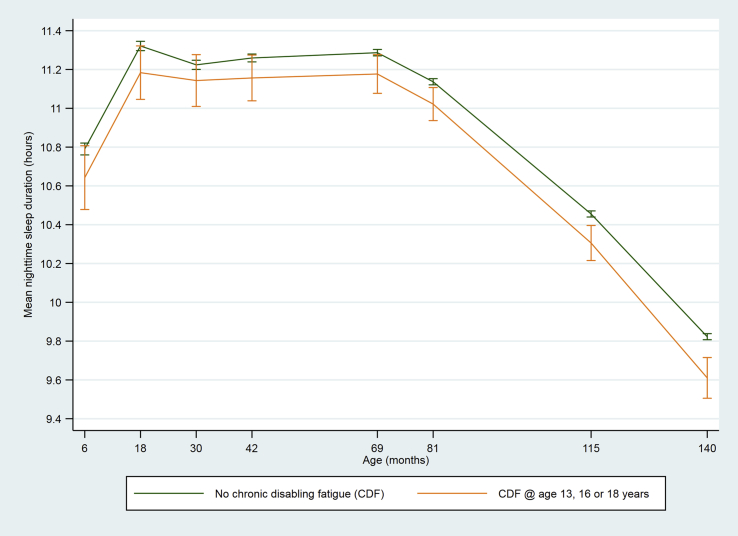
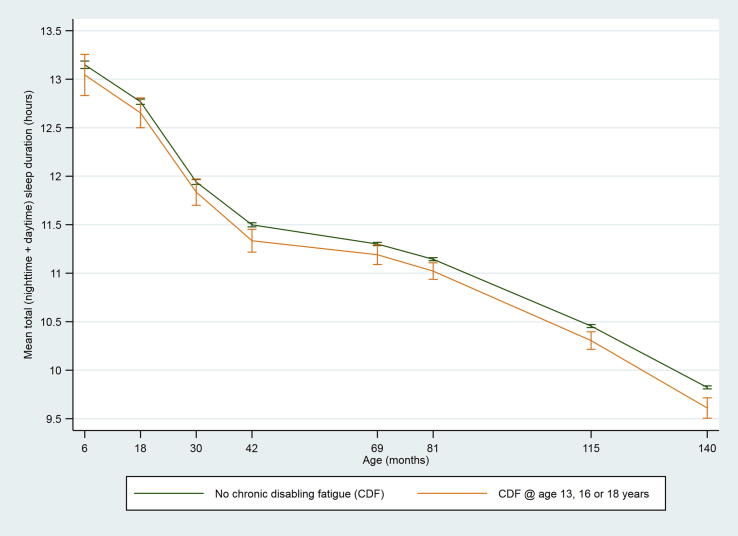
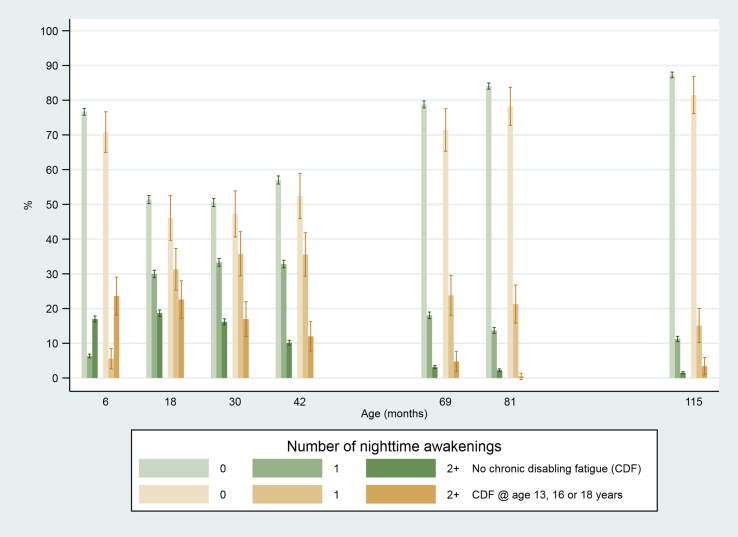
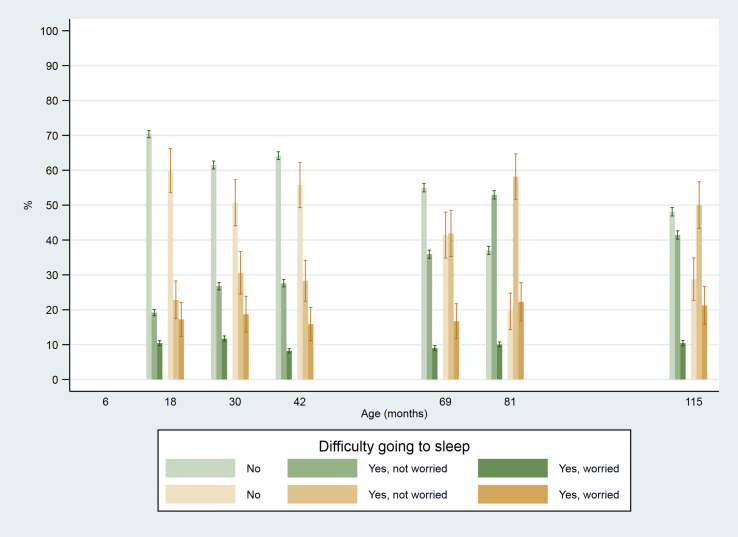
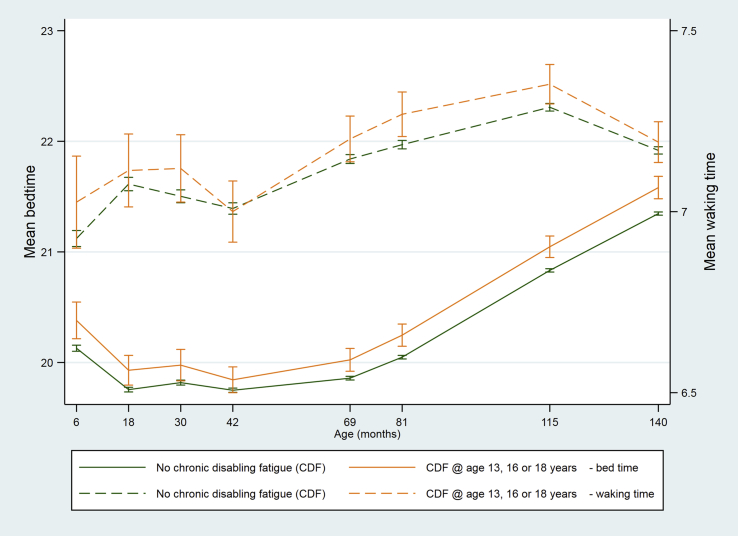
Results: Children who had CDF during adolescence had shorter night-time sleep duration from 6 months to 11 years of age, and there was strong evidence that difficulties in going to sleep were more common in children who subsequently developed CDF. The odds of CDF at age 13 years were 39% lower (odds ratio (OR) = 0.61, 95% CI = 0.43, 0.88) for each additional hour of night-time sleep at age nine years, and the odds of CDF at age 16 years were 51% lower (OR = 0.49, 95% CI = 0.34, 0.70) for each additional hour of night-time sleep at age 11 years. Mean night-time sleep duration at age nine years was 13.9 (95% CI = 3.75, 24.0) minutes shorter among children who developed CDF at age 13 years, and sleep duration at age 11 years was 18.7 (95% CI = 9.08, 28.4) minutes shorter among children who developed CDF at age 16 (compared with children who did not develop CDF at 13 and 16 years, respectively).
Conclusions: Children who develop chronic disabling fatigue in adolescence have shorter night-time sleep duration throughout early childhood, suggesting that sleep abnormalities may have a causal role in CFS/ME or that sleep abnormalities and CFS/ME are associated with a common pathophysiological cause.
Keywords: ALSPAC; Adolescence; CFS/ME; Chronic fatigue syndrome; Paediatric; Sleep.
Copyright © 2018 The Author(s). Published by Elsevier B.V. All rights reserved.
Figures
References
-
- Werker C.L., Nijhof S.L., van de Putte E.M. Clinical practice: chronic fatigue syndrome. Eur J Pediatr. 2013;172:1293–1298. - PubMed
-
- Missen A., Hollingworth W., Eaton N. The financial and psychological impacts on mothers of children with chronic fatigue syndrome (CFS/ME) Child Care Health Dev. 2012;38:505–512. - PubMed
-
- Crawley E., Sterne J.A. Association between school absence and physical function in paediatric chronic fatigue syndrome/myalgic encephalopathy. Arch Dis Child. 2009;94:752–756. - PubMed
-
- National Institute for Health and Care Excellence (NICE) NICE; London: 2007. Chronic fatigue syndrome/myalgic encephalomyelitis (or encephalopathy): diagnosis and management of CFS/ME in adults and children (NICE guidelines CG53)
-
- Fukuda K., Straus S.E., Hickie I., International Chronic Fatigue Syndrome Study Group The chronic fatigue syndrome: a comprehensive approach to its definition and study. Ann Intern Med. 1994;121:953–959. - PubMed
Publication types
MeSH terms
Grants and funding
LinkOut - more resources
Full Text Sources
Other Literature Sources
Medical
Molecular Biology Databases
