


Lymphoedema management to prevent acute dermatolymphangioadenitis in podoconiosis in northern Ethiopia (GoLBeT): a pragmatic randomised controlled trial
- PMID: 29773516
- PMCID: PMC6562300
- DOI: 10.1016/S2214-109X(18)30124-4
Lymphoedema management to prevent acute dermatolymphangioadenitis in podoconiosis in northern Ethiopia (GoLBeT): a pragmatic randomised controlled trial
Abstract
Background: Podoconiosis (also known as endemic, non-filarial elephantiasis) affects about 4 million subsistence farmers in tropical Africa. Poor awareness of the condition and inadequate evidence for the efficacy of treatment mean that no government in an endemic country yet offers lymphoedema management for patients with podoconiosis. Among patients with filarial lymphoedema, trials suggest that limb care is effective in reducing the most disabling sequelae: episodes of acute dermatolymphangioadenitis. We aimed to test the hypothesis that a simple, inexpensive lymphoedema management package would reduce the incidence of acute dermatolymphangioadenitis in adult patients with podoconiosis in northern Ethiopia.
Methods: We did a pragmatic randomised controlled trial at health posts and health centres in 18 sub-districts of Aneded woreda (district) in Amhara, northern Ethiopia. Participants were adults aged 18 years and older, had a diagnosis of at least stage 2 podoconiosis (persistent lymphoedema) and a negative antigen test for filariasis, and intended to remain within Aneded woreda for the duration of the trial. Patients were randomly assigned (1:1) to either receive a package containing instructions for foot hygiene, skin care, bandaging, exercises, and use of socks and shoes, with support by lay Community Podoconiosis Agents at monthly meetings (intervention group) or to receive no intervention (control group). Participants were aware of their group assignment, but researchers doing all analyses were masked to treatment group. The primary outcome was incidence of acute dermatolymphangioadenitis episodes in the total period of observation of each participant, measured by use of validated patient self-reported pictorial diaries. This trial was registered with the International Standard Randomised Controlled Trials Number Register, number ISRCTN67805210.
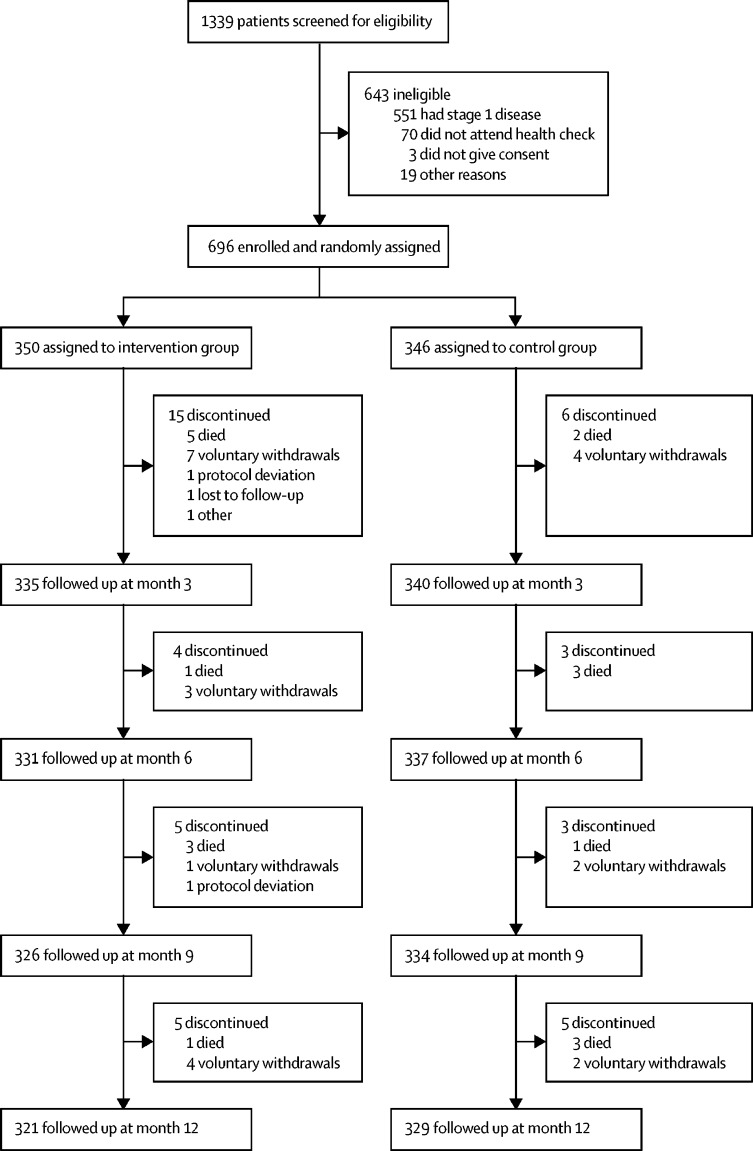
Findings: Between Dec 1, 2014, and June 30, 2015, 1339 patients were screened, and 696 patients were enrolled and randomly allocated to treatment groups. We allocated 350 patients to the intervention group and 346 patients to the control group. 321 (92%) patients from the intervention group and 329 (95%) patients from the control group provided follow-up results at 12 months. During the 12 months of follow-up, 16 550 new episodes of acute dermatolymphangioadenitis occurred during 765·2 person-years. The incidence of acute dermatolymphangioadenitis was 19·4 episodes per person-year (95% CI 18·9-19·9) in the intervention group and 23·9 episodes per person-year (23·4-24·4) in the control group. The ratio of incidence rate in the intervention group to that of the control group was 0·81 (0·74 to 0·89; p<0·0001), with a rate difference of -4·5 (-5·1 to -3·8) episodes per person-year. No serious adverse events related to the intervention were reported.
Interpretation: A simple, inexpensive package of lymphoedema self-care is effective in reducing the frequency and duration of acute dermatolymphangioadenitis. We recommend its implementation by the governments of endemic countries.
Funding: Joint Global Health Trials scheme (from the Wellcome Trust, the UK Medical Research Council, and UK Aid).
Copyright © 2018 The Author(s). Published by Elsevier Ltd. This is an Open Access article under the CC BY 4.0 license. Published by Elsevier Ltd.. All rights reserved.
Comment in
-
Integrated care programme for acute episodes in patients with podoconiosis.Lancet Glob Health. 2018 Jul;6(7):e714-e715. doi: 10.1016/S2214-109X(18)30226-2. Epub 2018 May 15. Lancet Glob Health. 2018. PMID: 29773515 No abstract available.
-
Lymphoedema management in podoconiosis.Lancet Glob Health. 2018 Sep;6(9):e962. doi: 10.1016/S2214-109X(18)30328-0. Lancet Glob Health. 2018. PMID: 30103994 No abstract available.
-
Lymphoedema management in podoconiosis - Authors reply.Lancet Glob Health. 2018 Sep;6(9):e963. doi: 10.1016/S2214-109X(18)30330-9. Lancet Glob Health. 2018. PMID: 30103995 Free PMC article. No abstract available.
References
-
- Price EW. The association of endemic elephantiasis of the lower legs in East Africa with soil derived from volcanic rocks. Trans R Soc Trop Med Hyg. 1976;70:288–295. - PubMed
-
- Price EW, Bailey D. Environmental factors in the etiology of endemic elephantiasis of the lower legs in tropical Africa. Trop Geogr Med. 1984;36:1–5. - PubMed
-
- Ferguson J, Yeshanehe WE, Matts P, Davey G, Mortimer P, Fuller C. Assessment of skin barrier function in podoconiosis: measurement of stratum corneum hydration and transepidermal water loss. Br J Dermatol. 2013;168:550–554. - PubMed
-
- Price EW. The site of lymphatic blockade in endemic (non-filarial) elephantiasis of the lower legs. J Trop Med Hyg. 1977;80:230–237. - PubMed
Publication types
MeSH terms
Associated data
Grants and funding
LinkOut - more resources
Full Text Sources
Other Literature Sources
Medical
Research Materials
