Clinical Trial
. 2018 Aug;103(8):1298-1307.
doi: 10.3324/haematol.2017.171249. Epub 2018 May 17.

Safety and efficacy of second-line bosutinib for chronic phase chronic myeloid leukemia over a five-year period: final results of a phase I/II study

Affiliations
Clinical Trial

Safety and efficacy of second-line bosutinib for chronic phase chronic myeloid leukemia over a five-year period: final results of a phase I/II study

Carlo Gambacorti-Passerini et al. Haematologica. 2018 Aug.

Abstract

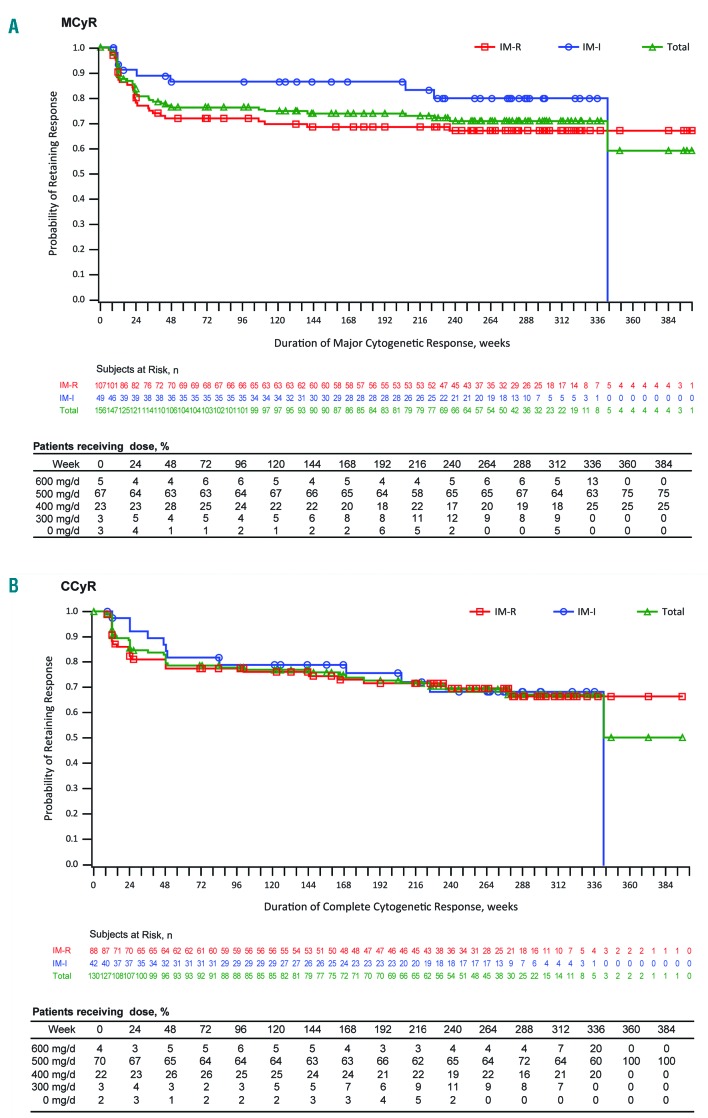
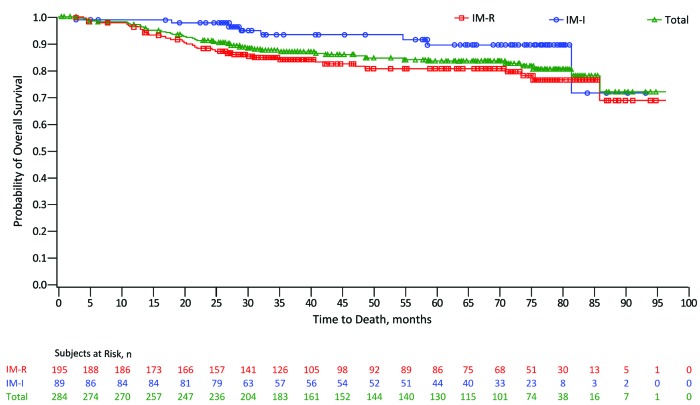
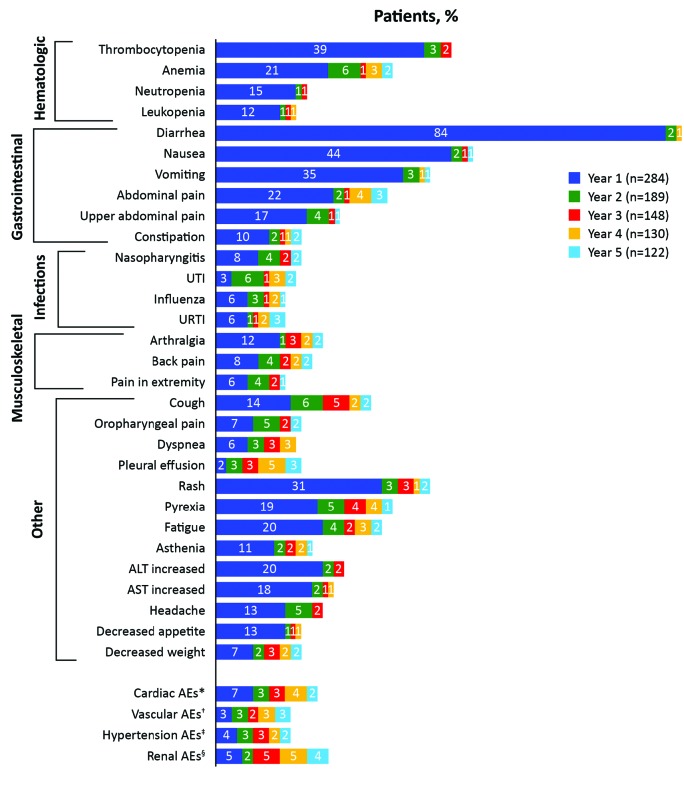
Bosutinib is a Src/Abl tyrosine kinase inhibitor indicated for adults with newly-diagnosed Philadelphia positive chronic myeloid leukemia or with resistant/intolerant disease. We report the final results of a phase I/II study of second-line bosutinib in chronic phase chronic myeloid leukemia patients after imatinib failure (n=284). Median follow up and treatment durations were 54.8 (range 0.6-96.3) and 25.6 (0.2-96.3) months, respectively. At years 2 and 5, 54% and 40% of patients, respectively, remained on bosutinib. Cumulative major cytogenetic response and complete cytogenetic response rates (newly-attained or maintained from baseline) were 58% and 46%, respectively, by year 2 and 60% and 50% by year 5. Kaplan-Meier probability of maintaining major and complete cytogenetic response was 76% and 78%, respectively, at year 2 and 71% and 69% at year 5. Cumulative incidence of on-treatment disease progression/death was similar at years 5 (19%) and 2 (15%); Kaplan-Meier overall survival was 91% at year 2 and 84% at year 5. Of 169 patients who had discontinued bosutinib by year 5, 38 did so after year 2, most commonly for disease progression (n=11). Most adverse events initially occurred within two years. Overall, gastrointestinal events were the most common (diarrhea 86%, nausea 46%, vomiting 37%); the most common grade 3/4 toxicity was thrombocytopenia (25%). None of the 4 on-treatment deaths in years 3-5 were related to bosutinib. Bosutinib demonstrated durable efficacy and manageable toxicity through year 5 confirming its importance in the treatment of chronic phase chronic myeloid leukemia patients resistant/intolerant to prior imatinib. This trial was registered at clinicaltrials.gov identifier: 00261846.

Trial registration: ClinicalTrials.gov NCT00261846.


Figures

Figure 1.
Figure 1.
Duration of response. Duration of major cytogenetic response (MCyR) (A) and complete cytogenetic response (CCyR) (B) among responders. Open circles indicate censored observations. IM-I: imatinib-intolerant; IM-R: imatinib-resistant; n: number; d: day.
Figure 2.
Figure 2.
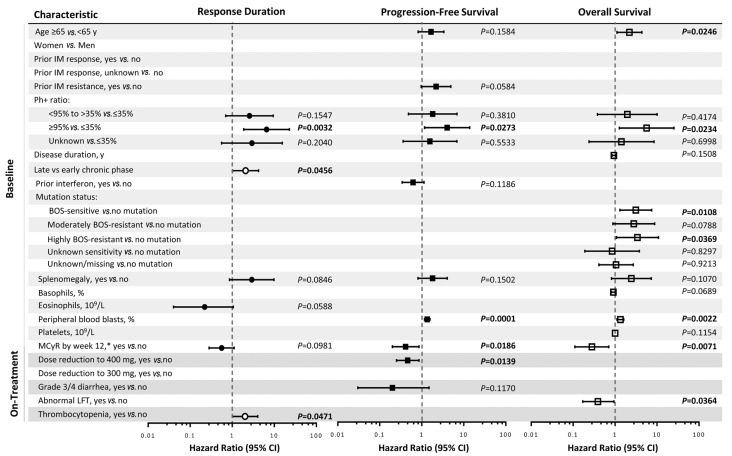
Predictors of response loss, disease progression, and death. Closed circles represent major cytogenetic response (MCyR) duration and open circles represent complete cytogenetic response. Based on multivariate Cox regression models. Parameters failing to meet elimination criteria (0.20) not shown. Hazard ratios >1 indicate worse outcome. P-values were not adjusted for multiple comparisons; significant P-values are in bold. Definitions of covariates can be found in the Online Supplementary Methods. On-treatment characteristics are Cox time-dependent covariates. *Baseline factor for durable response model. BOS: bosutinib; IM: imatinib; LFT: liver function test; Ph+: Philadelphia chromosome positive; y: years; CI: confidence interval.
Figure 3.
Figure 3.
Kaplan-Meier estimated overall survival. Open circles indicate censored observations. Overall survival was calculated as the first date of study dosing until the date of death; patients without events were censored at the last contact. Per protocol, patients were followed for overall survival for two years after treatment discontinuation. Analysis includes data from a long-term extension study. IM-I: imatinib-intolerant; IM-R: imatinib-resistant; n: number.
Figure 4.
Figure 4.
Incidence of newly-occurring adverse events (AEs) over time. Denominators are the number of patients on treatment during the indicated years (NB: incidences of certain AEs appear higher in later years compared with previous years due to a lower number of patients on treatment). Newly-occurring AEs were those not experienced by the same patient previously among patients on treatment during a given year (1 year = 365.25 days). *Includes the high-level group terms (HLGTs) cardiac arrhythmias, pericardial disorders, and heart failures under the cardiac disorders system organ class (SOC); relevant preferred terms (PTs) (cardiac death, sudden cardiac death, sudden death) under the general disorders and administration site SOC conditions; relevant PTs (decreased ejection fraction, abnormal electrocardiogram QT interval, prolonged electrocardiogram QT, long QT syndrome, congenital long QT syndrome, Torsade de pointes, ventricular tachycardia) under the SOC investigations. HLGTs included: coronary artery disorders, atherosclerosis, stenosis, vascular insufficiency and necrosis, embolism and thrombosis; high-level terms (HLTs) included arterial therapeutic procedures (excluding aortic), central nervous system hemorrhages and cerebrovascular accidents, central nervous system vascular disorders not elsewhere classified (NEC), non-site specific vascular disorders NEC, peripheral vascular disorders NEC (excluding the PTs flushing and hot flash), transient cerebrovascular events, vascular imaging procedures NEC, and vascular therapeutic procedures NEC and all subordinate terms. HLGTs included: vascular hypertensive disorders and cardiac and vascular investigations (excluding enzyme tests), the HLT vascular tests NEC (including blood pressure); PTs included: abnormal blood pressure, abnormal ambulatory blood pressure, increased ambulatory blood pressure, abnormal diastolic blood pressure, increased diastolic blood pressure, increased blood pressure, abnormal systolic blood pressure, and increased systolic blood pressure. §HLT included: renal failure and impairment; PTs included: blood creatinine abnormal, blood creatinine increased, creatinine renal clearance abnormal, creatinine renal clearance decreased, glomerular filtration rate abnormal, glomerular filtration rate decreased. ALT: alanine aminotransferase; AST: aspartate aminotransferase; URTI: upper respiratory tract infection; UTI: urinary tract infection; n: number.

References

    1. Gambacorti-Passerini C, Antolini L, Mahon FX, et al. Multicenter independent assessment of outcomes in chronic myeloid leukemia patients treated with imatinib. J Natl Cancer Inst. 2011;103(7):553–561. - PubMed
    1. Vigano I, Di Giacomo N, Bozzani S, Antolini L, Piazza R, Gambacorti Passerini C. First-line treatment of 102 chronic myeloid leukemia patients with imatinib: a long-term single institution analysis. Am J Hematol. 2014;89(10):E184–187. - PubMed
    1. GLEEVEC® (imatinib mesylate). Full Prescribing Information. Novartis Pharmaceuticals Corporation, East Hanover, NJ, USA, 2016.
    1. TASIGNA® (nilotinib). Full Prescribing Information. Novartis Pharmaceuticals Corporation, East Hanover, NJ, USA, 2016.
    1. SPRYCEL® (dasatinib). Full Prescribing Information. Bristol-Myers Squibb Company, Princeton, NJ, USA, 2016.

Publication types

MeSH terms

Associated data