Clofarabine, high-dose cytarabine and liposomal daunorubicin in pediatric relapsed/refractory acute myeloid leukemia: a phase IB study
- PMID: 29773602
- PMCID: PMC6119144
- DOI: 10.3324/haematol.2017.187153
Clofarabine, high-dose cytarabine and liposomal daunorubicin in pediatric relapsed/refractory acute myeloid leukemia: a phase IB study
Abstract
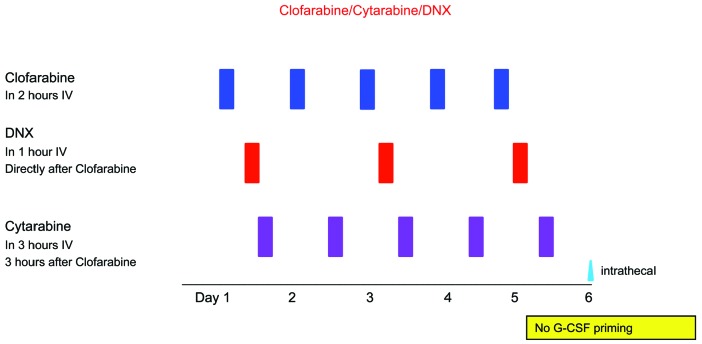
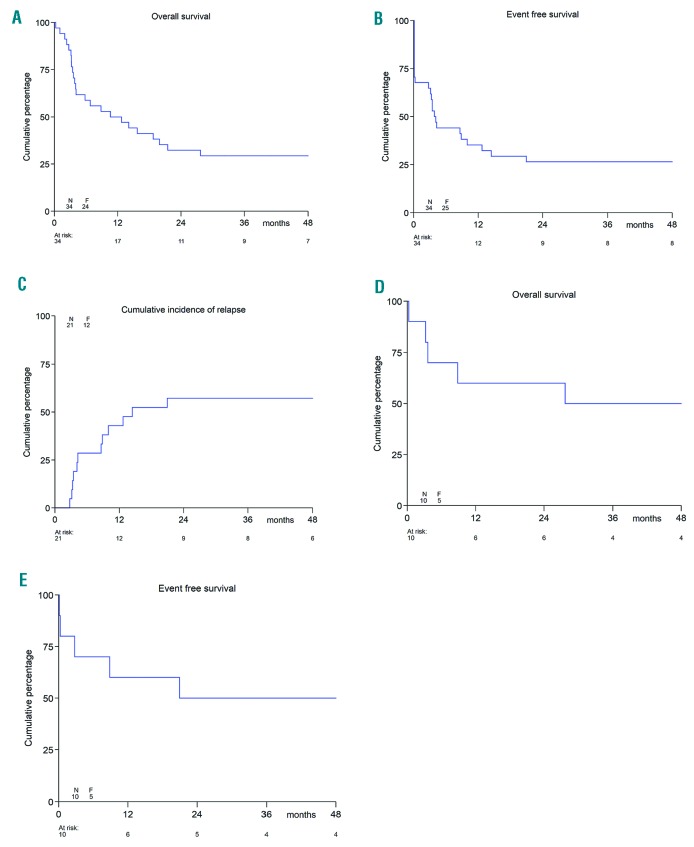
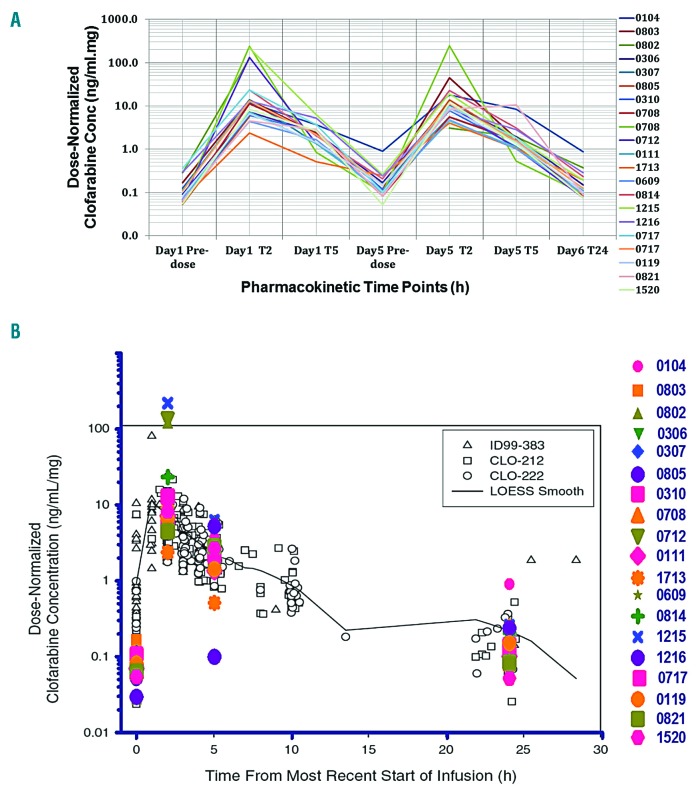
Survival in children with relapsed/refractory acute myeloid leukemia is unsatisfactory. Treatment consists of one course of fludarabine, cytarabine and liposomal daunorubicin, followed by fludarabine and cytarabine and stem-cell transplantation. Study ITCC 020/I-BFM 2009-02 aimed to identify the recommended phase II dose of clofarabine replacing fludarabine in the abovementioned combination regimen (3+3 design). Escalating dose levels of clofarabine (20-40 mg/m2/day × 5 days) and liposomal daunorubicin (40-80 mg/m2/day) were administered with cytarabine (2 g/m2/day × 5 days). Liposomal DNR was given on day 1, 3 and 5 only. The cohort at the recommended phase II dose was expanded to make a preliminary assessment of anti-leukemic activity. Thirty-four children were enrolled: refractory 1st (n=11), early 1st (n=15), ≥2nd relapse (n=8). Dose level 3 (30 mg/m2clofarabine; 60 mg/m2liposomal daunorubicin) appeared to be safe only in patients without subclinical fungal infections. Infectious complications were dose-limiting. The recommended phase II dose was 40 mg/m2 clofarabine with 60 mg/m2 liposomal daunorubicin. Side-effects mainly consisted of infections. The overall response rate was 68% in 31 response evaluable patients, and 80% at the recommended phase II dose (n=10); 22 patients proceeded to stem cell transplantation. The 2-year probability of event-free survival (pEFS) was 26.5±7.6 and probability of survival (pOS) 32.4±8.0%. In the 21 responding patients, the 2-year pEFS was 42.9±10.8 and pOS 47.6±10.9%. Clofarabine exposure in plasma was not significantly different from that in single-agent studies. In conclusion, clofarabine was well tolerated and showed high response rates in relapsed/refractory pediatric acute myeloid leukemia. Patients with (sub) clinical fungal infections should be treated with caution. Clofarabine has been taken forward in the Berlin-Frankfurt-Münster study for newly diagnosed acute myeloid leukemia. The Study ITCC-020 was registered as EUDRA-CT 2009-009457-13; Dutch Trial Registry number 1880.
Copyright© 2018 Ferrata Storti Foundation.
Figures
References
-
- Gorman MF, Ji L, Ko RH, et al. Outcome for children treated for relapsed or refractory acute myelogenous leukemia (rAML): a Therapeutic Advances in Childhood Leukemia (TACL) Consortium study. Pediatr Blood Cancer. 2010;55(3):421–429. - PubMed
-
- Kaspers GJ, Zimmermann M, Reinhardt D, et al. Improved outcome in pediatric relapsed acute myeloid leukemia: results of a randomized trial on liposomal daunorubicin by the International BFM Study Group. J Clin Oncol. 2013;31(5):599–607. - PubMed
-
- Milligan DW, Wheatley K, Littlewood T, Craig JI, Burnett AK, Group NHOCS. Fludarabine and cytosine are less effective than standard ADE chemotherapy in high-risk acute myeloid leukemia, and addition of G-CSF and ATRA are not beneficial: results of the MRC AML-HR randomized trial. Blood. 2006;107(12):4614–4622. - PubMed
-
- Ehlers S, Herbst C, Zimmermann M, et al. Granulocyte colony-stimulating factor (G-CSF) treatment of childhood acute myeloid leukemias that overexpress the differentiation-defective G-CSF receptor isoform IV is associated with a higher incidence of relapse. J Clin Oncol. 2010;28(15):2591–2597. - PubMed
Publication types
MeSH terms
Substances
Associated data
LinkOut - more resources
Full Text Sources
Other Literature Sources
Medical