. 2018 May 17;8(1):7130.
doi: 10.1038/s41598-018-25199-w.

Cardiovascular Disease Risk Varies by Birth Month in Canines

Affiliations

Cardiovascular Disease Risk Varies by Birth Month in Canines

Mary Regina Boland et al. Sci Rep. .

Abstract

The canine heart is a robust physiological model for the human heart. Recently, birth month associations have been reported and replicated in humans using clinical health records. While animals respond readily to their environment in the wild, a systematic investigation of birth season dependencies among pets and specifically canines remains lacking. We obtained data from the Orthopedic Foundation of Animals on 129,778 canines representing 253 distinct breeds. Among canines that were not predisposed to cardiovascular disease, a clear birth season relationship is observed with peak risk occurring in June-August. Our findings indicate that acquired cardiovascular disease among canines, especially those that are not predisposed to cardiovascular disease, appears birth season dependent. The relative risk of cardiovascular disease for canines not predisposed to cardiovascular disease was as high as 1.47 among July pups. The overall adjusted odds ratio, when mixed breeds were excluded, for the birth season effect was 1.02 (95% CI: 1.002, 1.047, p = 0.032) after adjusting for breed and genetic cardiovascular predisposition effects. Studying birth season effects in model organisms can help to elucidate potential mechanisms behind the reported associations.


Conflict of interest statement

The authors declare no competing interests.

Figures

Figure 1
Figure 1
Algorithm for Processing OFA Cardiac Reports from Canines and Categorizing Each Canine’s Overall Cardiac Health Status. All dog icons (“akita”, “pomeranian”, “doberman”, “dalmatian”, “poodle”) within the figure are by: parkjisun, from thenounproject.com.
Figure 2
Figure 2
Prevalence of Breed Clade in the Public OFA Dataset (left-graph) and Proportion with Cardiovascular Disease per Breed Clade (right-graph). Some breeds (e.g., retrievers/pointers) were very common (left-graph red clade) while having only moderate levels of cardiovascular disease risk (right-graph red clade). While other clades (e.g., grass-green clade) had a high-risk of cardiovascular disease (right graph).
Figure 3
Figure 3
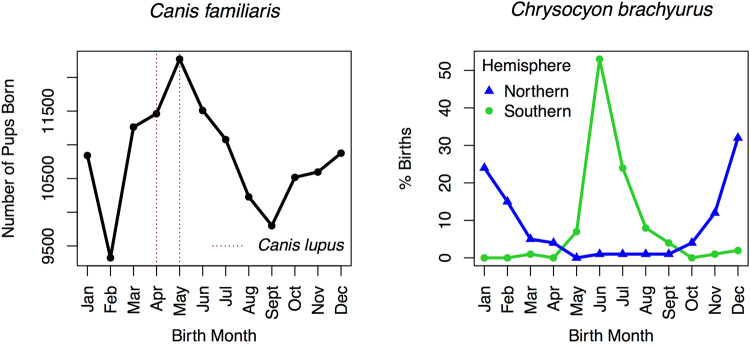
Number of Canis familiaris pups born per month in the OFA dataset (left-hand graph) and Chrysocyon brachyurus (maned wolf) born in captivity when exposed to Northern or Southern Hemisphere Climate. Left-hand graph shows the crude background birth rate by month of all pups/dogs included in the OFA dataset analyzed in this study. April and May are highlighted as these represent wild birth month dates for Canis lupus in extreme Northern climates. Right-hand graph shows data on captive maned wolves (Chrysocyon brachyurus) left to breed in Northern or Southern Hemispheres from Maia et Gouveia.
Figure 4
Figure 4
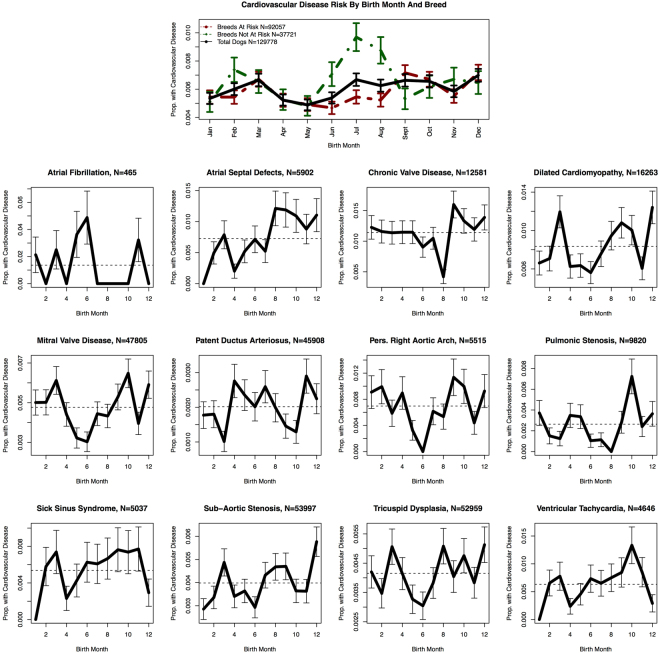
Cardiovascular Disease Risk Varies by Birth Month Among Canines that are not Predisposed to Cardiovascular Disease. The twelve subplots in the lower portion of the figure show the break down by birth month of dogs that are susceptible to that particular subtype of cardiovascular disease. The y-axis displays the proportion within those cohorts that developed cardiovascular disease.
Figure 5
Figure 5
Cardiovascular Disease Risk By Birth Month in Canines (Canis familiaris) and Humans (Homo sapiens). The vertical lines represent the inferred conception month for the high-risk birth month in each group. Canines from breeds at risk for cardiovascular disease have a peak birth month in September, which corresponds to a July conception month. Canines from breeds not at risk for cardiovascular disease have a peak birth month in July corresponding to a May conception month. Shaded in red is the period between the two conception months. In humans (lower graph) there is some differences between Mount Sinai Hospital (MSH) and Columbia University Medical Center (CUMC). Again the inferred conception month for the peak birth month for cardiovascular risk is highlighted (dashed vertical lines, April for MSH and June for CUMC). The first trimester period for both MSH and CUMC for the peak coronary arteriosclerosis birth month at both sites (Jan – MSH, Mar – CUMC) is highlighted in red. We highlight the first trimester in humans, as this is the developmental period that is most comparable with canines. Notice the overlap between the highlighted red regions between canines (upper graph) and humans (lower graph) with regards to peak cardiovascular disease risk conception periods. There is overlap between these regions for June and July.

References

    1. Azevedo L, Serrano C, Amorim A, Cooper DN. Trans-species polymorphism in humans and the great apes is generally maintained by balancing selection that modulates the host immune response. Human Genomics. 2015;9:1–6. doi: 10.1186/s40246-015-0043-1. - DOI - PMC - PubMed
    1. Boyko AR. The domestic dog: man’s best friend in the genomic era. Genome biology. 2011;12:216. doi: 10.1186/gb-2011-12-2-216. - DOI - PMC - PubMed
    1. Cadieu E, et al. Coat variation in the domestic dog is governed by variants in three genes. science. 2009;326:150–153. doi: 10.1126/science.1177808. - DOI - PMC - PubMed
    1. Hagenaars SP, et al. Genetic prediction of male pattern baldness. PLoS genetics. 2017;13:e1006594. doi: 10.1371/journal.pgen.1006594. - DOI - PMC - PubMed
    1. Parker HG, et al. An expressed fgf4 retrogene is associated with breed-defining chondrodysplasia in domestic dogs. Science. 2009;325:995–998. doi: 10.1126/science.1173275. - DOI - PMC - PubMed

Publication types

LinkOut - more resources