. 2018 May 8:14:1171-1181.
doi: 10.2147/NDT.S156501. eCollection 2018.

The impact of total sleep deprivation upon cognitive functioning in firefighters

Affiliations

The impact of total sleep deprivation upon cognitive functioning in firefighters

Sławomir Kujawski et al. Neuropsychiatr Dis Treat. .

Abstract

Introduction: Firefighters as a profession are required to maintain high levels of attention for prolonged periods. However, total sleep deprivation (TSD) could influence negatively upon performance, particularly when the task is prolonged and repetitive.

Purpose: The aim of this study is to examine the influence of TSD on cognitive functioning in a group of firefighters.

Subjects and methods: Sixty volunteers who were active male fire brigade officers were examined with a computerized battery test that consisted of simple reaction time (SRT) (repeated three times), choice reaction time, visual attention test, and delayed matching to sample. Six series of measurements were undertaken over a period of TSD.

Results: Performance in the second attempt in SRT test was significantly worse in terms of increased number of errors and, consequently, decreased number of correct responses during TSD. In contrast, the choice reaction time number of correct responses as well as the visual attention test reaction time for all and correct responses significantly improved compared to initial time points.

Conclusion: The study has confirmed that subjects committed significantly more errors and, consequently, noted a smaller number of correct responses in the second attempt of SRT test. However, the remaining results showed reversed direction of TSD influence. TSD potentially leads to worse performance in a relatively easy task in a group of firefighters. Errors during repetitive tasks in firefighting routines could potentially translate into catastrophic consequences.

Keywords: choice reaction time; constant routine protocol; delayed matching to sample mental functioning; simple reaction time; visual attention test.


Conflict of interest statement

Disclosure The authors report no conflicts of interest in this work.

Figures
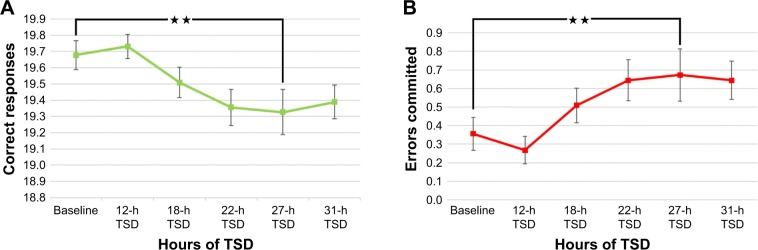
Figure 1
Figure 1
Number of correct responses and errors committed in SRT tests. Notes: (A) The X-axis indicates the time point of battery test execution. The Y-axis indicates the analyzed results of the test (number of correct responses in that case). Attempts in SRT test in which statistically significant effect of sleep deprivation on correct responses was observed using repeated measures ANOVA. Statistically significant differences in the number of correct responses between particular time points revealed by the post hoc Bonferroni correction are marked with double asterisks (p<0.05). Errors bars indicate SE. (B) Statistically significant differences in the number of errors committed between particular time points revealed by the post hoc Bonferroni correction are marked with double asterisks (p<0.05). Interestingly, differences in the number of committed errors among three attempts in SRT are the lowest in the last time point. Abbreviations: ANOVA, analysis of variance; SE, standard error; SRT, simple reaction time; TSD, total sleep deprivation.
Figure 2
Figure 2
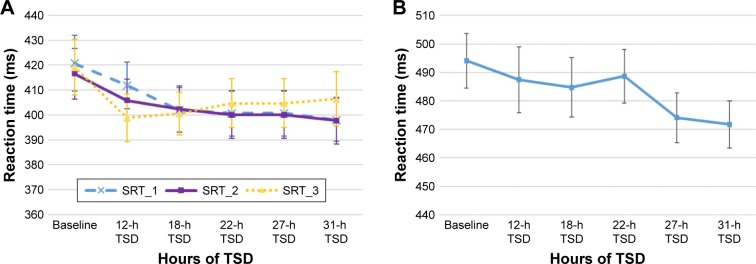
Reaction time in SRT and CRT tests. Notes: (A) No statistically significant (p>0.05) effects of TSD on reaction time or on the correct reaction time (results not shown) in SRT test were observed. Interestingly, an opposite trend could be observed, that is, the reaction times tend to be lower (improved) in the following attempts. (B) Statistically significant effect of TSD on the reaction time in correct and all responses in CRT test was observed using repeated measures ANOVA (p<0.05). The greatest reaction time was obtained in the first time point of TSD. Abbreviations: ANOVA, analysis of variance; CRT, choice reaction time; SRT, simple reaction time; TSD, total sleep deprivation.
Figure 3
Figure 3
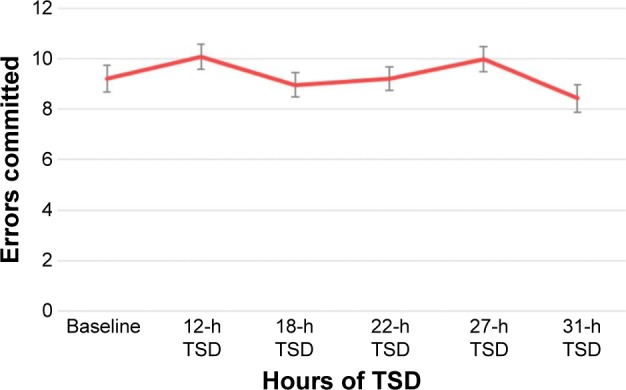
Number of errors committed in delayed matching to sample (DMS) test. Notes: Statistically significant effect of TSD on the number of committed errors in DMS test was observed using repeated measures ANOVA (p<0.05). Interestingly, the last time point was characterized by the lowest mean number of committed errors. Abbreviations: ANOVA, analysis of variance; TSD, total sleep deprivation.
Figure 4
Figure 4
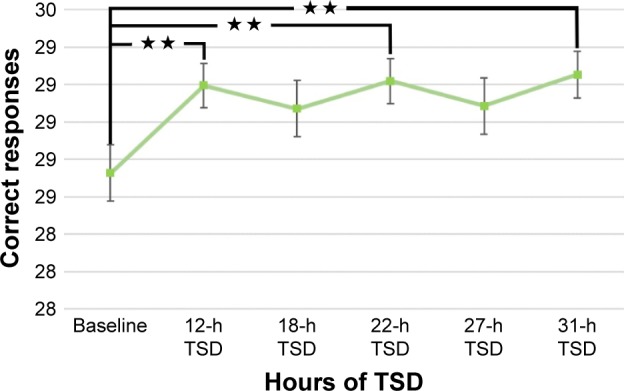
Number of correct responses in CRT test. Notes: Statistically significant differences in the number of correct responses between particular time points revealed by the post hoc Bonferroni correction are marked with double asterisks (p<0.05). The lowest number of correct responses was obtained in the first time point of TSD. Abbreviations: ANOVA, analysis of variance; CRT, choice reaction time; TSD, total sleep deprivation.
Figure 5
Figure 5
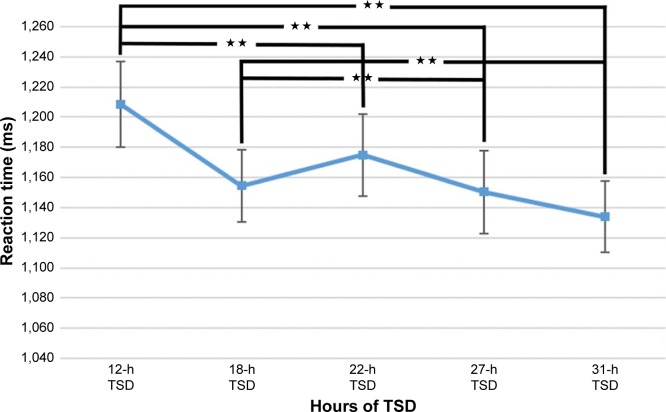
Reaction time in VAT. Notes: Statistically significant differences in the reaction time between particular time points revealed by the post hoc Bonferroni correction are marked with double asterisks (p<0.05). Interestingly, VAT reaction times for all responses tend to decrease in the second, third, and fourth time points in TSD, while the reaction time in the last three time points tend to be at a relatively constant level. Abbreviations: TSD, total sleep deprivation; VAT, visual attention test.

References

    1. Robinson ES, Bills AG. Two factors in the work decrement. Can J Exp Psychol. 1926;9:415–443.
    1. Poffenberger AT. The effects of continuous mental work. Am J Psychol. 1928;12(5):459.
    1. Wilkinson RT. Effects of up to go hours’ sleep deprivation on different types of work. Appl Ergon. 1964;7:175–186.
    1. Manly T, Owen AM, McAvinue L, et al. Enhancing the sensitivity of a sustained attention task to frontal damage: convergent clinical and functional imaging evidence. Neurocase. 2003;9:340–349. - PubMed
    1. Dinges DF, Kribbs NB. Performing while sleepy: effects of experimentally-induced sleepiness. In: Monk TH, editor. Human Performance and Cognition Sleep, Sleepiness and Performance. Oxford, UK: John Wiley & Sons; 1991. pp. 97–128.

LinkOut - more resources