Positive site selection bias in meta-analyses comparing natural regeneration to active forest restoration
- PMID: 29774239
- PMCID: PMC5955619
- DOI: 10.1126/sciadv.aas9143
Positive site selection bias in meta-analyses comparing natural regeneration to active forest restoration
Abstract
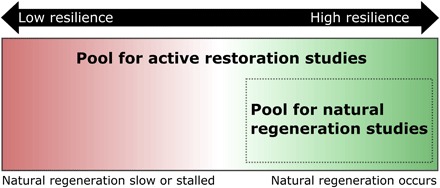
Several recent meta-analyses have aimed to determine whether natural regeneration is more effective at recovering tropical forests than active restoration (for example, tree planting). We reviewed this literature and found that comparisons between strategies are biased by positive site selection. Studies of natural forest regeneration are generally conducted at sites where a secondary forest was already present, whereas tree planting studies are done in a broad range of site conditions, including non-forested sites that may not have regenerated in the absence of planting. Thus, a level of success in forest regeneration is guaranteed for many studies representing natural regeneration, but not for those representing active restoration. The complexity of optimizing forest restoration is best addressed by paired experimentation at the same site, replicated across landscapes. Studies that have taken this approach reach different conclusions than those arising from meta-analyses; the results of paired experimental comparisons emphasize that natural regeneration is a highly variable process and that active restoration and natural regeneration are complementary strategies.
Figures
References
-
- United Nations Convention on Biological Diversity, Decision adopted by the conference of the parties to the Convention on Biological Diversity at its eleventh meeting. XI/16. Ecosystem restoration (United Nations Convention on Biological Diversity, 2012).
-
- United Nations Convention to Combat Desertification, Land matters for climate. Reducing the gap and approaching the target (United Nations Convention to Combat Desertification, 2015).
-
- United Nations Framework Convention on Climate Change, Adoption of the Paris Agreement (United Nations Framework Convention on Climate Change, 2015).
-
- Bonner M. T. L., Schmidt S., Shoo L. P., A meta-analytical global comparison of aboveground biomass accumulation between tropical secondary forests and monoculture plantations. For. Ecol. Manage. 291, 73–86 (2013).
Publication types
MeSH terms
LinkOut - more resources
Full Text Sources
Other Literature Sources