


Active Learning Increases Children's Physical Activity across Demographic Subgroups
- PMID: 29774241
- PMCID: PMC5949864
- DOI: 10.1249/TJX.0000000000000051
Active Learning Increases Children's Physical Activity across Demographic Subgroups
Abstract
Purpose: Given the need to find more opportunities for physical activity within the elementary school day, this study was designed to asses the impact of I-CAN!, active lessons on: 1) student physical activity (PA) outcomes via accelerometry; and 2) socioeconomic status (SES), race, sex, body mass index (BMI), or fitness as moderators of this impact.
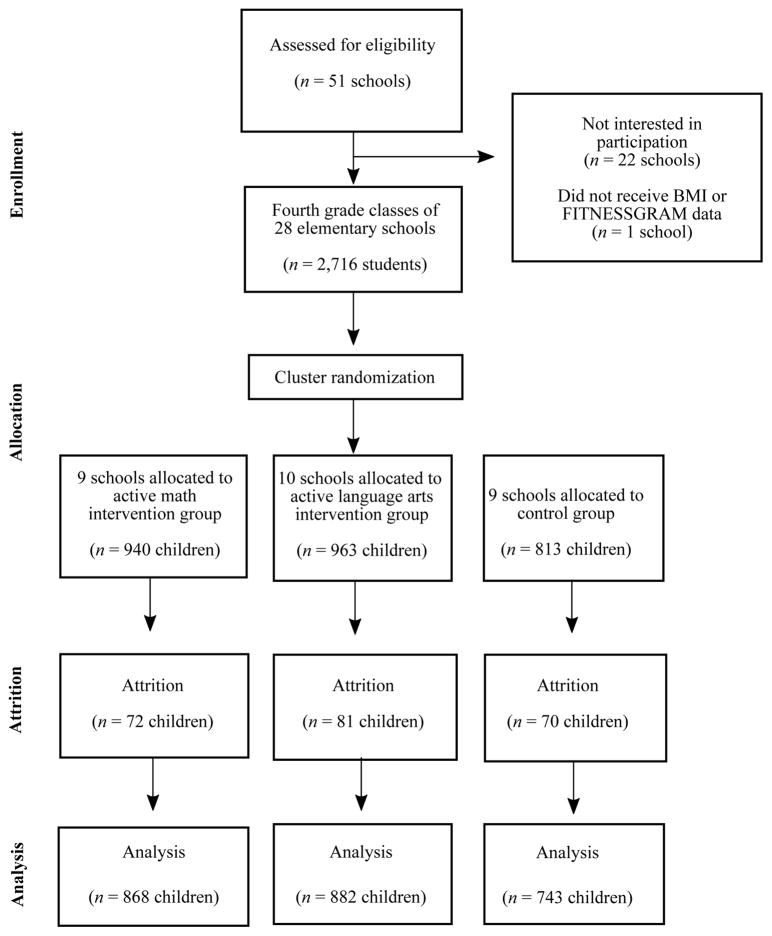
Methods: Participants were 2,493 fourth grade students (45.9% male, 45.8% white, 21.7% low SES) from 28 central Texas elementary schools randomly assigned to intervention (n=19) or control (n=9). Multilevel regression models evaluated the effect of I-CAN! on PA and effect sizes were calculated. The moderating effects of SES, race, sex, BMI, and fitness were examined in separate models.
Results: Students in treatment schools took significantly more steps than those in control schools (β = 125.267, SE = 41.327, p = .002, d = .44). I-CAN! had a significant effect on MVPA with treatment schools realizing 80% (β = 0.796, SE =0.251, p = .001; d = .38) more MVPA than the control schools. There were no significant school-level differences on sedentary behavior (β = -0.177, SE = 0.824, p = .83). SES, race, sex, BMI, and fitness level did not moderate the impact of active learning on step count and MVPA.
Conclusion: Active learning increases PA within elementary students, and does so consistently across demographic sub-groups. This is important as these sub-groups represent harder to reach populations for PA interventions. While these lessons may not be enough to help children reach daily recommendations of PA, they can supplement other opportunities for PA. This speaks to the potential of schools to adopt policy change to require active learning.
Keywords: active learning; children; elementary school; physical activity.
Conflict of interest statement
Conflict of Interest Statement: The authors declare that they have no conflicts of interest to disclose. Additionally, the results of the present study do not constitute endorsement by ACSM. Authors also declare results are presented clearly and honestly without fabrications, falsification, or inappropriate data manipulation.
Figures
References
-
- Thompson PD, Buchner D, Piña IL, Balady GJ, Williams MA, Marcus BH, et al. Exercise and Physical Activity in the Prevention and Treatment of Atherosclerotic Cardiovascular Disease. Circulation. 2003 Jun 24;107(24):3109–16. - PubMed
-
- Boyle T, Keegel T, Bull F, Heyworth J, Fritschi L. Physical Activity and Risks of Proximal and Distal Colon Cancers: A Systematic Review and Meta-analysis. J Natl Cancer Inst. 2012 Aug 22;:djs354. - PubMed
-
- Wu Y, Zhang D, Kang S. Physical activity and risk of breast cancer: a meta-analysis of prospective studies. Breast Cancer Res Treat. 2012 Dec 30;137(3):869–82. - PubMed
-
- Keum N, Ju W, Lee DH, Ding EL, Hsieh CC, Goodman JE, et al. Leisure-time physical activity and endometrial cancer risk: Dose–response meta-analysis of epidemiological studies. Int J Cancer. 2014 Aug 1;135(3):682–94. - PubMed
-
- Strong WB, Malina RM, Blimkie CJR, Daniels SR, Dishman RK, Gutin B, et al. Evidence Based Physical Activity for School-age Youth. J Pediatr. 2005 Jun;146(6):732–7. - PubMed
Grants and funding
LinkOut - more resources
Full Text Sources
Other Literature Sources