Review
. 2018 Aug;75(16):2897-2916.
doi: 10.1007/s00018-018-2836-6. Epub 2018 May 17.

Roles of heat shock factor 1 beyond the heat shock response

Affiliations
Review

Roles of heat shock factor 1 beyond the heat shock response

János Barna et al. Cell Mol Life Sci. 2018 Aug.

Abstract

Various stress factors leading to protein damage induce the activation of an evolutionarily conserved cell protective mechanism, the heat shock response (HSR), to maintain protein homeostasis in virtually all eukaryotic cells. Heat shock factor 1 (HSF1) plays a central role in the HSR. HSF1 was initially known as a transcription factor that upregulates genes encoding heat shock proteins (HSPs), also called molecular chaperones, which assist in refolding or degrading injured intracellular proteins. However, recent accumulating evidence indicates multiple additional functions for HSF1 beyond the activation of HSPs. Here, we present a nearly comprehensive list of non-HSP-related target genes of HSF1 identified so far. Through controlling these targets, HSF1 acts in diverse stress-induced cellular processes and molecular mechanisms, including the endoplasmic reticulum unfolded protein response and ubiquitin-proteasome system, multidrug resistance, autophagy, apoptosis, immune response, cell growth arrest, differentiation underlying developmental diapause, chromatin remodelling, cancer development, and ageing. Hence, HSF1 emerges as a major orchestrator of cellular stress response pathways.

Keywords: Ageing; Apoptosis; Autophagy; Cancer; Cell cycle; Circadian rhythm; Development; Differentiation; Heat shock factor 1; Heat shock proteins; Heat shock response; Immune response; Multidrug resistance; Oxidative stress; Proteasome; Unfolded protein response.


Conflict of interest statement

The authors declare no competing interest.

Figures
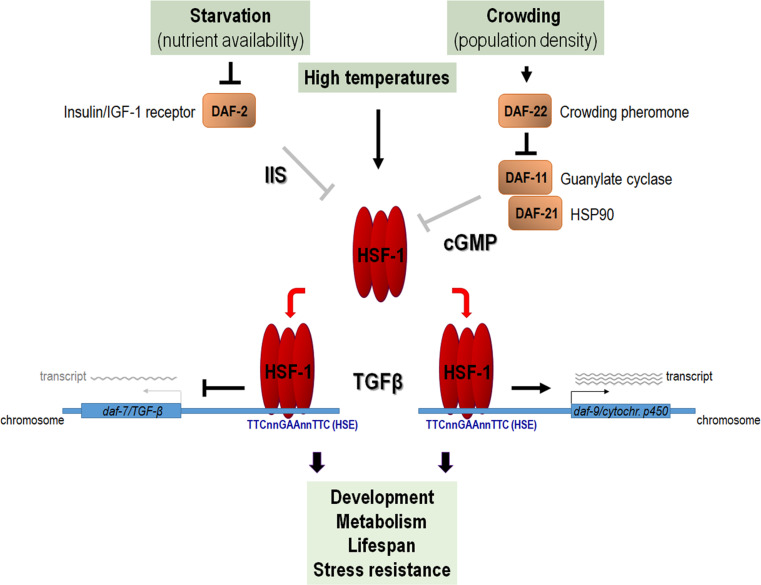
Fig. 1
Fig. 1
Signal integration by HSF-1 in response to various stress factors in C. elegans. HSF-1 is activated by diverse environmental stress factors, including starvation, high temperatures, and crowding. This activation is mediated by the insulin/IGF-1 (IIS) and cyclic guanosine monophosphate (cGMP) signalling pathways. HSF-1 activity then influences the expression of key components (daf-7 and daf-9) of transforming growth factor-beta (TGFβ) signalling, which regulates development, metabolism, ageing, and stress resistance in this organism. This way, HSF-1 intertwines the insulin/IGF-1, cGMP, and TGFβ signalling systems in orchestrating cellular stress response. Arrows indicate activation; bars represent inhibitory interactions
Fig. 2
Fig. 2
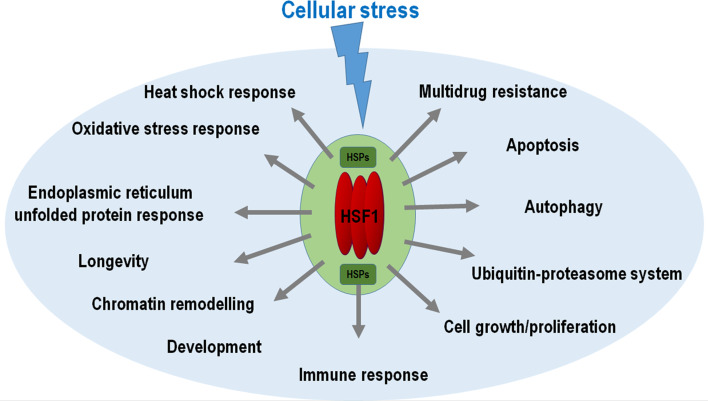
Co-regulation of cellular stress response mechanisms and processes by HSF1. HSF1 is activated by various cellular stress factors (represented by the blue swallow). HSF1 activity then upregulates key components of diverse stress response pathways and processes. Thus, HSF1 acts as a major orchestrator of cellular stress response pathways and processes

References

    1. Gomez-Pastor R, Burchfiel ET, Thiele DJ. Regulation of heat shock transcription factors and their roles in physiology and disease. Nat Rev Mol Cell Biol. 2018;19(1):4–19. doi: 10.1038/nrm.2017.73. - DOI - PMC - PubMed
    1. Bellaye PS, Burgy O, Causse S, Garrido C, Bonniaud P. Heat shock proteins in fibrosis and wound healing: good or evil? Pharmacol Ther. 2014;143(2):119–132. doi: 10.1016/j.pharmthera.2014.02.009. - DOI - PubMed
    1. Hooper PL, Balogh G, Rivas E, Kavanagh K, Vigh L. The importance of the cellular stress response in the pathogenesis and treatment of type 2 diabetes. Cell Stress Chaperon. 2014;19(4):447–464. doi: 10.1007/s12192-014-0493-8. - DOI - PMC - PubMed
    1. Willis MS, Patterson C. Hold me tight: role of the heat shock protein family of chaperones in cardiac disease. Circulation. 2010;122(17):1740–1751. doi: 10.1161/CIRCULATIONAHA.110.942250. - DOI - PMC - PubMed
    1. Xu Q. Role of heat shock proteins in atherosclerosis. Arterioscler Thromb Vasc Biol. 2002;22(10):1547–1559. doi: 10.1161/01.ATV.0000029720.59649.50. - DOI - PubMed

Publication types

MeSH terms

Substances

LinkOut - more resources