


Prevalence of resurgence of destructive behavior when thinning reinforcement schedules during functional communication training
- PMID: 29774545
- PMCID: PMC6041172
- DOI: 10.1002/jaba.472
Prevalence of resurgence of destructive behavior when thinning reinforcement schedules during functional communication training
Abstract
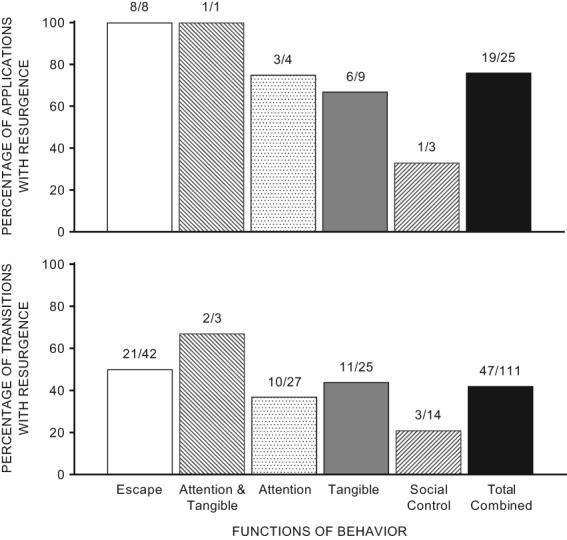
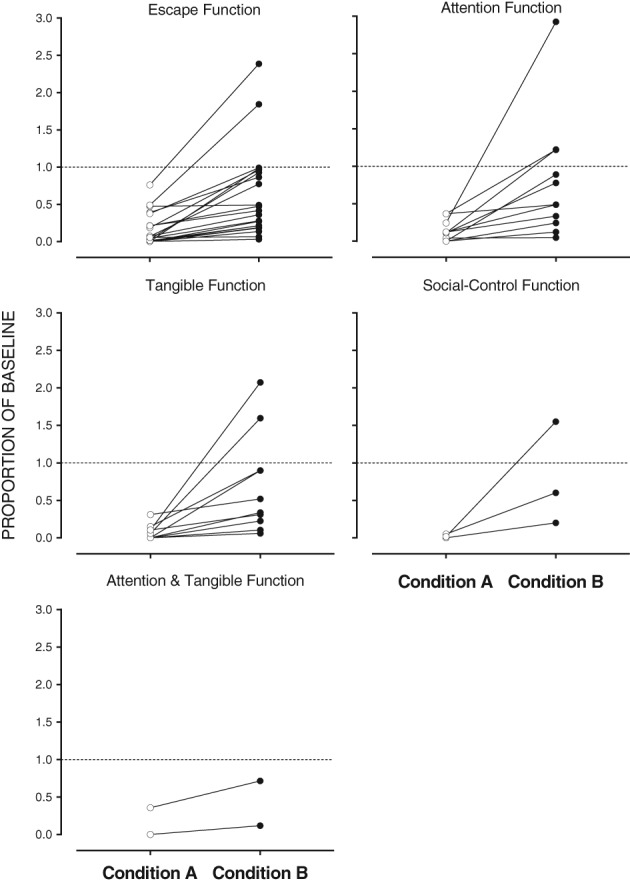
Functional communication training is a well-established treatment for socially reinforced destructive behavior that typically includes differential reinforcement of the functional communication response (FCR) in combination with extinction of destructive behavior. However, when the schedule of reinforcement for the FCR is thinned, destructive behavior may resurge (e.g., Greer, Fisher, Saini, Owen, & Jones, 2016). Currently, data are unavailable on the prevalence and characteristics of resurgence during reinforcement schedule thinning. In this study, we evaluated the prevalence of resurgence during reinforcement schedule thinning on a per-case and per-schedule-step basis and also evaluated the magnitude of resurgence in relation to the functions of destructive behavior. We observed resurgence in 19 of the 25 (76%) applications of reinforcement schedule thinning. In some cases, the magnitude of resurgence exceeded the mean levels of destructive behavior observed in baseline. We discuss these results relative to prior translational and applied research on resurgence.
Keywords: differential reinforcement; extinction burst; functional communication training; reinforcement schedule thinning; resurgence.
© 2018 Society for the Experimental Analysis of Behavior.
Figures
References
-
- Betz, A. M. , & Fisher, W. W. (2011). Functional analysis: History and methods In Fisher W. W., Piazza C. C., & Roane H. S. (Eds.), Handbook of applied behavior analysis (pp. 206‐225). New York, NY: Guilford Press.
-
- Call, N. A. , Clark, S. B. , Lomas Mevers, J. , Parks, N. A. , Volkert, V. M. , & Scheithauer, M. C. (2017). An individualized method for establishing and thinning multiple schedules of reinforcement following functional communication training. Learning and Motivation. Advance online publication. 10.1016/j.lmot.2017.03.006 - DOI
Publication types
MeSH terms
Grants and funding
LinkOut - more resources
Full Text Sources
Other Literature Sources
Medical
