. 2018 Jun;24(6):978-987.
doi: 10.3201/eid2406.172027.

Occupation-Associated Fatal Limbic Encephalitis Caused by Variegated Squirrel Bornavirus 1, Germany, 2013

Occupation-Associated Fatal Limbic Encephalitis Caused by Variegated Squirrel Bornavirus 1, Germany, 2013

Dennis Tappe et al. Emerg Infect Dis. 2018 Jun.

Abstract

Limbic encephalitis is commonly regarded as an autoimmune-mediated disease. However, after the recent detection of zoonotic variegated squirrel bornavirus 1 in a Prevost's squirrel (Callosciurus prevostii) in a zoo in northern Germany, we retrospectively investigated a fatal case in an autoantibody-seronegative animal caretaker who had worked at that zoo. The virus had been discovered in 2015 as the cause of a cluster of cases of fatal encephalitis among breeders of variegated squirrels (Sciurus variegatoides) in eastern Germany. Molecular assays and immunohistochemistry detected a limbic distribution of the virus in brain tissue of the animal caretaker. Phylogenetic analyses demonstrated a spillover infection from the Prevost's squirrel. Antibodies against bornaviruses were detected in the patient's cerebrospinal fluid by immunofluorescence and newly developed ELISAs and immunoblot. The putative antigenic epitope was identified on the viral nucleoprotein. Other zoo workers were not infected; however, avoidance of direct contact with exotic squirrels and screening of squirrels are recommended.

Keywords: Bornavirus; Germany; VSBV-1; limbic encephalitis; occupational risk; squirrel; transmission; variegated squirrel bornavirus 1; viruses; zoonoses.


Figures

Figure 1
Figure 1
Magnetic resonance imaging of the brain throughout the course of the disease in patient who died of limbic encephalitis caused by variegated squirrel bornavirus 1 (VSBV-1), Germany, 2013. A) T2-weighted transversal image at admission showing no pathologic changes. B) T2-weighted image 3 weeks after admission showing edema in limbic structures (insula, hippocampus, anterior cingulate) and in the basal ganglia. C) T2-weighted image 4 weeks after admission showing progressive edema. Additional myelopathy extended from the medulla down into the thoracic segments (not shown). D) FLAIR image 4 weeks after admission showing edema in the anterior cingulate cortex. E) T1-weighted image 4 weeks after admission without contrast showing slight hemorrhage in the basal ganglia.
Figure 2
Figure 2
Phylogenetic analysis of complete coding sequences from variegated squirrel bornavirus 1 (VSBV-1) and other members of Bornaviridae. The phylogenetic trees were inferred by using the Bayesian Markov Chain Monte Carlo method and in parallel a maximum-likelihood method (tree not shown). Statistical support of grouping from Bayesian posterior probabilities (clade credibilities >90%) and maximum-likelihood bootstrap replicates (>70%) are indicated with an asterisk. Taxon information includes GenBank accession number and virus abbreviation. Branch colors are based on bornavirus species. The VSBV-1 sequence from the patient generated during this study and the highly similar VSBV-1 sequence from the zoo squirrel are shown in bold. Inset shows detail of mammalian 2 bornavirus section. Scale bars represent nucleotide substitutions per site.
Figure 3
Figure 3
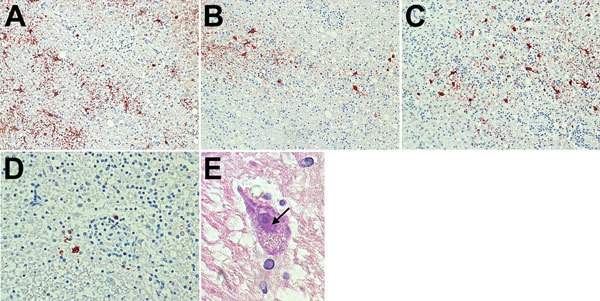
Immunohistochemical and histologic slides of brain of patient who died of limbic encephalitis caused by variegated squirrel bornavirus 1 (VSBV-1), Germany, 2013. Immunohistochemistry of viral antigen in subcortical areas of the brain was performed by using a polyclonal antiserum against VSBV-1 N protein. Viral antigen was present in neurons and glial cells in nuclei and cytoplasm. A) Substantia nigra. Immunoperoxidase stain with hematoxylin counterstain; original magnification ×200. B) Striatum. Immunoperoxidase stain with hematoxylin counterstain; original magnification ×200. C) Subcortical area next to the hypothalamus. Immunoperoxidase stain with hematoxylin counterstain; original magnification ×200. D) Subcortical area next to the hippocampus. Immunoperoxidase stain with hematoxylin counterstain; original magnification ×400. E) Intranuclear eosinophilic inclusion body resembling a bornavirus-like Joest-Degen body (arrow). Hematoxylin and eosin stain; original magnification ×600.
Figure 4
Figure 4
N protein (p40) peptide microarray–based epitope mapping of variegated squirrel bornavirus 1 from patient who died of limbic encephalitis, Germany, 2013. A) The N protein–based peptide microarray chip consists of 8 identical arrays composed of 360 15-mer peptides with an offset of 1 aa. Each subarray was bordered by biotin spots (green). B) Representative single-channel readouts from 1 subarray in 16-bit pseudocolor is given for the protein A–purified patient cerebrospinal fluid sample. Signals were classified positive if they appeared in each of the 8 subarrays. The detected signal is surrounded by an orange box and labeled by the corresponding spot number. C) The alanine scan of spot 116 showed highest antibody binding for the original sequence and less bound antibodies after substitution of the indicated amino acids by alanine. D) Mapping of antibody target sequences onto the tetrameric P40 nucleoprotein 3D-structure (PDB:1N93). Monomers are depicted in gray and gold, amino acids necessary for antibody binding (red) and inconsequential (pink) related to spot 116. Potential binding sites of antibodies for spot 116 are shown in the lower panels as red (1 monomer) and blue (spanning 2 adjacent monomers and forming a binding pocket) overlay.

References

    1. Brierley JB, Corsellis JAN, Hierons R, Nevin S. Subacute encephalitis of later adult life mainly affecting the limbic areas. Brain. 1960;83:357–68. 10.1093/brain/83.3.357 - DOI
    1. Graus F, Titulaer MJ, Balu R, Benseler S, Bien CG, Cellucci T, et al. A clinical approach to diagnosis of autoimmune encephalitis. Lancet Neurol. 2016;15:391–404. 10.1016/S1474-4422(15)00401-9 - DOI - PMC - PubMed
    1. Sinmaz N, Amatoury M, Merheb V, Ramanathan S, Dale RC, Brilot F. Autoantibodies in movement and psychiatric disorders: updated concepts in detection methods, pathogenicity, and CNS entry. Ann N Y Acad Sci. 2015;1351:22–38. 10.1111/nyas.12764 - DOI - PubMed
    1. Leypoldt F, Wandinger KP. Paraneoplastic neurological syndromes. Clin Exp Immunol. 2014;175:336–48. 10.1111/cei.12185 - DOI - PMC - PubMed
    1. Ahmad SA, Archer HA, Rice CM, Gerhand S, Bradley M, Wilkins A. Seronegative limbic encephalitis: case report, literature review and proposed treatment algorithm. Pract Neurol. 2011;11:355–61. 10.1136/practneurol-2011-000084 - DOI - PubMed

Publication types

MeSH terms