Case Reports
doi: 10.3201/eid2406.172044.
Importation of Human Seoul Virus Infection to Germany from Indonesia
- PMID: 29774860
- PMCID: PMC6004851
- DOI: 10.3201/eid2406.172044
Item in Clipboard
Case Reports
Importation of Human Seoul Virus Infection to Germany from Indonesia
Emerg Infect Dis.
2018 Jun.
Abstract
Seoul hantavirus-associated hemorrhagic fever with renal syndrome cases are rare outside Asia and have not yet been found in Germany. We report clinical and molecular evidence for a Seoul virus infection in a patient in Germany. The infection was most likely acquired during a stay in Sulawesi, Indonesia.
Keywords: Germany; HFRS; Indonesia; SEOV; Seoul virus; hantaviruses; hemorrhagic fever with renal syndrome; human infection; importation; imported case; viruses; zoonoses.
Figures
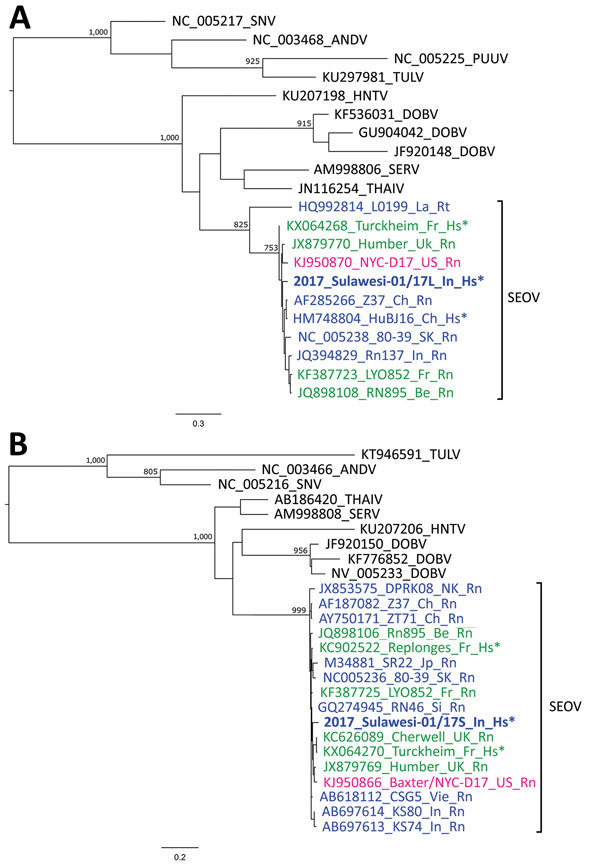
Maximum-likelihood phylogenetic trees of partial RNA segments of orthohantaviruses. A) Large RNA segments based on a 347-nt alignment and the general time reversible plus gamma distribution model of nucleotide substitution. B) Small RNA segments based on a 318-nt alignment and the Hasegawa–Kishino–Yano 85 plus gamma distribution model. Trees were constructed by using PhyML3.0 (8) and the best-fitting model according to smart model selection in this software and 1,000 bootstrap replicates. Values along branches are bootstrap values >75% for major clades. GenBank accession number, strain, country of origin, and host are shown for each virus isolate. Bold indicates SEOV isolated from the patient in this study. Blue indicates SEOV strains from Asia, green indicates SEOV strains from Europe, and red indicates SEOV strains from the Americas. Scale bars indicate nucleotide substitutions per site. *Sequences from viruses of human origin. ANDV, Andes virus; Be, Belgium; Ch, China; DOBV, Dobrava-Belgrade virus; Fr, France; HNTV, Hantaan virus; Hs, Homo sapiens; In, Indonesia; Jp, Japan; La, Laos; NK, North Korea; PUUV, Puumala virus; Rn, Rattus norvegicus; Rt, R. tanezumi; SEOV, Seoul virus; SERV, Serang virus; Si, Singapore; SK, South Korea; SNV, Sin nombre virus; THAIV, Thailand virus; TULV, Tula virus; UK, United Kingdom; US, United States; Vie, Vietnam.
References
-
- Goeijenbier M, Verner-Carlsson J, van Gorp EC, Rockx B, Koopmans MP, Lundkvist Å, et al. Seoul hantavirus in brown rats in the Netherlands: implications for physicians—Epidemiology, clinical aspects, treatment and diagnostics. Neth J Med. 2015;73:155–60. - PubMed
Publication types
MeSH terms
Substances
LinkOut - more resources
Full Text Sources
Other Literature Sources