


Malaria determining risk factors at the household level in two rural villages of mainland Equatorial Guinea
- PMID: 29776367
- PMCID: PMC5960103
- DOI: 10.1186/s12936-018-2354-x
Malaria determining risk factors at the household level in two rural villages of mainland Equatorial Guinea
Abstract
Background: After the introduction of an artemisinin-based combination therapy, the reduction of prevalence of malaria infections has shown a remarkable progress during the last decade. However due to the lack of a consistent malaria control programme and socioeconomic inequalities, Plasmodium infection is still one of the major cause of disease in Equatorial Guinea, namely in the rural communities. This study explored the associated risk factors of malaria transmission at the microeconomic level (households) in two rural villages of mainland Equatorial Guinea.
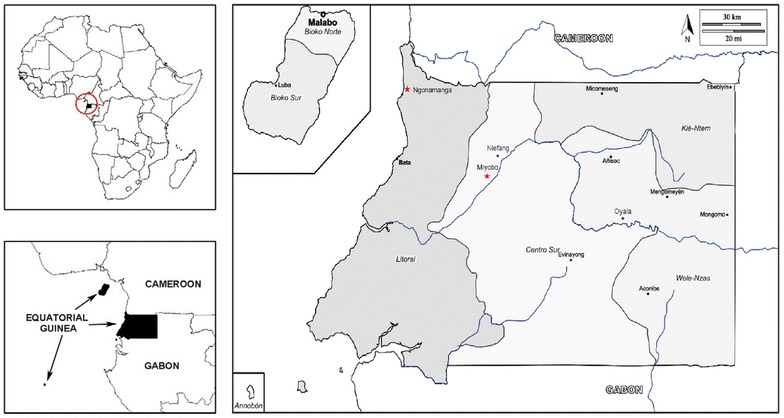
Methods: This survey involved 232 individuals living in 69 households located in two rural villages, Ngonamanga and Miyobo, of coastal and interior of Equatorial Guinea, respectively. Malaria prevalence was measured by PCR and parasitaemia level by optical microscopy; household socioeconomic status (SES) was measured based on house characteristics using a 2-step cluster analysis. Logistic regression analysis was performed to investigate the relationship of a diverse set of independent variables on being diagnosed with malaria and on showing high levels of parasitaemia.
Results: The prevalence of Plasmodium spp. infection was 69%, with 80% of households having at least one parasitaemic member. The majority of houses have eaves (80%), walls of clay/wood (90%) and zinc roof (99%) and only 10% of them have basic sanitation facilities. The studied areas showed reduced rates of indoor residual spraying coverage (9%), and long-lasting insecticide-treated net ownership (35%), with none of these preventive tools showing any significant effects on malaria risk in these areas. Neither the risk of malaria infection (PCR positive result) or the development of high parasitaemia did show association with SES.
Conclusions: This study has contributed to reinforce the importance of living conditions associated to a high risk of malaria infection and vulnerability to develop high parasitaemia. This study also contributes to future malaria control interventions to be implemented in mainland Equatorial Guinea or in other countries with similar environmental conditions.
Keywords: Equatorial Guinea; Malaria infection; Plasmodium spp.; Risk factors; Socioeconomic status.
Figures
References
-
- WHO . World malaria report 2017. Geneva: World Health Organization; 2017.
-
- Guerra M, Neres R, Salgueiro P, Mendes C, Ndong-Mabale N, Berzosa P, et al. Plasmodium falciparum genetic diversity in continental Equatorial Guinea before and after introduction of artemisinin-based combination therapy. Antimicrob Agents Chemother. 2017;61:e02556–e03015. doi: 10.1128/AAC.02556-15. - DOI - PMC - PubMed
-
- Unicef. Report on Regular Resources 2016. https://www.unicef.org/publications/files/Report_on_Regular_Resources_20.... Accessed 10 Apr 2018.
MeSH terms
Grants and funding
LinkOut - more resources
Full Text Sources
Other Literature Sources
Medical
Miscellaneous
