Review
. 2018 Jun;22(6):479-490.
doi: 10.1016/j.tics.2018.03.010.

Mind-Wandering as a Natural Kind: A Family-Resemblances View

Affiliations
Review

Mind-Wandering as a Natural Kind: A Family-Resemblances View

Paul Seli et al. Trends Cogn Sci. 2018 Jun.

Abstract

As empirical research on mind-wandering accelerates, we draw attention to an emerging trend in how mind-wandering is conceptualized. Previously articulated definitions of mind-wandering differ from each other in important ways, yet they also maintain overlapping characteristics. This conceptual structure suggests that mind-wandering is best considered from a family-resemblances perspective, which entails treating it as a graded, heterogeneous construct and clearly measuring and describing the specific aspect(s) of mind-wandering that researchers are investigating. We believe that adopting this family-resemblances approach will increase conceptual and methodological connections among related phenomena in the mind-wandering family and encourage a more nuanced and precise understanding of the many varieties of mind-wandering.

Keywords: definition; family resemblances; heterogeneous; mind-wandering; varieties.


Figures

Figure 1 (Key Figure)
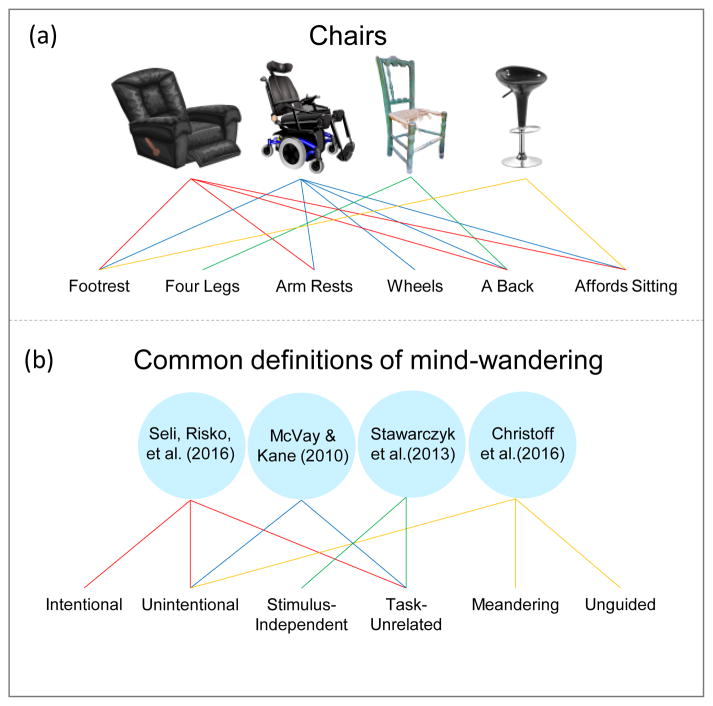
Schematic for a family-resemblances view. In panel (a) are four chairs that share one or more features with the each other. For example, the first, second, and fourth chairs all afford sitting (the third chair has a broken seat), and the first, second, and third chairs all have backs. However, no single feature runs through all members of the family of chairs. Hence, there is no universal feature that defines membership. Instead, the “family” of chairs is held together by overlapping features. In panel (b) are examples of different definitions of mind-wandering from four articles [, , , , respectively]. Across these articles, mind-wandering is defined with reference to specific aspects of conscious experiences, including intentionality, stimulus-dependence, task relatedness, and/or content stability. However, the family resemblances-view posits that, just as there is no single feature that defines the chair family, there are no specific features that a thought must have to be granted membership in the mind-wandering family. Instead, by the family-resemblance view, mind-wandering is a collection of related experiences that share some, but not all, features.
Figure 2
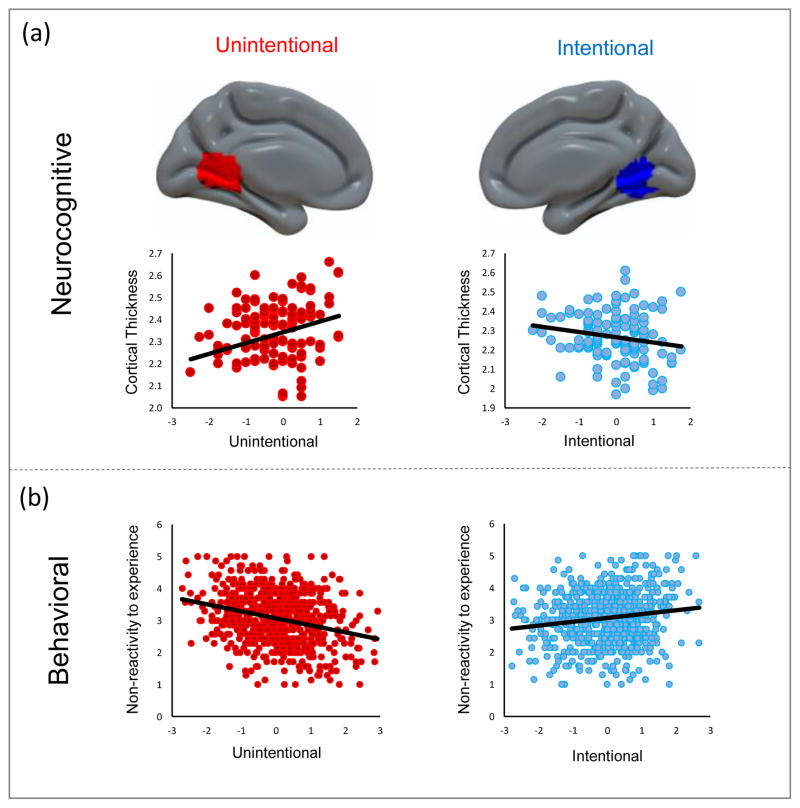
Figure 2. Distinct neurocognitive and behavioral correlates of unintentional and intentional mind-wandering
Panel (a) illustrates a dissociation between intentional and unintentional mind-wandering in correlations with thickness of the retrosplenial cortex/lingual gyrus [40]. Participants reporting higher rates of trait-level unintentional mind-wandering tended to show greater cortical thickness in the retrosplenial cortex/lingual gyrus in the left hemisphere than did participants reporting lower rates of unintentional mind-wandering. Conversely, participants reporting higher rates of trait-level intentional mind-wandering tended to show less cortical thickness in the retrosplenial cortex/lingual gyrus in the right hemisphere than did participants reporting lower rates of intentional mind-wandering. Panel (b) displays a dissociation between intentional and unintentional mind-wandering in their relations to self-reported mindfulness (i.e., the non-reactivity to experience facet of the five-facet mindfulness questionnaire [55]). Whereas participants reporting higher rates of unintentional mind-wandering tended to report lower levels of mindfulness, those reporting higher rates of intentional mind-wandering tended to report higher levels of mindfulness.

Comment in

References

    1. Killingsworth MA, Gilbert DT. A wandering mind is an unhappy mind. Science. 2010;330(6006):932. - PubMed
    1. Gorgolewski KJ, et al. A correspondence between individual differences in the brain’s intrinsic functional architecture and the content and form of self-generated thoughts. PLoS One. 2014;9(5):e97176. - PMC - PubMed
    1. Baird B, et al. Back to the future: autobiographical planning and the functionality of mind-wandering. Conscious Cogn. 2011;20(4):1604–11. - PubMed
    1. Baird B, et al. Inspired by distraction: mind wandering facilitates creative incubation. Psychol Sci. 2012;23(10):1117–22. - PubMed
    1. Smallwood J, et al. Going AWOL in the brain: mind wandering reduces cortical analysis of external events. J Cogn Neurosci. 2008;20(3):458–69. - PubMed

Publication types