


Reach and Acceptability of a Mobile Reminder Strategy and Facebook Group Intervention for Weight Management in Less Advantaged Adolescents: Insights From the PRALIMAP-INÈS Trial
- PMID: 29776897
- PMCID: PMC5984273
- DOI: 10.2196/mhealth.7657
Reach and Acceptability of a Mobile Reminder Strategy and Facebook Group Intervention for Weight Management in Less Advantaged Adolescents: Insights From the PRALIMAP-INÈS Trial
Abstract
Background: Although information and communication technology interventions appear to be a promising means of reducing the health inequality gap in overweight and obesity prevention, research on information and communication technology interventions is lacking outside the Anglo-Saxon world.
Objective: The aim of this study was to assess the reach and acceptability of 2 information and communication technology interventions delivered as part of a French nutritional program: an SMS text messaging (short message service, SMS) attendance-reminder for collective sessions strategy and a Facebook challenge group.
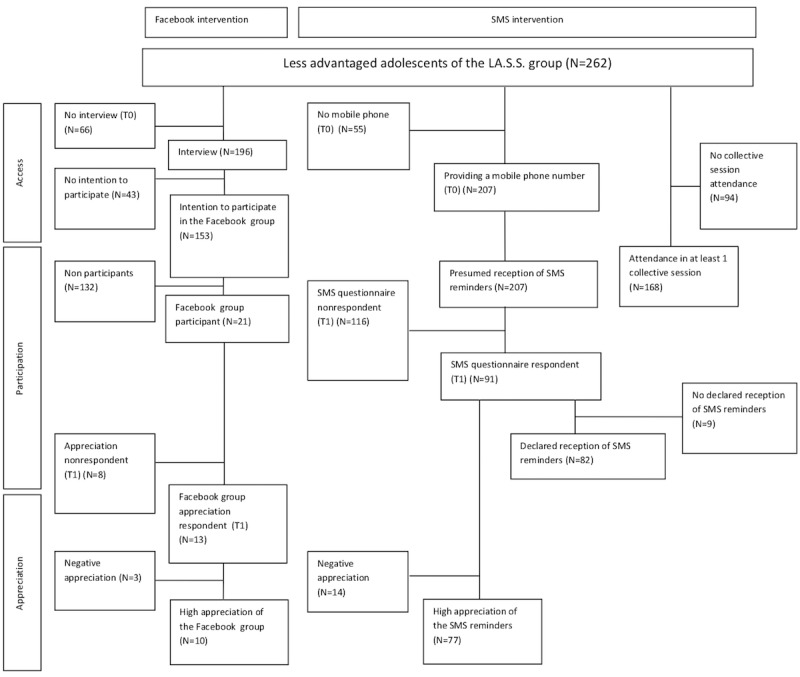
Methods: This study sample comprised 262 socially less advantaged overweight adolescents aged between 13 and 18 years. The information and communication technology interventions were carried out during the 2013-2014 academic year in 33 French state-run schools. For the SMS attendance-reminder for collective sessions strategy, at the start of the academic year, adolescents were asked to give their mobile number. SMS attendance-reminders were sent shortly before each of the 5 collective sessions. For the Facebook challenge group, adolescents were invited to join a closed Facebook group in which challenges on physical activity and on diet were posted weekly. Process data and 2 sets of face-to-face interviews were also used to interpret participation rates and access to Facebook. Appreciation for both interventions was evaluated by a questionnaire at the end of the academic year.
Results: Of the recruited adolescents, 79.0% (207/262) gave their mobile number, reflecting high access to a mobile phone. Giving a number was significantly more likely for girls (odds ratio [OR] 2.1, 95% CI 1.1-3.9; P=.02) and adolescents in a vocational or general high school as opposed to middle school (OR 1.0, 95% CI 0.4-2.7; OR 0.2, 95% CI 0.1-0.5; P<.001). Indicating a mobile number at the start of the year was not significantly associated with participation in collective sessions. Of the adolescents seen at the start-of-year face-to-face interviews, 78.1% (153/196) declared an interest in the Facebook challenge group, which implies having a Facebook account or being able to have access to one. However, only 21 adolescents went through the process of joining the group. Although there was satisfaction with the Facebook group among the participants, the low participation rate in the Facebook group does not allow conclusions to be drawn with confidence.
Conclusions: The results are in line with the claim that using information and communication technologies in health programs is unlikely to widen health inequalities. However, in this population of French adolescents, mobile phone strategies seem more adapted to a high school context, and caution should be exercised with a younger audience. Although there is positive appreciation of the SMS attendance-reminders and a Facebook intervention is initially highly appealing to less advantaged adolescents, no evidence of impact could be demonstrated. These results highlight the difficulty in assessing the impact of specific interventions in complex health programs.
Trial registration: Clinicaltrials.gov NCT01688453; https://clinicaltrials.gov/ct2/show/NCT01688453 (Archived by WebCite at http://www.webcitation.org/6yy6EQ0SM).
Keywords: adolescent; overweight; social media; socioeconomic factors; text messaging; weight loss.
©Laura Saez, Johanne Langlois, Karine Legrand, Marie-Hélène Quinet, Edith Lecomte, Abdou Y Omorou, Serge Briançon, PRALIMAP-INÈS Trial Group. Originally published in JMIR Mhealth and Uhealth (http://mhealth.jmir.org), 18.05.2018.
Conflict of interest statement
Conflicts of Interest: None declared.
Figures
References
-
- Organisation for Economic Co-operation and Development . OECD. Paris: OECD; 2012. [2017-05-22]. Obesity Update http://www.oecd.org/health/49716427.pdf .
-
- Organisation for Economic Co-operation and Development . OECD. Paris: OECD; 2014. [2017-05-22]. Obesity Update 2014 http://www.oecd.org/health/Obesity-Update-2014.pdf .
-
- Roche France. Neuilly-sur-Seine: Roche; 2012. [2018-03-22]. Enquête épidémiologique nationale sur le surpoids et l'obésité (Obépi 2012) http://www.roche.fr/content/dam/roche_france/fr_FR/doc/obepi_2012.pdf .
-
- Frederick CB, Snellman K, Putnam RD. Increasing socioeconomic disparities in adolescent obesity. Proc Natl Acad Sci U S A. 2014 Jan 28;111(4):1338–42. doi: 10.1073/pnas.1321355110. http://www.pnas.org/cgi/pmidlookup?view=long&pmid=24474757 1321355110 - DOI - PMC - PubMed
Associated data
LinkOut - more resources
Full Text Sources
Other Literature Sources
Medical
Miscellaneous
