


Patellofemoral Cartilage Repair
- PMID: 29777422
- PMCID: PMC5970109
- DOI: 10.1007/s12178-018-9474-3
Patellofemoral Cartilage Repair
Abstract
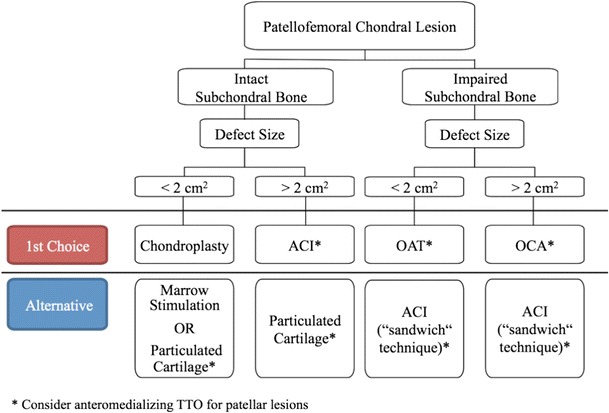
Purpose of review: This review provides an overview of well-established and newly developed cartilage repair techniques for cartilage defects in the patellofemoral joint (PFJ). An algorithm will be presented for approaching cartilage defects considering the distinct anatomy of both the patellar and trochlear articular surfaces.
Recent findings: Recent studies on cartilage repair in the PFJ have demonstrated improved outcomes in an attempt to delay or obviate the need for arthroplasty, and improve symptoms in young patients. While autologous chondrocyte implantation shows good and excellent outcomes for chondral lesions, osteochondral defects are adequately addressed with osteochondral allograft transplantation. In case of patellar malalignment, concomitant tibial tubercle osteotomy can significantly improve outcomes. Particulated cartilage and bone marrow aspirate concentrate are potential new alternative treatments for cartilage repair, currently in early clinical studies. Due to the frequency of concomitant anatomic abnormalities in the PFJ, a thorough clinical examination combined with careful indication for each procedure in each individual patient combined with meticulous surgical technique is central to achieve satisfying outcomes. Additional comparative studies of cartilage repair procedures, as well as investigation of newer techniques, are needed.
Keywords: Autologous chondrocyte implantation; Cartilage repair; Chondral lesion; Osteochondral allograft; Particulated allograft; Patellofemoral joint.
Conflict of interest statement
Conflict of Interest
Andreas H. Gomoll reports grants from JRF during the conduct of study and personal fees from NUTECH outside of the submitted work.
Alexandre Barbieri Mestriner and Jakob Ackermann declare that they have no conflict of interest.
Human and Animal Rights and Informed Consent
This article does not contain any studies with human or animal subjects performed by any of the authors.
Figures


References
-
- Bitton R. The economic burden of osteoarthritis. Am J Manag Care. 2009;15(8 Suppl):S230–S235. - PubMed
Publication types
LinkOut - more resources
Full Text Sources
Other Literature Sources
Research Materials
