. 2018 May 19;20(1):42.
doi: 10.1186/s13058-018-0969-z.

Hyperprolactinemia-inducing antipsychotics increase breast cancer risk by activating JAK-STAT5 in precancerous lesions

Affiliations

Hyperprolactinemia-inducing antipsychotics increase breast cancer risk by activating JAK-STAT5 in precancerous lesions

A N Johnston et al. Breast Cancer Res. .

Abstract

Background: Psychiatric medications are widely prescribed in the USA. Many antipsychotics cause serum hyperprolactinemia as an adverse side effect; prolactin-Janus kinase 2 (JAK2)-signal transducer and activator of transcription 5 (STAT5) signaling both induces cell differentiation and suppresses apoptosis. It is controversial whether these antipsychotics increase breast cancer risk.

Methods: We investigated the impact of several antipsychotics on mammary tumorigenesis initiated by retrovirus-mediated delivery of either ErbB2 or HRas or by transgenic expression of Wnt-1.

Results: We found that the two hyperprolactinemia-inducing antipsychotics, risperidone and pimozide, prompted precancerous lesions to progress to cancer while aripiprazole, which did not cause hyperprolactinemia, did not. We observed that risperidone and pimozide (but not aripiprazole) caused precancerous cells to activate STAT5 and suppress apoptosis while exerting no impact on proliferation. Importantly, we demonstrated that these effects of antipsychotics on early lesions required the STAT5 gene function. Furthermore, we showed that only two-week treatment of mice with ruxolitinib, a JAK1/2 inhibitor, blocked STAT5 activation, restored apoptosis, and prevented early lesion progression.

Conclusions: Hyperprolactinemia-inducing antipsychotics instigate precancerous cells to progress to cancer via JAK/STAT5 to suppress the apoptosis anticancer barrier, and these cancer-promoting effects can be prevented by prophylactic anti-JAK/STAT5 treatment. This preclinical work exposes a potential breast cancer risk from hyperprolactinemia-inducing antipsychotics in certain patients and suggests a chemoprevention regime that is relatively easy to implement compared to the standard 5-year anti-estrogenic treatment in women who have or likely have already developed precancerous lesions while also requiring hyperprolactinemia-inducing antipsychotics.

Keywords: Antipsychotics; Breast cancer; Cancer; JAK; Mammary gland; Neuroleptics; Prolactin; Ruxolitinib; STAT5.


Conflict of interest statement

Ethics approval

All animals were handled according to the animal protocol approved by the Institutional Animal Care and Use Committee (IACUC) at Baylor College of Medicine.

Competing interests

Dr. Li receives the ruxolitinib and research support from Incyte Corp. The authors declare that they have no other competing interests

Publisher’s Note

Springer Nature remains neutral with regard to jurisdictional claims in published maps and institutional affiliations.

Figures
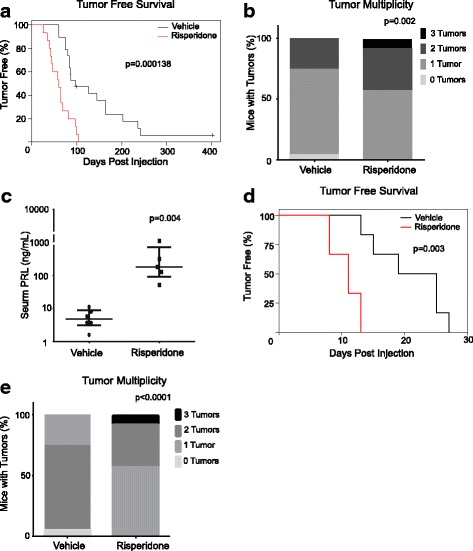
Fig. 1
Fig. 1
Risperidone promotes carcinogenesis initiated by caErbB2 and HrasQ61L. a Kaplan-Meier tumor-free survival curve of mice infected by replication-competent avian sarcoma (RCAS)-caErbB2. The p value was determined by the generalized Gehan-Wilcoxon test with Rho = 1. b Tumor multiplicity. The chi square test was for used comparison. c Serum prolactin (PRL) levels. The Mann-Whitney test was used to determine the p values. Each dot in this plot represents one mouse. d Kaplan-Meier tumor-free survival curve of mice infected by RCAS-HRasQ61L. The p value was determined by the generalized Gehan-Wilcoxon test with Rho = 1. e Tumor multiplicity. The chi square test was for used comparison
Fig. 2
Fig. 2
Risperidone increases early lesion burden and lowers the level of apoptosis. a Immunohistochemistry analysis and the accompanying dot plot for the HA tag on replication-competent avian sarcoma (RCAS)-caErbB2 provirus. b Immunofluorescence for Ki67 and the accompanying dot plot. c and d Immunofluorescence staining for cleaved caspase 3 (c) and TUNEL assay (d) with the accompanying dot plots. The p values were determined by the Mann-Whitney test. Each dot in these plots represents one mouse
Fig. 3
Fig. 3
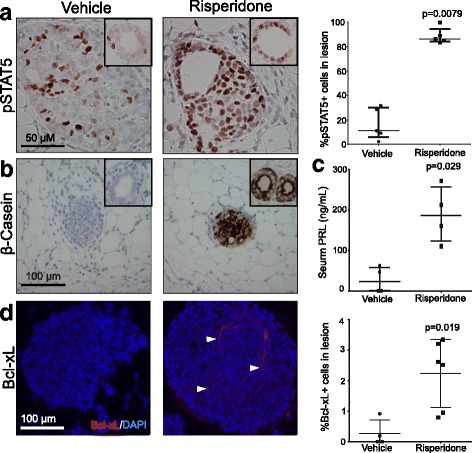
Risperidone treatment increases signal transducer and activator of transcription 5 (STAT5) activity. a Immunohistochemistry staining for pSTAT5 in early precancerous lesions and in normal ducts (inset) and the accompany dot plot. b Immunohistochemistry analysis of the downstream effector of STAT5, β-casein, in early lesions and normal ducts (inset). c Serum prolactin (PRL) levels. d Immunofluorescence and the accompanying dot plot for Bcl-xL. The p values were determined by the Mann-Whitney test. Each dot in these plots represents one mouse
Fig. 4
Fig. 4
Genetic ablation of signal transducer and activator of transcription 5 (STAT5)a dismantles the effects of risperidone on early lesions. a pSTAT5 immunohistochemistry analysis and the accompanying dot plot. b TUNEL assay and the accompanying dot plot. c Immunohistochemistry analysis and the accompanying dot plot for the HA tag on replication-competent avian sarcoma (RCAS)-caErbB2 provirus. The p values were determined by analysis of variance. Each dot in these plots represents one mouse
Fig. 5
Fig. 5
Ruxolitinib (Ruxo) treatment restore the apoptosis anticancer barrier and blocks early lesion expansion. a Immunofluorescence staining for Ki67 and the resulting dot plot. b and c Immunofluorescence staining for cleaved caspase 3 (b) and TUNEL assay (c) with the accompanying dot plots. d Immunohistochemistry analysis and the accompanying dot plot for the HA tag on RCAS-caErbB2 provirus. The p values were determined by the Mann-Whitney test. Each dot in these plots represents one mouse. Risp, risperidone

References

    1. Lindsley CW. The top prescription drugs of 2011 in the United States: antipsychotics and antidepressants once again lead CNS therapeutics. ACS Chem Neurosci. 2012;3(8):630–631. doi: 10.1021/cn3000923. - DOI - PMC - PubMed
    1. Peuskens J, Pani L, Detraux J, De Hert M. The effects of novel and newly approved antipsychotics on serum prolactin levels: a comprehensive review. CNS drugs. 2014;28(5):421–453. - PMC - PubMed
    1. Montgomery J, Winterbottom E, Jessani M, Kohegyi E, Fulmer J, Seamonds B, Josiassen RC. Prevalence of hyperprolactinemia in schizophrenia: association with typical and atypical antipsychotic treatment. J Clin Psychiatry. 2004;65(11):1491–1498. doi: 10.4088/JCP.v65n1108. - DOI - PubMed
    1. Suliman AM, Smith TP, Gibney J, McKenna TJ. Frequent misdiagnosis and mismanagement of hyperprolactinemic patients before the introduction of macroprolactin screening: application of a new strict laboratory definition of macroprolactinemia. Clin Chem. 2003;49(9):1504–1509. doi: 10.1373/49.9.1504. - DOI - PubMed
    1. Meltzer HY, Fang VS. The effect of neuroleptics on serum prolactin in schizophrenic patients. Arch Gen Psychiatry. 1976;33(3):279–286. doi: 10.1001/archpsyc.1976.01770030003001. - DOI - PubMed

Publication types

MeSH terms