


Understanding Men's Elevated Alcohol Use, Gender Equity Ideologies, and Intimate Partner Violence Among Married Couples in Rural India
- PMID: 29779428
- PMCID: PMC6131423
- DOI: 10.1177/1557988318775844
Understanding Men's Elevated Alcohol Use, Gender Equity Ideologies, and Intimate Partner Violence Among Married Couples in Rural India
Abstract
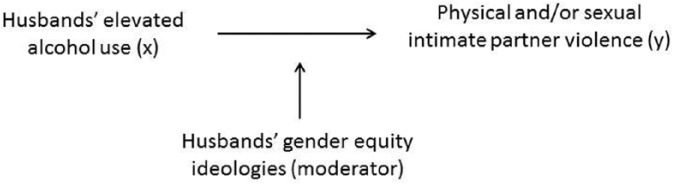
Qualitative evidence suggests that husbands' inequitable gender equity (GE) ideologies may influence associations between husbands' alcohol use and intimate partner violence (IPV) against wives. However, little quantitative research exists on the subject. To address this gap in the literature, associations of husbands' elevated alcohol use and GE ideologies with wives' reports of IPV victimization among a sample of married couples in Maharashtra, India, were examined. Cross-sectional analyses were conducted using data from the baseline sample of the Counseling Husbands to Achieve Reproductive Health and Marital Equity (CHARM) study. Participants included couples aged 18 to 30 years ( N = 1081). Regression models assessed the relationship between husbands' elevated alcohol use and GE ideologies (using the Gender-Equitable Men [GEM] Scale) and wives' history of physical and/or sexual IPV victimization ever in marriage. Husbands and wives were 18 to 30 years of age, and married on average of 3.9 years ( SD ± 2.7). Few husbands (4.6%) reported elevated alcohol use. Husbands had mean GEM scores of 47.3 ( SD ± 5.4, range: 35-67 out of possible range of 24-72; least equitable to most equitable). Approximately one fifth (22.3%) of wives reported a history of physical and/or sexual IPV. Wives were less likely to report IPV if husbands reported greater GE ideologies (adjusted odds ratio [AOR]: 0.97, 95% CI [0.95, 0.99]), and husband's elevated alcohol use was associated with increased risk of IPV in the final adjusted model (AOR: 1.89, 95% CI [1.01, 3.40]). Findings from this study indicate the need for male participation in violence intervention and prevention services and, specifically, the need to integrate counseling on alcohol use and GE into such programming.
Keywords: IPV; alcohol use; gender equity attitudes.
Conflict of interest statement
Figures
References
-
- Chandrasekaran V., Krupp K., George R., Madhivanan P. (2007). Determinants of domestic violence among women attending an human immunodeficiency virus voluntary counseling and testing center in Bangalore, India. Indian Journal of Medical Sciences, 61(5), 253–262. - PubMed
-
- Connell R. W. (1995). Masculinities. Berkeley, CA: University of California Press.
-
- Connell R. W., Messerschmidt J. W. (2005). Hegemonic masculinity: Rethinking the concept. Gender & Society, 19, 829–859.
-
- Dasgupta R. K., Gokulsing K. M. (2013). Introduction: Perceptions of masculinity and challenges to the Indian male. In Dasgupta R., Gokulsing K. M. (Eds.), Masculinity and its challenges in India: Essays on changing perceptions (pp. 5–26). Jefferson, NC: Jefferson Publishers.
Publication types
MeSH terms
Grants and funding
LinkOut - more resources
Full Text Sources
Other Literature Sources
Medical
Research Materials
Miscellaneous
