


The emerging use of social media for health-related purposes in low and middle-income countries: A scoping review
- PMID: 29779724
- PMCID: PMC7108283
- DOI: 10.1016/j.ijmedinf.2018.04.010
The emerging use of social media for health-related purposes in low and middle-income countries: A scoping review
Abstract
Background: Social media allows for instant access to, and dissemination of, information around the globe. Access to social media in low- and middle-income countries has increased exponentially in recent years due to technological advances. Despite this growth, the use of social media in low- and middle-income countries is less well-researched than in high-income countries.
Objective: To identify, explore and summarize the current state of the literature on the use of social media for health in low- and middle-income countries.
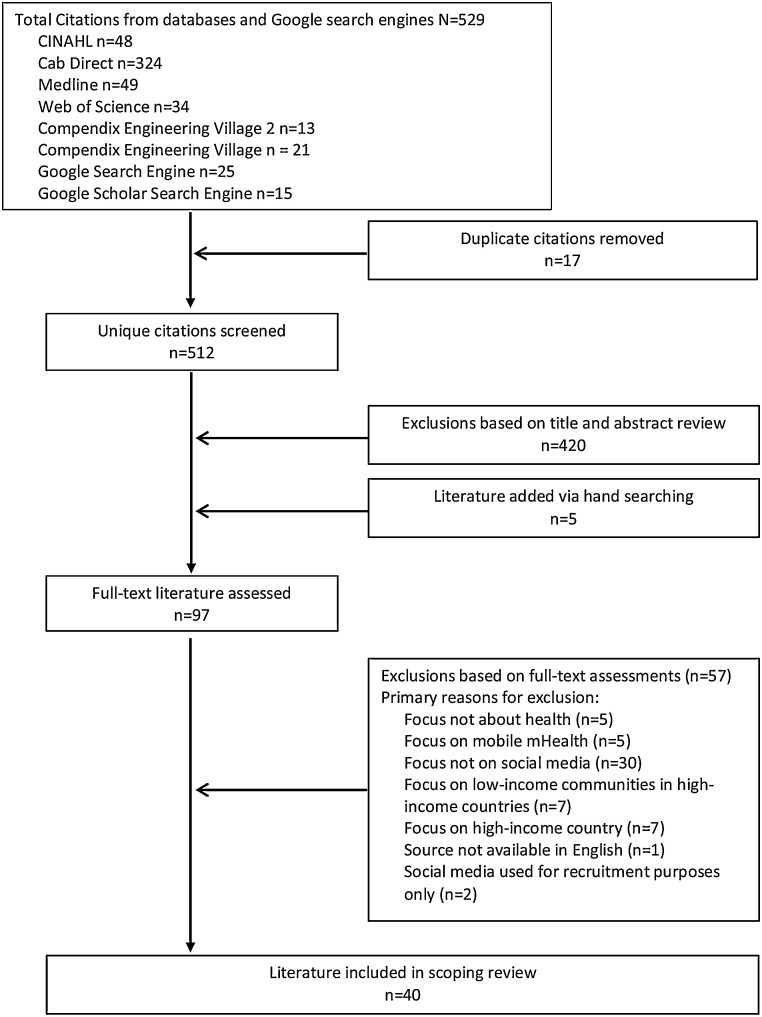
Methods: A scoping review was conducted on literature available to December 2017. Six databases were searched, and grey literature was identified through the Google and Google Scholar search engines. Literature was considered for inclusion if it (1) was published in English, (2) was conducted in or in relation to a low or middle-income country, (3) reported on as least one type of social media or social media use generally for health purposes, and (4) reported on at least one aspect of human health. Content analysis was performed to identify themes.
Results: Forty articles met the inclusion criteria. Thirty-one were research articles, and nine were review/discussion/descriptive and evaluative reports. Since 2010, when the first article was published, most of the literature has focused on Asian (n = 15) and African (n = 12) countries. Twitter (n = 11) and Facebook (n = 10) were the most frequently discussed individual social media platforms. Four themes were identified: (1) use for health education and influence (sub-themes were health behaviour and health education); (2) use within infectious disease and outbreak situations; (3) use within natural disaster, terrorism, crisis and emergency response situations; and (4) producers and consumers of social media for health (sub-themes were misinformation, organizational challenges, users' expectations, and challenges of unique sub-populations). Most studies addressed more than one theme.
Conclusion: Social media has the ability to facilitate disease surveillance, mass communication, health education, knowledge translation, and collaboration amongst health providers in low- and middle-income countries. Misinformation or poorly communicated information can contribute to negative health behaviours and adverse health outcomes amongst consumers, as well as hysteria and chaos. Organizations using social media should provide accurate and readable information. Promotion of credible social media sites by governments, health care professionals and researchers, as well as education on the appropriate use of social media, could help to lessen the effect of misinformation. This is a nascent body of literature and future research should investigate the relative effectiveness of various platforms for different users, other potential uses, and pursue a broader geographical focus.
Keywords: Developing countries; Health; Low-income countries; Middle-income countries; Social media; Social networking sites.
Copyright © 2018 Elsevier B.V. All rights reserved.
References
Publication types
MeSH terms
LinkOut - more resources
Full Text Sources
Other Literature Sources
Medical
Miscellaneous
