. 2018 Feb 15;9(13):3354-3359.
doi: 10.1039/c7sc05233b. eCollection 2018 Apr 7.

Identification of a selective DNA ligase for accurate recognition and ultrasensitive quantification of N6-methyladenosine in RNA at one-nucleotide resolution

Affiliations

Identification of a selective DNA ligase for accurate recognition and ultrasensitive quantification of N6-methyladenosine in RNA at one-nucleotide resolution

Weiliang Liu et al. Chem Sci. .

Abstract

N6-Methyladenosine (m6A) is the most frequent post-transcriptional modification in RNA, and it plays a critical role in biological processes. The functions of m6A remain largely unexplored due to a lack of highly sensitive methods to quantitatively determine the m6A modification fraction at a precise location. Here, we first reveal that T3 DNA ligase has significant selectivity towards the m6A modification. On the basis of the new finding, we establish an ultrasensitive quantitation assay for accurately determining m6A at one-nucleotide resolution in RNA. With the proposed assay, as low as 4 fM RNA containing m6A can be determined and the selectivity is up to 54.1-fold to discriminate m6A against unmodified adenosine (A). The sensitivity has been improved about 106-fold so the proposed method can be successfully employed to accurately determine m6A in real biological samples, even in low abundance RNA.


Figures
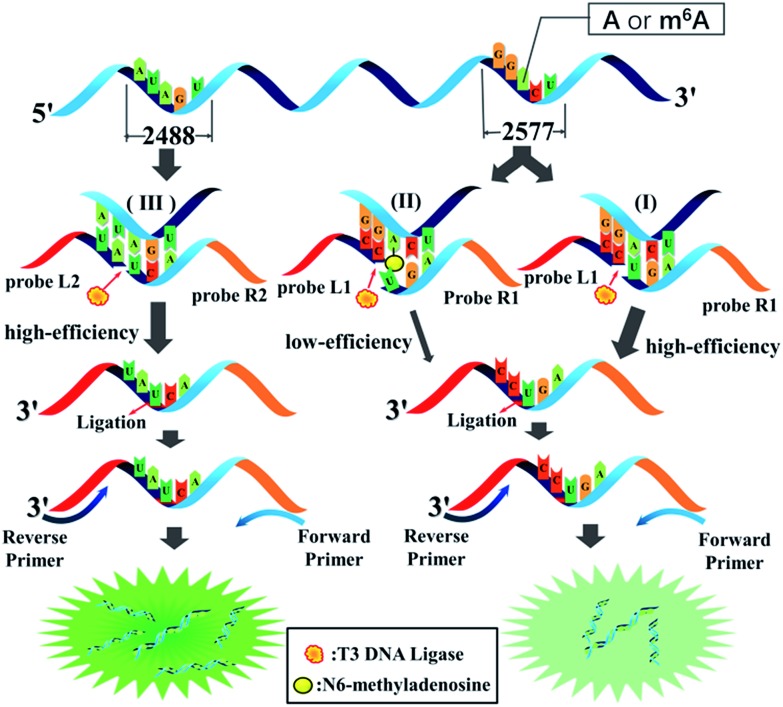
Fig. 1
Fig. 1. The general outline of the ligation-dependent PCR assay for m6A detection.
Fig. 2
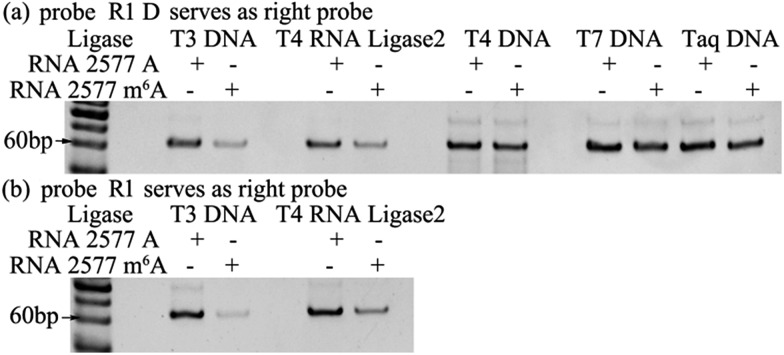
Fig. 2. Gel electrophoresis for identifying a ligase with substantial selectivity towards m6A. The probes used in the reactions were probe R1 D (a) and probe R1 (b).
Fig. 3
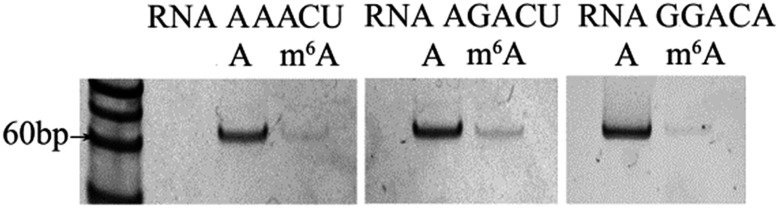
Fig. 3. Gel electrophoresis for assessing the effects of core sequences on specificity.
Fig. 4
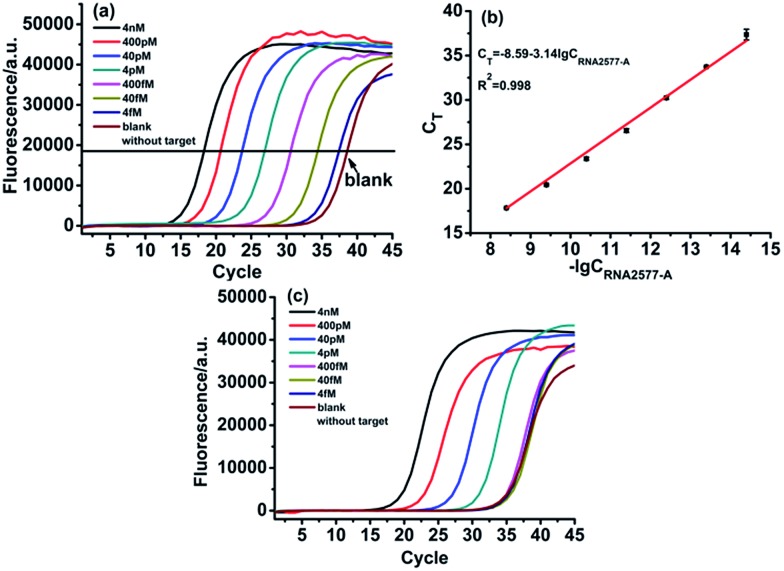
Fig. 4. Specificity and sensitivity of the ligase-dependent PCR assay: (a) real-time fluorescence curves produced by the RNA2577-A segment in the concentration range from 4 fM to 4 nM under optimum experimental conditions. (b) The relationship between CT and lg of RNA2577-A concentration (M). (c) Real-time fluorescence curves produced by the RNA2577-m6A segment in the concentration range from 4 fM to 4 nM under optimum experimental conditions.
Fig. 5
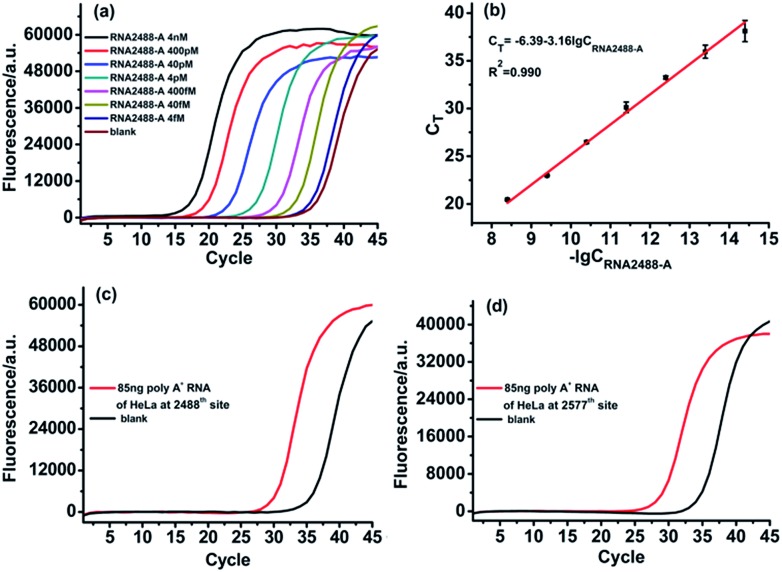
Fig. 5. Determination of m6A in poly A+ RNA of HeLa cells. (a) Real-time fluorescence curves produced by the RNA2488-A segment in the concentration range from 4 fM to 4 nM. (b) The linear relationship between CT and lg of RNA2488-A concentration (M). (c) Real-time fluorescence curves produced by RNA2488-A in 85 ng poly A+ RNA of HeLa cells under optimum experimental conditions. (d) Real-time fluorescence curves produced by RNA2577-A in 85 ng poly A+ RNA of HeLa cells under optimum experimental conditions.

References

    1. Desrosiers R., Friderici K., Rottman F. Proc. Natl. Acad. Sci. U. S. A. 1974;71:3971–3975. - PMC - PubMed
    1. Deng X., Chen K., Luo G.-Z., Weng X., Ji Q., Zhou T., He C. Nucleic Acids Res. 2015;43:6557–6567. - PMC - PubMed
    1. Dimock K., Stoltzfus C. M. Biochemistry. 1977;16:471–478. - PubMed
    1. Kane S. E., Beemon K. Mol. Cell. Biol. 1985;5:2298–2306. - PMC - PubMed
    1. Choi Y. C., Busch H. Biochemistry. 1978;17:2551–2560. - PubMed