The role of liquid biopsy in predicting post-operative recurrence of non-small cell lung cancer
- PMID: 29780630
- PMCID: PMC5945696
- DOI: 10.21037/jtd.2018.04.08
The role of liquid biopsy in predicting post-operative recurrence of non-small cell lung cancer
Abstract
Background: Radical resection is the cornerstone for patients with early stage of non-small cell lung cancer (NSCLC). However, fatal disease recurs in about 30-70% of resected cases. The circulating tumor cells (CTCs) is one of the main causes of recurrence of cancer. Circulating tumor DNA (ctDNA) is also a potential predictive biomarker of recurrence in patients with early stage NSCLC. A meta-analysis was conducted to identify the prognostic value of the CTCs and ctDNA in predicting the disease recurrence after surgery of NSCLC patients.
Methods: Electronic databases were comprehensively searched for eligible studies. A random effects model was used. The primary endpoint was the hazards ratio (HR) for the disease-free survival (DFS) between CTCs/ctDNA positive and negative groups. The relative risks (RR) of one and two-year recurrence rate between CTCs/ctDNA positive and negative groups were also calculated.
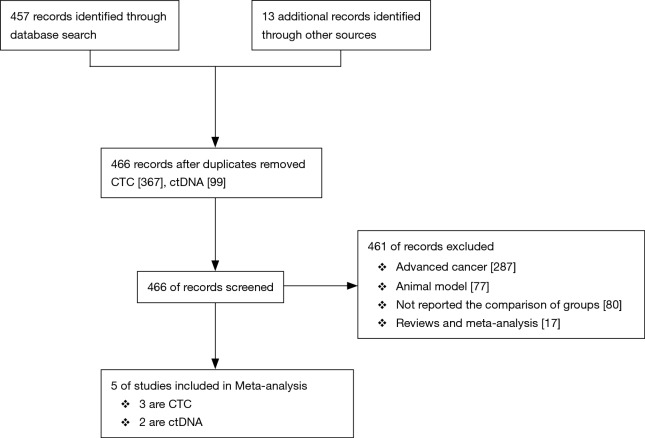
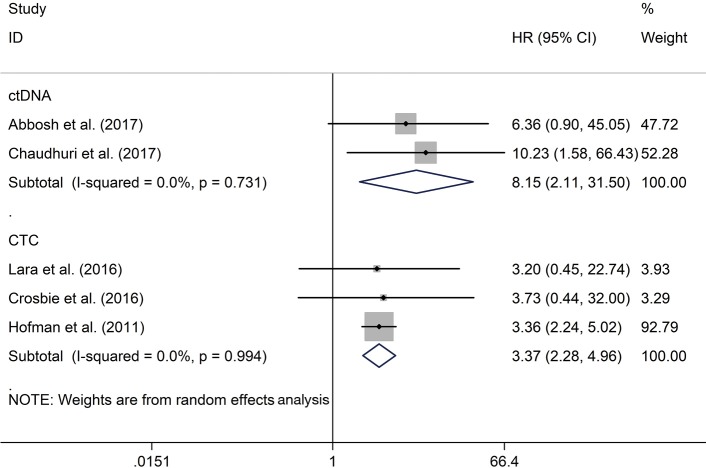
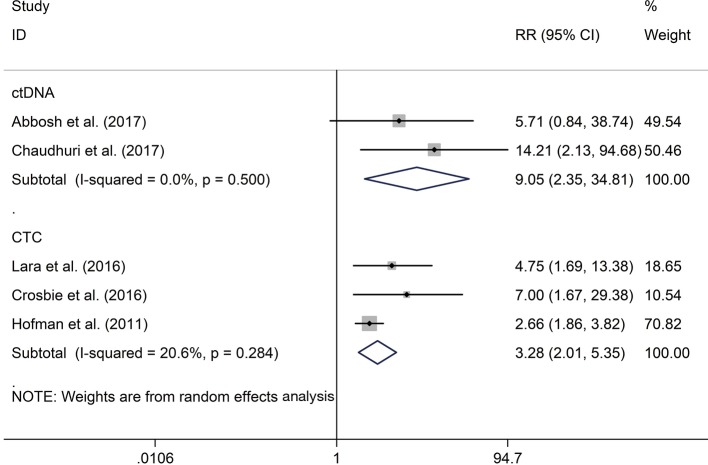
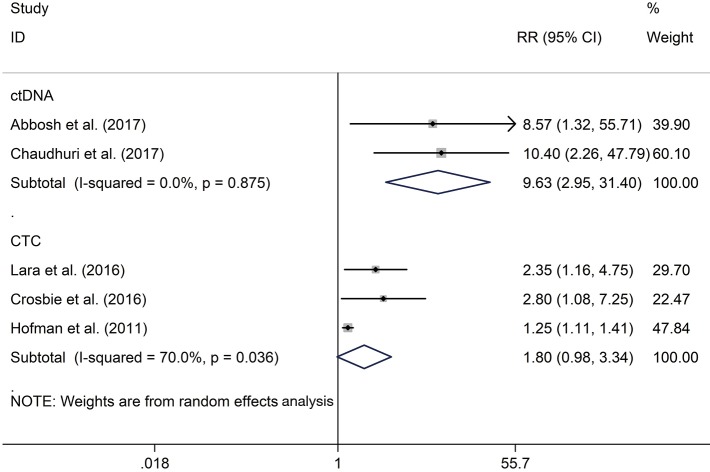
Results: A total of 5 studies involving 351 patients were included, in which 3 were studies on CTCs and 2 were ctDNA. Our result revealed that positive peripheral blood CTCs (HR, 3.37; 95% CI: 2.28-4.96; P<0.001) and ctDNA (HR, 8.15; 95% CI: 2.11-31.50; P=0.002) indicated poor prognosis for DFS. One (68% vs. 18.2%; RR 3.28; P<0.001) and two (76% vs. 44%; RR 1.80; P=0.06) years recurrence rate were higher in CTCs positive group compared with the negative group, respectively. The same result was also observed in ctDNA positive versus negative groups of 1 (77.9% vs. 8.3%; RR 9.05; P=0.001) and 2 (85.6% vs. 8.3%; RR 9.63; P<0.001) years recurrence rate.
Conclusions: Both postoperative CTCs and ctDNA are promising predictive biomarkers of early tumor recurrence in NSCLC patients. In addition, detection based on ctDNA seems to be more sensitive than CTCs.
Keywords: Non-small cell lung cancer (NSCLC); circulating tumor DNA (ctDNA); circulating tumor cell (CTC); recurrence.
Conflict of interest statement
Conflicts of Interest: The authors have no conflicts of interest to declare.
Figures
References
LinkOut - more resources
Full Text Sources
Other Literature Sources